Rania Gatou
Secretary General of the International Humanitarian Organization Coeurs Pour Tous
Researcher in Cardiac Surgery
Cultural Columnist – Researcher in Cultural Discourse
Poet – Visual Artist (https://raniagatou.gr/)
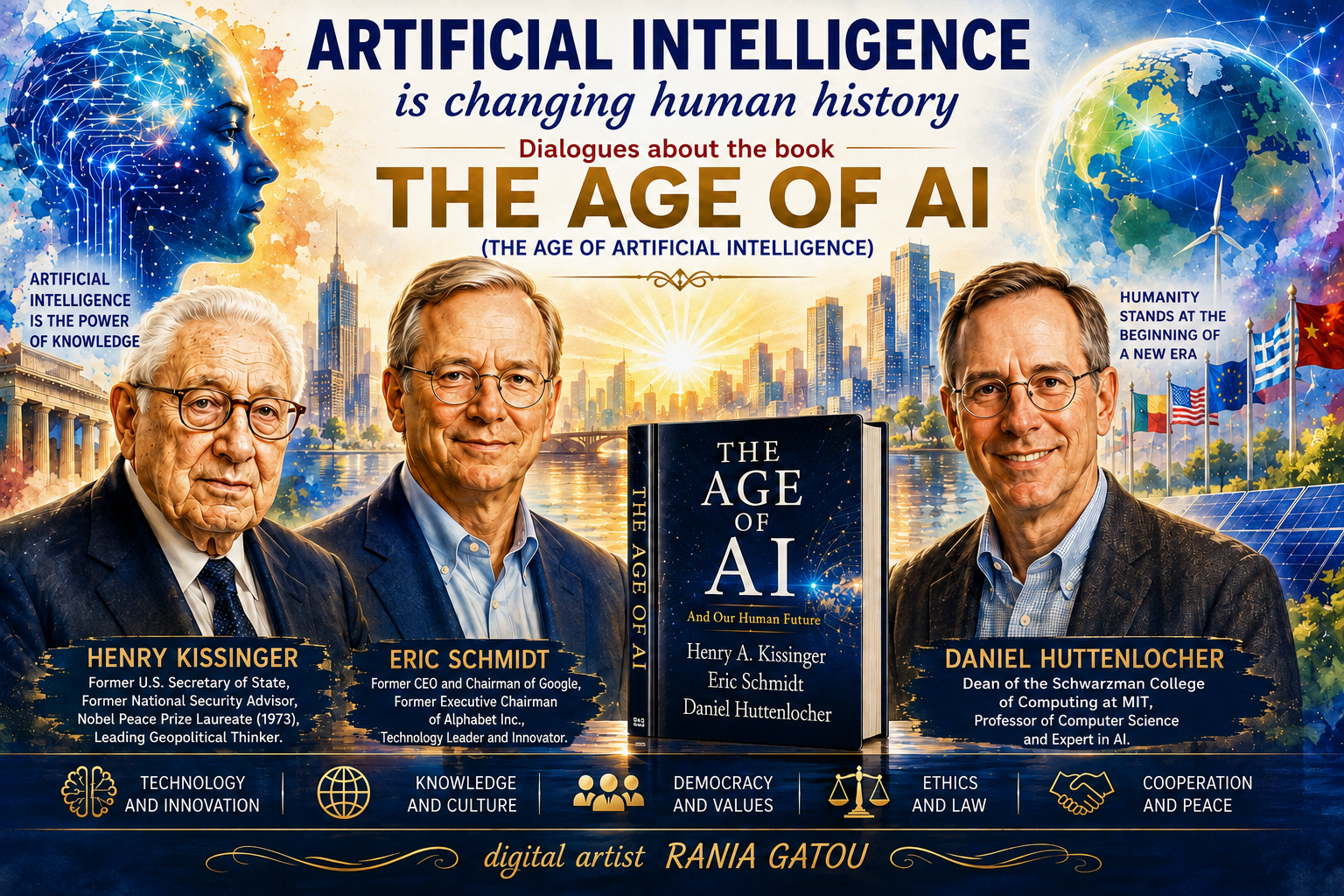
Henry Kissinger
Former United States Secretary of State, former U.S. National Security Advisor, Nobel Peace Prize Laureate (1973), leading theorist of geopolitics and international relations.
Eric Schmidt
Former Chief Executive Officer (CEO) and Chairman of Google, former Executive Chairman of Alphabet Inc., entrepreneur, and internationally recognized leader in technology and artificial intelligence.
Daniel Huttenlocher
Dean of the Schwarzman College of Computing at the Massachusetts Institute of Technology (MIT), Professor of Computer Science, and specialist in artificial intelligence, machine learning, and computer science.
Kyriakos Kyriazopoulos
Director of the Master’s Program entitled Theory of Law and Interdisciplinary Legal Studies and Coordinator of the Seminar Artificial Intelligence, Ethics and Democracy at the Law School of the Aristotle University of Thessaloniki (AUTH) (https://theory.law.auth.gr/).
Artificial Intelligence Is Changing Human History
Rania Gatou: Professor, The Age of AI by Henry Kissinger, Eric Schmidt, and Daniel Huttenlocher is already regarded as one of the most significant works on artificial intelligence. Before we examine its contents, I would like to ask you something fundamental. What led three individuals with such different backgrounds—a distinguished diplomat, a pioneer of digital technology, and an academic—to collaborate on writing this book?
Professor Kyriakos Kyriazopoulos: The very composition of the authors reveals the purpose of the work. Henry Kissinger comes from the field of geopolitics and the history of international relations. Eric Schmidt represents Google’s technological and entrepreneurial experience. Daniel Huttenlocher is an academic with profound expertise in computer science and artificial intelligence. Their message is already clear from the very first page: artificial intelligence is not an issue that concerns only engineers or programmers. It affects philosophy, politics, economics, law, science, and ultimately human existence itself. For this reason, an interdisciplinary approach is required.
Rania Gatou: From the very first pages, it becomes evident that the authors do not regard artificial intelligence as merely another technological innovation. They give the impression that they believe humanity is entering an entirely new historical era.
Professor Kyriakos Kyriazopoulos: Indeed. This is perhaps the central thesis of the entire book. The authors argue that AI is not simply an evolution of computers. Rather, it is a technology that transforms the very way knowledge is produced. In their view, the emergence of artificial intelligence is a historical event comparable in significance to the invention of the printing press, the Renaissance, or the Enlightenment. It is not merely humanity’s tools that are changing; the way human beings perceive the world and themselves is also changing.
Rania Gatou: It is striking that someone like Henry Kissinger, whose career has been so closely associated with diplomacy and strategy, chose to engage so deeply with artificial intelligence.
Professor Kyriakos Kyriazopoulos: It is no coincidence. Throughout his life, Kissinger studied the great turning points of history. He understands that every technological revolution is accompanied by a corresponding transformation in the exercise of power, the balance among states, and humanity’s conception of the world. In the book, he advances the view that AI may bring about even greater changes than those produced by the Industrial Revolution because it does not merely replace physical labor; it is beginning to influence human cognitive activity itself.
Rania Gatou: The authors also seem concerned that society has not yet grasped the magnitude of this transformation.
Professor Kyriakos Kyriazopoulos: Precisely. They argue that most people use artificial intelligence applications every day without realizing that they represent the beginning of a profound historical transformation. AI is already present in search engines, social media, medical applications, transportation, the economy, and defense. Yet societies continue to regard it merely as a collection of useful tools rather than as a new form of knowledge capable of transforming the very foundations of human coexistence.
Rania Gatou: There is one statement in the Preface that particularly impressed me. The authors declare that they are not writing the book in order to provide all the answers.
Professor Kyriakos Kyriazopoulos: That is an exceptionally important observation. They state that humanity is at the beginning of a process whose final outcome no one can foresee. Their purpose is to initiate a global dialogue. They believe that the questions raised by artificial intelligence cannot be answered solely by computer scientists. The participation of lawyers, philosophers, theologians, historians, political scientists, and all social institutions is equally necessary.
Rania Gatou: Would you therefore say that the book is more philosophical than technical?
Professor Kyriakos Kyriazopoulos: Certainly. It is not a textbook on artificial intelligence. It does not explain algorithms or mathematical models. The authors are interested in the consequences of AI. Their central question is profoundly anthropological: what does it mean to be human when machines emerge that can produce knowledge, make decisions, and solve problems in ways that human beings are unable to explain fully?
Rania Gatou: In other words, even before examining the individual applications of AI, the authors invite us to reconsider humanity’s place in history.
Professor Kyriakos Kyriazopoulos: That is precisely the starting point of the book. Artificial intelligence is not merely a new chapter in the history of technology. It is a new chapter in the history of humanity. And the great question that runs throughout the entire work is whether human beings will succeed in guiding this new era according to their own values, or whether they will allow technology itself to shape the future of human civilization.
AlphaZero: When the Machine Began to Think Differently from Humans
Rania Gatou: Professor, during our first discussion you explained that the authors regard artificial intelligence as the beginning of a new historical era for humanity. The first substantial example they present is AlphaZero. Why do they begin with it?
Professor Kyriakos Kyriazopoulos: Because, in their view, AlphaZero represents the first event that demonstrated that artificial intelligence can develop a method of solving problems fundamentally different from the one that human civilization has created over centuries. It is not simply a computer that plays chess better than humans. Rather, it is a system that reached the highest level of performance without being taught the human strategies of the game.
Rania Gatou: So the programmers did not provide it with chess books or the established opening theories?
Professor Kyriakos Kyriazopoulos: No. That is precisely what distinguishes AlphaZero from earlier chess programs. Previous systems contained enormous databases with millions of human chess games and followed strategies developed by the world’s greatest chess masters over many centuries. AlphaZero began knowing only the rules of the game. It played millions of games against itself and, through this process, independently developed strategies that no human had ever taught it.
Rania Gatou: That sounds almost unbelievable. Are you saying that the machine created its own “chess thinking”?
Professor Kyriakos Kyriazopoulos: Exactly. And this is where the great significance of the example lies. The authors emphasize that AlphaZero did not imitate human beings. It developed its own method of evaluating positions and making decisions. Its moves were described by leading grandmasters as creative, bold, and often incomprehensible according to the traditional human understanding of chess.
Rania Gatou: Does that mean the machine became creative?
Professor Kyriakos Kyriazopoulos: The authors deliberately avoid using the term creativity too readily. However, they raise the question of whether we should redefine what creative thinking actually means. When a machine discovers solutions that no human has ever imagined, and those solutions prove superior, then the very concept of knowledge acquires a new meaning.
Rania Gatou: Does this also change the way we understand human intelligence?
Professor Kyriakos Kyriazopoulos: Precisely. For centuries, we believed that knowledge was transmitted from one human being to another. In the case of AlphaZero, something entirely different occurs. Knowledge is not transmitted; it is generated autonomously by the system itself through learning. This constitutes one of the fundamental turning points highlighted in the book.
Rania Gatou: Why does this concern Henry Kissinger so deeply?
Professor Kyriakos Kyriazopoulos: Because Kissinger realizes that human history has always rested upon the assumption that human beings are the sole producers of knowledge. If a second producer emerges—namely artificial intelligence—then the very foundations of civilization are transformed. It is not only technology that changes; the relationship between human beings and knowledge, power, and decision-making changes as well.
Rania Gatou: The book mentions that even the world’s leading chess players struggled to explain many of AlphaZero’s moves.
Professor Kyriakos Kyriazopoulos: Yes. And this is perhaps the most remarkable point. Until now, we believed that we could always explain why a computer reached a particular decision. With AlphaZero, however, a new phenomenon emerges. The machine arrives at correct decisions, yet human beings struggle to understand fully the reasoning that led to them. The authors believe that this development foreshadows a new relationship between human beings and machines.
Rania Gatou: Does that mean that in the future people may have to trust decisions they cannot explain?
Professor Kyriakos Kyriazopoulos: That is precisely one of the central philosophical questions of the book. If an artificial intelligence diagnoses a disease more accurately than the world’s best physicians or proposes a strategic solution that no expert has imagined, will we follow its recommendation even if we do not fully understand its reasoning? This is a question that will increasingly accompany us in the years ahead.
Rania Gatou: So, ultimately, the example of AlphaZero is not really about chess.
Professor Kyriakos Kyriazopoulos: Exactly. Chess is merely the example. The authors use AlphaZero to demonstrate that we are entering an era in which artificial intelligence may discover solutions to any complex problem—in medicine, chemistry, physics, economics, engineering, and strategy. The real message is not that the machine became a better chess player. It is that it may be beginning to develop forms of knowledge that have never before existed in human history.
Rania Gatou: And that explains why the authors open the book with this example.
Professor Kyriakos Kyriazopoulos: Precisely. From the very first pages, they want to show readers that the discussion is not about faster data processing or the automation of work. It concerns the emergence of a new form of intelligence capable of generating knowledge in ways fundamentally different from those of human beings. From this realization begins the entire reflection of the book on the future of civilization, politics, science, and human nature itself.
The Discovery of Halicin and the AI That Sees What Humans Cannot See
Rania Gatou: Professor, after the example of AlphaZero, the authors move to a completely different application of artificial intelligence: the discovery of the antibiotic Halicin. Why do they consider this example even more significant than chess?
Professor Kyriakos Kyriazopoulos: Because here we leave behind a world governed by clear rules, such as chess, and enter the real world of science. In chess we know every rule of the game. In biology and chemistry, by contrast, nature is extraordinarily complex and often still unknown. The authors use the case of Halicin to demonstrate that artificial intelligence is no longer confined to solving problems. It can also contribute to the production of new scientific knowledge.
Rania Gatou: What exactly happened with Halicin?
Professor Kyriakos Kyriazopoulos: Researchers trained an artificial intelligence system to identify chemical structures with potential antibiotic properties. Instead of following the conventional methods of scientific investigation, the AI examined an enormous number of chemical compounds and identified one substance that had not attracted scientists’ attention as a possible antibiotic. This substance was named Halicin and proved to be highly effective against antibiotic-resistant bacteria. This example demonstrates that AI can recognize relationships that the human mind had previously failed to perceive.
Rania Gatou: The authors seem to be more impressed by the process than by the drug itself.
Professor Kyriakos Kyriazopoulos: That is a very perceptive observation. Halicin is undoubtedly important as a scientific discovery. However, for Kissinger and his co-authors it primarily symbolizes the arrival of a new era. The crucial point is that the machine reached its conclusion without following the reasoning traditionally employed by researchers. In other words, it did not merely accelerate human research; it followed an entirely different path toward knowledge.
Rania Gatou: Does that mean AI is beginning to function like a new kind of scientist?
Professor Kyriakos Kyriazopoulos: The authors are extremely careful in their wording. They do not claim that AI possesses consciousness or human understanding. They do point out, however, that it produces results which human beings often find difficult both to predict and, in many cases, to explain fully. This gives rise to a profound philosophical question: Can knowledge exist without a human understanding of the process by which it was produced?
Rania Gatou: Does this also transform the role of the scientist?
Professor Kyriakos Kyriazopoulos: Inevitably. Until now, scientists themselves formulated the hypotheses they intended to investigate. In the age of AI, the machine may increasingly propose hypotheses, while human beings will be called upon to test, interpret, and evaluate them. Thus, the collaboration between humans and machines assumes a fundamentally new form. Human beings remain responsible for scientific judgment, but AI becomes an exceptionally powerful partner in the search for new knowledge.
Rania Gatou: I see that behind the example of Halicin lies a much deeper philosophical issue.
Professor Kyriakos Kyriazopoulos: Exactly. The authors invite us to reconsider the meaning of the very concept of discovery. For centuries, we believed that every major scientific breakthrough resulted from human intuition and creativity. Today, however, a new factor has emerged—one capable of producing discoveries through computational processes that exceed the capabilities of the human brain.
Rania Gatou: Could this happen in other scientific disciplines as well?
Professor Kyriakos Kyriazopoulos: The authors believe that it certainly can. They explain that the same principle may be applied in biology, chemistry, physics, astronomy, materials science, and many other fields. Artificial intelligence possesses the ability to analyze enormous quantities of data and identify patterns that no human being could recognize within the same amount of time.
Rania Gatou: Yet there is also an obvious risk. If AI discovers solutions that we cannot explain, how can we be certain that they are correct?
Professor Kyriakos Kyriazopoulos: This is perhaps the most important question raised at this point in the book. The authors do not believe that human judgment should be abandoned. On the contrary, they insist that the greater the capabilities of artificial intelligence become, the greater the need for human responsibility, scientific verification, and ethical oversight. Artificial intelligence may propose solutions, but responsibility for accepting and implementing them always remains with human beings.
Rania Gatou: So the example of Halicin is ultimately not only about medicine.
Professor Kyriakos Kyriazopoulos: Precisely. Just as AlphaZero is not really about chess, Halicin is not simply about an antibiotic. In both cases, the authors seek to demonstrate that artificial intelligence inaugurates a new mode of knowledge production. The question is no longer whether AI will assist science. The real question is how it will transform the very concept of scientific discovery and what place human beings will occupy within this new reality.
The Birth of Generative Artificial Intelligence: When Machines Began to Produce Knowledge
Rania Gatou: Professor, in our previous two discussions we examined examples in which artificial intelligence solved problems or contributed to scientific discoveries. At this point in the book, however, the authors seem to take an even greater step forward. They speak of machines that are no longer limited to analyzing information but have begun to generate entirely new content. Why do they consider this transition so significant?
Professor Kyriakos Kyriazopoulos: Because until recently, most people regarded computers merely as computational tools. They could process enormous quantities of data, but they were not thought capable of creating. The authors argue that with the new generation of artificial intelligence systems, something fundamentally different has emerged. Machines are now beginning to produce texts, images, music, computer programs, and even scientific proposals. They do not simply reproduce existing information; they generate new outputs through synthesis. This development represents one of the most significant turning points of our era.
Rania Gatou: So the very concept of creation is changing?
Professor Kyriakos Kyriazopoulos: That is precisely what the authors seek to explore. For centuries, creativity was regarded as an exclusively human characteristic. Writing a book, composing music, or solving a difficult problem were considered expressions of human intelligence. Today, systems have emerged that can produce comparable results within a remarkably short time. This does not mean that they possess human consciousness, but it compels humanity to reconsider what is actually meant by the term creation.
Rania Gatou: The authors seem to avoid both excessive enthusiasm and excessive alarm.
Professor Kyriakos Kyriazopoulos: Indeed. That is one of the defining characteristics of the entire book. They present artificial intelligence neither as humanity’s savior nor as an inevitable existential threat. Instead, they seek to understand it as a historical phenomenon. They argue that humanity is entering a new reality and that the challenge is not to stop technological progress, but to learn how to use it wisely and responsibly.
Rania Gatou: Until now, computers primarily functioned by executing instructions written by humans. What changes with these new systems?
Professor Kyriakos Kyriazopoulos: The authors explain that modern artificial intelligence systems are trained on enormous quantities of data and learn to recognize relationships, patterns, and structures. Consequently, when they are asked to answer a question or generate a text, they do not retrieve a ready-made answer from a database. Instead, they produce a new synthesis based upon what they have learned during training. This capability fundamentally distinguishes the new generation of AI from earlier information systems.
Rania Gatou: Does this mean that artificial intelligence will also transform education?
Professor Kyriakos Kyriazopoulos: The authors believe that its consequences will be profound. When a machine can write an essay, translate a text, summarize a scientific paper, or propose solutions to a complex problem, the way we learn, teach, and assess knowledge inevitably changes. Memorization alone is no longer sufficient. Greater value will increasingly be placed upon critical thinking, creativity, ethical judgment, and the ability to collaborate effectively with these new technological tools.
Rania Gatou: Therefore, AI is not merely replacing certain professions. It is also transforming the very process of learning itself.
Professor Kyriakos Kyriazopoulos: Precisely. And this is where the authors express one of their deepest concerns. If society continues to educate people according to models developed for the past while technology advances at an exponential rate, an ever-widening gap will emerge between the capabilities of artificial intelligence and the skills possessed by human beings. For this reason, they regard education as perhaps the most important field requiring adaptation to the new era.
Rania Gatou: Yet another issue arises. How can we be certain that the content produced by artificial intelligence is always accurate?
Professor Kyriakos Kyriazopoulos: The authors emphasize that human judgment remains irreplaceable. Artificial intelligence can generate remarkably persuasive results, but this does not mean that everything it produces is accurate or appropriate. Human beings continue to bear responsibility for evaluation, verification, and final decision-making. Artificial intelligence is an extraordinarily powerful tool, but it does not replace human responsibility.
Rania Gatou: Could we therefore say that the book proposes a new relationship between human beings and machines?
Professor Kyriakos Kyriazopoulos: Exactly. It is not a relationship of competition but one of cooperation, provided that human beings continue to determine the goals and values that guide technological development. Machines may accelerate research, support education, and strengthen decision-making processes. Nevertheless, the fundamental choices concerning how this power is to be used must always remain in human hands.
Rania Gatou: So the real question is not whether artificial intelligence is capable of creating.
Professor Kyriakos Kyriazopoulos: Precisely. The real question is how human civilization will change once creation is no longer regarded as an exclusively human characteristic. This question runs throughout the entire book and prepares the reader for the next major theme: why the authors return to the history of philosophy—from Plato to the Enlightenment—in order to interpret the contemporary revolution brought about by artificial intelligence.
From Plato to the Enlightenment: Why the Authors Return to the History of Philosophy
Rania Gatou: Professor, so far we have discussed AlphaZero, Halicin, and the new generation of artificial intelligence. Yet, in the next part of the book, the authors do something that may surprise many readers. Instead of continuing with technological examples, they turn to the history of philosophy. Why do they choose this path?
Professor Kyriakos Kyriazopoulos: Because they wish to demonstrate that every major technological revolution is accompanied by an even deeper intellectual revolution. Artificial intelligence changes not only our tools; it transforms the way we understand knowledge, truth, humanity, and the world itself. To explain the significance of today’s transformation, the authors therefore return to the great turning points in the history of Western thought.
Rania Gatou: The journey begins in ancient Greece.
Professor Kyriakos Kyriazopoulos: Precisely. The authors remind us that Greek philosophy introduced an entirely new conception of knowledge. Plato and Aristotle sought to understand the world through the rational pursuit of truth. From that time onward, the conviction gradually emerged that human beings could approach reality through the power of reason and observation.
Rania Gatou: Why is this important for artificial intelligence?
Professor Kyriakos Kyriazopoulos: Because for two and a half millennia we regarded it as self-evident that knowledge is the product of the human mind. According to the authors, this assumption is now being challenged for the first time. A new producer of knowledge has appeared—artificial intelligence—and this compels us to re-examine fundamental philosophical concepts.
Rania Gatou: The discussion then moves to the Middle Ages. Why?
Professor Kyriakos Kyriazopoulos: The authors wish to show that knowledge has not always been understood in the same way. During the Middle Ages, truth was believed to be revealed primarily through divine revelation and theological tradition. Human reason certainly played an important role, but it functioned within a broader theological framework.
Rania Gatou: Then comes the Renaissance.
Professor Kyriakos Kyriazopoulos: Exactly. The Renaissance marked a profound transformation. Human beings gradually became the focal point of scientific inquiry. Observation of nature, experimentation, and the mathematical description of the world assumed primary importance. The authors regard this period as the beginning of the modern scientific outlook that ultimately led to the development of computers and artificial intelligence.
Rania Gatou: So AI is the product of a long historical evolution.
Professor Kyriakos Kyriazopoulos: Precisely. This is a point the authors repeatedly emphasize. Artificial intelligence did not emerge suddenly. It is the result of centuries of scientific and philosophical development. Yet, like every great revolution, it raises entirely new questions that cannot be answered exclusively with the intellectual tools of the past.
Rania Gatou: The book also places considerable emphasis on the Enlightenment. Why is it regarded as so important?
Professor Kyriakos Kyriazopoulos: Because the Enlightenment established the conviction that human reason is the principal means of understanding the world. Science, rationality, and progress became inseparably linked. For more than two centuries, Western civilization was built upon the confidence that human beings, through the use of reason, could explain and master reality.
Rania Gatou: And now the authors argue that this certainty is being put to the test?
Professor Kyriakos Kyriazopoulos: Exactly. When artificial intelligence begins to produce results that human beings struggle to explain, the very concept of rationality acquires a new dimension. This does not mean that human reason is abolished. It does mean, however, that it is no longer the only means by which highly complex knowledge can be generated. This is perhaps the deepest philosophical message of the book.
Rania Gatou: I have the impression that the authors are not simply writing about artificial intelligence. They are writing about the history of human civilization.
Professor Kyriakos Kyriazopoulos: That is an excellent observation. Artificial intelligence serves as the starting point for a much broader discussion. The authors examine how each historical era shaped a particular understanding of knowledge and how today’s technological revolution compels us to reconsider many of those long-held assumptions.
Rania Gatou: Could we therefore say that, according to the authors, artificial intelligence represents the next great chapter in the history of human thought?
Professor Kyriakos Kyriazopoulos: That is precisely their conclusion. Just as Greek philosophy, the Renaissance, and the Enlightenment transformed the way human beings understood the world, artificial intelligence inaugurates a new historical era. The great challenge is that, this time, the transformation concerns not only our ideas about the world but also our relationship with a new form of intelligence that now actively participates in the production of knowledge. This realization prepares the reader for the next chapter of the book, in which the authors examine how the modern conception of reason and knowledge was shaped by René Descartes and early modern philosophy.
Descartes, the Enlightenment, and the New Challenge of Artificial Intelligence
Rania Gatou: Professor, in our previous discussion we saw that the authors return to the history of philosophy in order to explain artificial intelligence. In the next part of the book, they place particular emphasis on René Descartes. Why does Descartes occupy such an important place in their thinking?
Professor Kyriakos Kyriazopoulos: Because René Descartes was one of the most influential figures in modern philosophy. With his famous dictum, Cogito, ergo sum (“I think, therefore I am”), he placed conscious human thought at the very foundation of knowledge. The authors maintain that the entire modern scientific tradition was built upon the assumption that human beings are the only beings capable of thinking, analyzing, and producing conscious knowledge. The emergence of artificial intelligence does not invalidate this philosophical position, but it compels it to confront entirely new questions.
Rania Gatou: So, does AI challenge Descartes’ philosophy?
Professor Kyriakos Kyriazopoulos: The authors do not use the word challenge. They point out, however, that reality has become far more complex. For centuries, we assumed that every sophisticated analysis, every new theory, and every creative synthesis originated exclusively from the human mind. Today, we see artificial intelligence systems achieving results that, until very recently, were regarded as the exclusive privilege of human beings. This obliges us to redefine what we mean by thought, knowledge, and intelligence.
Rania Gatou: Therefore, the authors are discussing not only technology but also the very concept of human identity.
Professor Kyriakos Kyriazopoulos: Precisely. This is perhaps the book’s most original characteristic. Artificial intelligence is presented not merely as a technological revolution but also as a philosophical challenge. When a machine is capable of solving problems, generating language, creating images, or proposing scientific hypotheses, human beings are inevitably led to ask which characteristics still make them unique.
Rania Gatou: The book also discusses the Enlightenment as an era characterized by profound confidence in reason.
Professor Kyriakos Kyriazopoulos: Exactly. The authors remind readers that the Enlightenment believed human reason capable of explaining nature, organizing society, and leading humanity toward progress. Science became the dominant means of understanding the world. Artificial intelligence itself was born within this intellectual tradition. Yet it creates an entirely new situation: a tool has emerged that produces results which human beings themselves cannot always interpret completely.
Rania Gatou: It is almost as though a new form of knowledge is emerging—one that does not always follow the traditional patterns of human reasoning.
Professor Kyriakos Kyriazopoulos: That is precisely the authors’ argument. This does not mean that AI possesses philosophical consciousness or that it understands the world as human beings do. It does mean, however, that it can arrive at highly reliable results through processes fundamentally different from those employed by human thought. It is this difference that gives rise to the new philosophical questions.
Rania Gatou: Could one say that humanity is gradually losing its monopoly over knowledge?
Professor Kyriakos Kyriazopoulos: The authors do not express the matter in such absolute terms. They do observe, however, that human beings are no longer the only agents capable of generating complex cognitive solutions. This represents a profound historical transformation. Until now, every major scientific advance was produced by an individual or a community of human researchers. In the age of AI, a new collaborator has emerged whose capabilities continue to expand at an extraordinary pace.
Rania Gatou: Yet the book also conveys an optimistic message.
Professor Kyriakos Kyriazopoulos: Certainly. The authors do not believe that artificial intelligence should be approached with fear. On the contrary, they argue that it may contribute significantly to solving some of humanity’s greatest challenges—in medicine, science, energy, disease prevention and treatment, environmental protection, and the understanding of highly complex natural phenomena. The decisive issue is who determines the objectives toward which this technology is directed.
Rania Gatou: So the real problem is not artificial intelligence itself.
Professor Kyriakos Kyriazopoulos: Exactly. The real issue is how human beings choose to employ it. History demonstrates that every major technological discovery can serve either progress or destruction. According to the authors, artificial intelligence is no exception. Ethical responsibility always remains human.
Rania Gatou: Would you say that, up to this point in the book, the authors are preparing readers for the major social and political consequences of AI?
Professor Kyriakos Kyriazopoulos: Precisely. Having explained why artificial intelligence constitutes both a historical and a philosophical turning point, they proceed in the following chapters to examine its implications for society, the public sphere, democracy, the economy, and international relations. In other words, they move from the question “What is AI?” to the even more demanding question: “How will AI transform the world in which we live?”
Why Artificial Intelligence Represents a New Historical Turning Point for Human Civilization
Rania Gatou: Professor, so far we have followed the authors’ line of reasoning from the earliest examples of artificial intelligence to their historical and philosophical reflections. At this point in the book, I have the impression that they attempt to formulate a general conclusion. What is that conclusion?
Professor Kyriakos Kyriazopoulos: Their central conclusion is that artificial intelligence is not simply another technological advancement. The authors argue that it inaugurates a new historical era because it transforms the way knowledge is produced, decisions are made, and human society is organized. In their view, the consequences of AI cannot be compared merely to the advent of electricity or the Internet, but rather to the great historical transformations that fundamentally reshaped human civilization as a whole.
Rania Gatou: Why do they insist so strongly on the word era?
Professor Kyriakos Kyriazopoulos: Because they believe that AI does not affect only one area of human life. It changes not only industry, the economy, or science. Rather, it permeates almost every sphere of human activity. From education to healthcare, from national defense to public administration, from artistic creation to scientific research, artificial intelligence is gradually entering every institution of civilization.
Rania Gatou: Does that mean that no discipline will remain unaffected?
Professor Kyriakos Kyriazopoulos: That is precisely the authors’ position. They argue that just as the Industrial Revolution transformed every form of production, artificial intelligence will transform every form of intellectual labor. The intensity of that transformation may differ from one field to another, but no field will remain outside this historical process.
Rania Gatou: The book, however, is not written in a catastrophic tone. On the contrary, the authors also seem to perceive enormous opportunities.
Professor Kyriakos Kyriazopoulos: Indeed. They emphasize that AI can accelerate scientific progress, improve medicine, contribute to combating disease, increase productivity, and help solve complex global challenges. The essential question is not whether artificial intelligence will be used, but according to which principles and for what purposes it will be employed.
Rania Gatou: Therefore, technology itself is neither inherently good nor inherently bad.
Professor Kyriakos Kyriazopoulos: Exactly. The authors reject both technological utopianism and technophobia. They argue that technology is a source of power, but the direction in which that power is applied depends entirely upon human choices. Responsibility does not belong to the machine. It always belongs to the human beings who design, employ, and supervise the technology.
Rania Gatou: I was particularly struck by the fact that they repeatedly return to the concept of responsibility.
Professor Kyriakos Kyriazopoulos: It is one of the book’s central themes. The authors believe that the more powerful artificial intelligence becomes, the greater human responsibility also becomes. Technical expertise alone is no longer sufficient. Political wisdom, an appropriate legal framework, ethical reflection, and international cooperation become equally indispensable.
Rania Gatou: Could we say that the book is addressed primarily to political leaders?
Professor Kyriakos Kyriazopoulos: Not exclusively. It is addressed to politicians, scientists, educators, entrepreneurs, lawyers, and ordinary citizens alike. Its central message is that artificial intelligence concerns society as a whole. If decisions regarding its future are made only by a small group of technologists or governmental authorities, societies risk confronting developments that they have never consciously chosen.
Rania Gatou: So the book invites us to participate actively in shaping this new era.
Professor Kyriakos Kyriazopoulos: Precisely. The authors do not perceive humanity as a passive observer of technological change. On the contrary, they argue that people must become active participants in determining the future of artificial intelligence. The values that will govern this new era—freedom, democracy, justice, human dignity, and respect for fundamental rights—will not be determined by algorithms themselves. They will be determined by the choices made by human societies.
Rania Gatou: In other words, the future of AI is ultimately a question of civilization.
Professor Kyriakos Kyriazopoulos: Exactly. That is the deepest message conveyed in this part of the book. Artificial intelligence is not simply a technological issue; it is a civilizational issue. It compels humanity to reconsider the meaning of knowledge, power, responsibility, freedom, and human identity. For this reason, the authors insist that the debate on AI must not remain confined to engineers or technology companies. It must become a global dialogue involving the entire human community.
Artificial Intelligence and the Transformation of Human Civilization
Rania Gatou: Professor, throughout our discussion, the authors repeatedly emphasize that artificial intelligence should not be understood merely as another technological innovation. They seem to argue that humanity is entering an entirely new stage of civilization. Why do they place such emphasis on this idea?
Professor Kyriakos Kyriazopoulos: Because they believe that every great civilization has been shaped by the dominant way in which knowledge was produced and transmitted. The invention of writing transformed human memory. The invention of printing transformed education and culture. The scientific revolution transformed humanity’s understanding of nature. Artificial intelligence, however, introduces something fundamentally different: for the first time in history, knowledge itself is no longer produced exclusively by human beings.
Rania Gatou: So, according to the authors, this transformation is comparable only to the greatest turning points in history?
Professor Kyriakos Kyriazopoulos: Exactly. They deliberately compare artificial intelligence with those historical moments that permanently altered the course of civilization. Their argument is that AI is not simply another tool added to existing society. Rather, it is a force capable of reshaping the intellectual, economic, political, and cultural foundations upon which society itself is built.
Rania Gatou: Does this mean that future generations may understand knowledge differently from the way we do today?
Professor Kyriakos Kyriazopoulos: That is precisely one of the implications the authors invite us to consider. For centuries, education was based upon the assumption that knowledge originates in the human mind and is transmitted from teacher to student. In the emerging age of artificial intelligence, knowledge may increasingly arise through collaboration between human intelligence and artificial intelligence. Consequently, education itself, scientific research, and even intellectual creativity may gradually assume entirely new forms.
Rania Gatou: This appears to redefine humanity’s relationship with technology.
Professor Kyriakos Kyriazopoulos: Indeed. Throughout history, technology has generally extended human physical capabilities. Artificial intelligence is different because it extends, and in some respects complements, human cognitive capabilities. That distinction is of enormous importance. Humanity is no longer merely constructing stronger tools; it is creating systems capable of participating in intellectual activity.
Rania Gatou: The authors seem determined to avoid portraying AI either as a miracle or as a catastrophe.
Professor Kyriakos Kyriazopoulos: Precisely. Their approach is characterized by intellectual balance. They neither glorify artificial intelligence nor demonize it. Instead, they argue that every major technological revolution has created extraordinary opportunities while simultaneously introducing unprecedented risks. Artificial intelligence should therefore be approached with careful reflection, responsible governance, and ethical awareness rather than with either blind optimism or irrational fear.
Rania Gatou: Does the book therefore advocate regulation rather than unrestricted technological development?
Professor Kyriakos Kyriazopoulos: The authors certainly emphasize the necessity of responsible governance. They argue that technological capability alone is insufficient. Human societies must determine the principles according to which artificial intelligence should be developed and employed. Technological progress without ethical direction may generate consequences that humanity later finds difficult to control.
Rania Gatou: It seems that responsibility becomes increasingly important as AI itself becomes more powerful.
Professor Kyriakos Kyriazopoulos: Exactly. That is one of the book’s recurring themes. Greater technological capability inevitably requires greater human responsibility. The more influential artificial intelligence becomes in science, medicine, government, education, and international affairs, the more essential it becomes that human beings remain accountable for its objectives, its applications, and its consequences.
Rania Gatou: So the future ultimately depends not upon machines, but upon human choices.
Professor Kyriakos Kyriazopoulos: That is precisely the authors’ conclusion. Artificial intelligence does not determine humanity’s destiny by itself. Human beings remain responsible for defining the values, institutions, legal frameworks, and ethical principles that will guide its development. Technology may expand human possibilities, but it cannot determine the purposes for which those possibilities should be used.
Rania Gatou: In that sense, the book is not only about artificial intelligence. It is also about the future of humanity itself.
Professor Kyriakos Kyriazopoulos: Exactly. That is why The Age of AI has attracted such international attention. It is not merely a book about computers or algorithms. It is a profound reflection on the future of civilization. The authors invite readers to recognize that humanity is entering a historical period unlike any that has preceded it—a period in which cooperation between human intelligence and artificial intelligence may fundamentally reshape the future of our species. Their central message is that this future should not simply happen to us; it should be consciously shaped by us.
Artificial Intelligence, Power, and the Future of International Order
Rania Gatou: Professor, up to this point, we have discussed the historical, philosophical, and scientific dimensions of artificial intelligence. Given Henry Kissinger’s background, however, I imagine that the book also devotes considerable attention to geopolitics and international relations.
Professor Kyriakos Kyriazopoulos: Very much so. In fact, one of the book’s distinctive features is that it does not examine artificial intelligence solely as a scientific or technological phenomenon. Kissinger, Schmidt, and Huttenlocher argue that AI is rapidly becoming a decisive factor in the distribution of global power. Just as previous technological revolutions reshaped the balance among states, artificial intelligence is expected to redefine international competition during the twenty-first century.
Rania Gatou: Why do the authors believe that AI has such profound geopolitical significance?
Professor Kyriakos Kyriazopoulos: Because technological superiority has always been closely linked to political, economic, and military influence. Artificial intelligence possesses the capacity to transform strategic planning, intelligence analysis, cybersecurity, military operations, economic productivity, scientific innovation, and diplomatic decision-making. Consequently, states that achieve leadership in AI development may also acquire substantial geopolitical advantages.
Rania Gatou: Does the book suggest that artificial intelligence could become the defining strategic technology of our era?
Professor Kyriakos Kyriazopoulos: Precisely. The authors argue that AI is assuming a role comparable to that once played by nuclear technology, space technology, or information technology, but with one crucial difference: its applications extend into virtually every sector of society simultaneously. Artificial intelligence is therefore not confined to military competition; it also shapes economic competitiveness, scientific leadership, technological innovation, and international influence.
Rania Gatou: That sounds like an entirely new form of global competition.
Professor Kyriakos Kyriazopoulos: Exactly. The authors observe that nations are increasingly competing not only for natural resources or industrial capacity but also for computational power, advanced algorithms, highly skilled researchers, and access to vast quantities of high-quality data. Artificial intelligence has become one of the principal strategic assets of the twenty-first century.
Rania Gatou: Do the authors express concern about this competition?
Professor Kyriakos Kyriazopoulos: Yes, but their concern is balanced rather than alarmist. They recognize that technological competition often stimulates innovation. At the same time, they warn that if AI development proceeds without international dialogue and cooperation, the risk of misunderstanding, instability, and unintended escalation may increase significantly.
Rania Gatou: In other words, technological competition must be accompanied by political responsibility.
Professor Kyriakos Kyriazopoulos: Precisely. Kissinger’s diplomatic experience is particularly evident here. He repeatedly emphasizes that technological progress cannot be separated from political wisdom. International stability has always depended upon shared rules, mutual understanding, and institutions capable of managing competition peacefully. Artificial intelligence introduces new strategic realities that existing international frameworks may not yet be fully prepared to address.
Rania Gatou: Does the book advocate international cooperation in the governance of AI?
Professor Kyriakos Kyriazopoulos: Very much so. Although the authors recognize that states will inevitably compete in developing advanced technologies, they also argue that certain risks transcend national borders. Issues such as autonomous weapons, cybersecurity, global economic stability, scientific cooperation, and ethical standards require sustained international dialogue. Artificial intelligence is simultaneously a national strategic asset and a global challenge.
Rania Gatou: This seems consistent with one of the book’s recurring themes—that technological capability alone is not sufficient.
Professor Kyriakos Kyriazopoulos: Exactly. Throughout the book, the authors insist that technological progress must be accompanied by ethical reflection, legal development, political judgment, and international cooperation. Human civilization has repeatedly demonstrated that scientific breakthroughs produce their greatest benefits when they are guided by institutions capable of ensuring responsibility and accountability.
Rania Gatou: So the future of AI is inseparable from the future of international order.
Professor Kyriakos Kyriazopoulos: That is precisely the authors’ conclusion. Artificial intelligence will not merely influence individual technologies or industries; it will increasingly shape diplomacy, international security, economic competition, scientific collaboration, and global governance. For this reason, they argue that the debate surrounding AI must extend beyond laboratories and technology companies to include governments, universities, international organizations, legal scholars, philosophers, and civil society. Only through such broad participation can humanity hope to guide this unprecedented technological transformation in a manner consistent with its highest values.
Artificial Intelligence and Democracy: Can Democratic Societies Keep Pace with Technological Change?
Rania Gatou: Professor, after examining the geopolitical implications of artificial intelligence, the authors appear to turn their attention to democracy itself. Why do they regard AI as such an important challenge for democratic societies?
Professor Kyriakos Kyriazopoulos: Because democracy depends upon informed citizens, transparent institutions, public deliberation, and trust in reliable information. The authors argue that artificial intelligence has the potential to influence each of these foundations simultaneously. Consequently, AI is not merely a technological issue but also a constitutional, political, and democratic one.
Rania Gatou: In what ways can AI affect democratic life?
Professor Kyriakos Kyriazopoulos: The authors explain that artificial intelligence increasingly participates in the production, distribution, and analysis of information. As AI systems become more capable of generating persuasive texts, realistic images, convincing audio, and sophisticated videos, citizens may find it increasingly difficult to distinguish authentic information from fabricated content. This development creates entirely new challenges for democratic decision-making.
Rania Gatou: So the issue is not only technological accuracy but also public trust.
Professor Kyriakos Kyriazopoulos: Precisely. Democracy cannot function effectively without a sufficient level of trust in public discourse. If citizens are no longer confident about the authenticity of information, rational democratic debate becomes considerably more difficult. The authors therefore argue that preserving trustworthy information environments will become one of the central challenges of the age of artificial intelligence.
Rania Gatou: Do the authors suggest that artificial intelligence itself threatens democracy?
Professor Kyriakos Kyriazopoulos: They adopt a much more nuanced position. Artificial intelligence is not, in itself, either democratic or anti-democratic. Like every powerful technology, it may strengthen democratic institutions or weaken them, depending upon how human beings choose to develop, regulate, and employ it. Once again, responsibility remains fundamentally human.
Rania Gatou: Does the book also discuss the role of governments?
Professor Kyriakos Kyriazopoulos: Yes. The authors emphasize that governments face a particularly demanding responsibility. They must encourage scientific innovation while simultaneously protecting fundamental rights, democratic institutions, and the rule of law. Achieving this balance will require legislation, effective public institutions, independent oversight, and international cooperation.
Rania Gatou: That seems to require cooperation between many different disciplines.
Professor Kyriakos Kyriazopoulos: Exactly. One of the book’s recurring messages is that no single discipline can address these challenges alone. Computer scientists, lawyers, philosophers, political scientists, economists, educators, and public institutions must all contribute to shaping the future governance of artificial intelligence. The complexity of AI requires an equally comprehensive interdisciplinary response.
Rania Gatou: It appears that education also plays an essential role in protecting democracy.
Professor Kyriakos Kyriazopoulos: Indeed. The authors repeatedly emphasize that future citizens will require new forms of education. Beyond acquiring technical knowledge, they must develop critical thinking, ethical judgment, media literacy, and the ability to evaluate information responsibly. Democratic resilience increasingly depends not only upon institutions but also upon the intellectual preparation of citizens themselves.
Rania Gatou: So the challenge is broader than technological regulation.
Professor Kyriakos Kyriazopoulos: Very much so. Regulation is indispensable, but it is not sufficient. A democratic society capable of living responsibly with artificial intelligence also requires an educated citizenry, transparent institutions, scientific integrity, and a shared commitment to fundamental democratic values. Technology alone cannot preserve democracy; only responsible human action can do so.
Rania Gatou: Therefore, the authors ultimately place their confidence not in machines but in human responsibility.
Professor Kyriakos Kyriazopoulos: Exactly. That is one of the central philosophical conclusions running throughout the entire book. Artificial intelligence may become one of the most powerful technologies ever created, but it remains a human creation. Its future, and the future of democracy itself, will ultimately depend upon the wisdom, responsibility, and ethical judgment with which humanity chooses to employ it.
Artificial Intelligence and Human Responsibility: The Central Message of The Age of AI
Rania Gatou: Professor, after following the authors’ analysis from history and philosophy to science, geopolitics, and democracy, I have the impression that one central message runs through the entire book. Would it be fair to say that this message concerns human responsibility?
Professor Kyriakos Kyriazopoulos: I believe that is an excellent way of summarizing the book. Throughout every chapter, Kissinger, Schmidt, and Huttenlocher consistently return to the same fundamental idea: artificial intelligence does not determine humanity’s future by itself. Human beings remain responsible for the choices they make, the institutions they establish, the laws they enact, and the values they decide to preserve. Technology expands human capabilities, but it cannot determine humanity’s moral direction.
Rania Gatou: So the authors reject technological determinism.
Professor Kyriakos Kyriazopoulos: Precisely. They do not believe that history is predetermined by technological progress. Rather, they argue that every technological revolution presents humanity with new possibilities, while leaving open the question of how those possibilities will ultimately be used. Artificial intelligence creates unprecedented opportunities, but it also creates unprecedented responsibilities.
Rania Gatou: Does this explain why the authors repeatedly insist that AI should not remain exclusively in the hands of technologists?
Professor Kyriakos Kyriazopoulos: Exactly. They argue that artificial intelligence affects every aspect of human existence. Consequently, discussions concerning its future cannot be limited to engineers, programmers, or technology companies. Philosophers, lawyers, historians, political scientists, educators, economists, theologians, and citizens themselves must all participate in shaping the principles according to which AI will develop.
Rania Gatou: In other words, AI governance requires society as a whole.
Professor Kyriakos Kyriazopoulos: Indeed. The authors repeatedly emphasize that artificial intelligence is not merely a scientific achievement but also a social, political, legal, ethical, and cultural phenomenon. Every democratic society must therefore decide how to integrate this technology while preserving its constitutional principles and fundamental values.
Rania Gatou: Throughout the book, there also seems to be an underlying optimism.
Professor Kyriakos Kyriazopoulos: Yes. Although the authors never underestimate the risks associated with artificial intelligence, neither do they regard those risks as inevitable. On the contrary, they believe that AI possesses extraordinary potential to advance medicine, scientific research, education, environmental protection, economic productivity, and international cooperation. Their optimism, however, is always accompanied by a call for prudence, responsibility, and ethical reflection.
Rania Gatou: So their optimism is conditional rather than unconditional.
Professor Kyriakos Kyriazopoulos: Exactly. Their confidence rests upon the assumption that humanity will remain capable of governing technology rather than allowing technology to govern humanity. They repeatedly stress that artificial intelligence must remain a means serving human purposes rather than becoming an end in itself.
Rania Gatou: Could we therefore say that the authors place human dignity at the center of their thinking?
Professor Kyriakos Kyriazopoulos: I believe that is a fair interpretation of the overall spirit of the book. Although they approach artificial intelligence from different professional backgrounds, they converge upon the conviction that technological development must always remain compatible with human dignity, freedom, responsibility, and democratic values. These principles constitute the ethical framework within which AI should evolve.
Rania Gatou: It seems, then, that The Age of AI is ultimately a book about humanity rather than about machines.
Professor Kyriakos Kyriazopoulos: Precisely. That is why the book has become such an influential contribution to the international discussion on artificial intelligence. Its central concern is not whether machines will become more intelligent. Rather, it asks whether humanity will become wise enough to guide one of the most powerful technologies it has ever created. The future described in the book is therefore not predetermined. It will depend upon the collective decisions made by governments, institutions, scientists, educators, and citizens throughout the world.
Rania Gatou: If you had to summarize the entire book in a single sentence, what would it be?
Professor Kyriakos Kyriazopoulos: I would summarize it this way: Artificial intelligence marks the beginning of a new era in human history, but whether that era becomes one of unprecedented human flourishing or unprecedented human danger depends not upon artificial intelligence itself, but upon the wisdom, responsibility, and moral judgment of humanity.
Artificial Intelligence and Human Responsibility: The Central Message of The Age of AI
Rania Gatou: Professor, after following the authors’ analysis from history and philosophy to science, geopolitics, and democracy, I have the impression that one central message runs through the entire book. Would it be fair to say that this message concerns human responsibility?
Professor Kyriakos Kyriazopoulos: I believe that is an excellent way of summarizing the book. Throughout every chapter, Kissinger, Schmidt, and Huttenlocher consistently return to the same fundamental idea: artificial intelligence does not determine humanity’s future by itself. Human beings remain responsible for the choices they make, the institutions they establish, the laws they enact, and the values they decide to preserve. Technology expands human capabilities, but it cannot determine humanity’s moral direction.
Rania Gatou: So the authors reject technological determinism.
Professor Kyriakos Kyriazopoulos: Precisely. They do not believe that history is predetermined by technological progress. Rather, they argue that every technological revolution presents humanity with new possibilities, while leaving open the question of how those possibilities will ultimately be used. Artificial intelligence creates unprecedented opportunities, but it also creates unprecedented responsibilities.
Rania Gatou: Does this explain why the authors repeatedly insist that AI should not remain exclusively in the hands of technologists?
Professor Kyriakos Kyriazopoulos: Exactly. They argue that artificial intelligence affects every aspect of human existence. Consequently, discussions concerning its future cannot be limited to engineers, programmers, or technology companies. Philosophers, lawyers, historians, political scientists, educators, economists, theologians, and citizens themselves must all participate in shaping the principles according to which AI will develop.
Rania Gatou: In other words, AI governance requires society as a whole.
Professor Kyriakos Kyriazopoulos: Indeed. The authors repeatedly emphasize that artificial intelligence is not merely a scientific achievement but also a social, political, legal, ethical, and cultural phenomenon. Every democratic society must therefore decide how to integrate this technology while preserving its constitutional principles and fundamental values.
Rania Gatou: Throughout the book, there also seems to be an underlying optimism.
Professor Kyriakos Kyriazopoulos: Yes. Although the authors never underestimate the risks associated with artificial intelligence, neither do they regard those risks as inevitable. On the contrary, they believe that AI possesses extraordinary potential to advance medicine, scientific research, education, environmental protection, economic productivity, and international cooperation. Their optimism, however, is always accompanied by a call for prudence, responsibility, and ethical reflection.
Rania Gatou: So their optimism is conditional rather than unconditional.
Professor Kyriakos Kyriazopoulos: Exactly. Their confidence rests upon the assumption that humanity will remain capable of governing technology rather than allowing technology to govern humanity. They repeatedly stress that artificial intelligence must remain a means serving human purposes rather than becoming an end in itself.
Rania Gatou: Could we therefore say that the authors place human dignity at the center of their thinking?
Professor Kyriakos Kyriazopoulos: I believe that is a fair interpretation of the overall spirit of the book. Although they approach artificial intelligence from different professional backgrounds, they converge upon the conviction that technological development must always remain compatible with human dignity, freedom, responsibility, and democratic values. These principles constitute the ethical framework within which AI should evolve.
Rania Gatou: It seems, then, that The Age of AI is ultimately a book about humanity rather than about machines.
Professor Kyriakos Kyriazopoulos: Precisely. That is why the book has become such an influential contribution to the international discussion on artificial intelligence. Its central concern is not whether machines will become more intelligent. Rather, it asks whether humanity will become wise enough to guide one of the most powerful technologies it has ever created. The future described in the book is therefore not predetermined. It will depend upon the collective decisions made by governments, institutions, scientists, educators, and citizens throughout the world.
Rania Gatou: If you had to summarize the entire book in a single sentence, what would it be?
Professor Kyriakos Kyriazopoulos: I would summarize it this way: Artificial intelligence marks the beginning of a new era in human history, but whether that era becomes one of unprecedented human flourishing or unprecedented human danger depends not upon artificial intelligence itself, but upon the wisdom, responsibility, and moral judgment of humanity.
Artificial Intelligence and the Future of Humanity: A Concluding Reflection
Rania Gatou: Professor, after following the authors throughout this intellectual journey—from history and philosophy to science, geopolitics, democracy, and ethics—it seems that The Age of AI ultimately raises a much broader question than technology itself. Would it be fair to say that the book is fundamentally about the future of humanity?
Professor Kyriakos Kyriazopoulos: I believe that is precisely the conclusion the authors wish readers to reach. Artificial intelligence serves as the point of departure for a much wider reflection. Kissinger, Schmidt, and Huttenlocher are not simply asking how machines will evolve. They are asking how humanity itself will evolve in response to the emergence of a new form of intelligence. That is why the book constantly moves beyond technical matters and returns to philosophy, history, politics, law, and ethics.
Rania Gatou: So the authors deliberately avoid presenting AI as merely another technological innovation.
Professor Kyriakos Kyriazopoulos: Exactly. They repeatedly emphasize that artificial intelligence differs from previous technologies because it directly concerns the production of knowledge itself. Throughout history, humanity developed tools that amplified physical strength, accelerated transportation, or improved communication. AI, however, participates in intellectual processes that were previously regarded as uniquely human. This is what makes the present historical moment fundamentally different.
Rania Gatou: Does the book therefore suggest that humanity is entering a period of unprecedented uncertainty?
Professor Kyriakos Kyriazopoulos: Yes—but the uncertainty described by the authors should not be interpreted solely in a negative sense. Every great historical transformation created uncertainty because it opened possibilities that had previously been unimaginable. Artificial intelligence similarly expands humanity’s horizon. The future is therefore neither predetermined nor entirely predictable. It depends upon the decisions humanity will make during the coming decades.
Rania Gatou: This seems to explain why the authors repeatedly invite readers to participate actively in the discussion rather than simply observe technological developments.
Professor Kyriakos Kyriazopoulos: Precisely. One of the book’s most important messages is that the future of artificial intelligence should not be left exclusively to technological development. Citizens, educators, scientists, legislators, judges, philosophers, political leaders, international organizations, and civil society all have legitimate roles to play in determining the principles that will govern this technology. Artificial intelligence concerns humanity as a whole.
Rania Gatou: Would it therefore be correct to say that the book is ultimately an invitation to dialogue?
Professor Kyriakos Kyriazopoulos: Absolutely. In fact, the authors explicitly acknowledge that they do not claim to possess all the answers. Their objective is not to close the discussion but to open it. They invite readers from every discipline and every society to reflect together upon one of the most important transformations in human history. That openness to dialogue is one of the book’s greatest strengths.
Rania Gatou: Looking back over everything we have discussed, I have the impression that the book combines historical analysis, philosophical reflection, scientific understanding, and ethical responsibility into a single intellectual framework.
Professor Kyriakos Kyriazopoulos: I agree completely. That interdisciplinary character distinguishes The Age of AI from many other books on artificial intelligence. It neither limits itself to technical explanations nor confines itself to philosophical speculation. Instead, it brings together insights from diplomacy, computer science, history, political theory, ethics, and international relations in order to examine one common question: How should humanity live in the age of artificial intelligence?
Rania Gatou: If readers were to retain only one lesson after finishing the book, what should that lesson be?
Professor Kyriakos Kyriazopoulos: I believe the authors would answer that humanity must never lose sight of the fact that technological progress and human responsibility are inseparable. Artificial intelligence may become one of the most transformative achievements in history, but whether it serves human freedom, justice, peace, scientific progress, and human dignity will ultimately depend not upon algorithms, but upon the wisdom with which humanity chooses to govern them.
Rania Gatou: Thank you very much, Professor. I believe our discussion has helped readers understand that The Age of AI is far more than a book about technology. It is a book about humanity itself and about the choices that will shape our common future.
Professor Kyriakos Kyriazopoulos: Thank you as well. I hope that readers will approach the book not only as an analysis of artificial intelligence but also as an invitation to thoughtful reflection. The age of artificial intelligence has already begun. The question that remains open is how humanity will choose to live within it.
Artificial Intelligence as a New Historical Turning Point for Human Civilization
Rania Gatou: Professor, so far we have followed the authors’ line of reasoning from the earliest examples of artificial intelligence to their historical and philosophical reflections. At this point in the book, I have the impression that they attempt to formulate a general conclusion. What is that conclusion?
Professor Kyriakos Kyriazopoulos: Their central conclusion is that artificial intelligence is not merely another technological advance. The authors argue that it inaugurates a new historical era because it transforms the way knowledge is produced, decisions are made, and human society is organized. In their view, the consequences of AI cannot be compared only with the advent of electricity or the Internet, but rather with the great historical transitions that reshaped human civilization as a whole.
Rania Gatou: Why do they place such emphasis on the word era?
Professor Kyriakos Kyriazopoulos: Because they believe that AI does not influence only a single sphere of life. It changes not only industry, the economy, or science. It permeates almost every human activity. From education to healthcare, from defense to public administration, from artistic creation to scientific research, artificial intelligence is gradually entering every institution of civilization.
Rania Gatou: Does this mean that no field will remain unaffected?
Professor Kyriakos Kyriazopoulos: That is precisely the authors’ position. They argue that, just as the Industrial Revolution transformed every form of production, artificial intelligence will transform every form of intellectual work. The intensity of that transformation may differ from one field to another, but no field will remain outside this historical process.
Rania Gatou: The book, however, does not adopt a catastrophic tone. On the contrary, the authors also seem to perceive tremendous opportunities.
Professor Kyriakos Kyriazopoulos: Indeed. They insist that AI can accelerate scientific progress, improve medicine, contribute to combating disease, increase productivity, and help solve complex global problems. The essential question is not whether artificial intelligence will be used, but according to which principles and for what purposes it will be used.
Rania Gatou: Therefore, technology itself is neither inherently good nor inherently bad.
Professor Kyriakos Kyriazopoulos: Exactly. The authors reject both technological enthusiasm and technophobia. They argue that technology is a source of power, but the direction of that power depends upon human choices. Responsibility does not belong to the machine. It always belongs to the human being who designs, employs, and supervises the technology.
Rania Gatou: I was particularly struck by the fact that they repeatedly return to the concept of responsibility.
Professor Kyriakos Kyriazopoulos: It is one of the central themes of the book. The authors believe that the more powerful artificial intelligence becomes, the greater human responsibility also becomes. Technical expertise alone is no longer sufficient. Political wisdom, an appropriate legal framework, ethical reflection, and international cooperation are all indispensable.
Rania Gatou: Could we say that the book is addressed primarily to political leaders?
Professor Kyriakos Kyriazopoulos: Not exclusively. It is addressed to politicians, scientists, educators, entrepreneurs, lawyers, and ordinary citizens alike. Its message is that artificial intelligence concerns society as a whole. If decisions about its future are made only by a small group of technologists or governmental authorities, societies risk finding themselves confronted with developments that they have never consciously chosen.
Artificial Intelligence as a New Historical Turning Point for Human Civilization (continued)
Rania Gatou: Therefore, the book invites us to participate actively in shaping this new era.
Professor Kyriakos Kyriazopoulos: Precisely. The authors do not regard humanity as a passive observer of technological change. On the contrary, they argue that human beings must become active participants in determining the future of artificial intelligence. The values that will govern this new era—freedom, democracy, justice, human dignity, and respect for fundamental rights—will not be determined by algorithms themselves. They will be determined by the choices made by human societies.
Rania Gatou: In other words, the future of AI is ultimately a question of civilization.
Professor Kyriakos Kyriazopoulos: Exactly. That is the deepest message conveyed in this part of the book. Artificial intelligence is not merely a technological issue; it is a civilizational issue. It compels humanity to reconsider the meaning of knowledge, power, responsibility, freedom, and human identity. For this reason, the authors insist that the discussion surrounding AI must not remain confined to engineers or technology companies. It must become a global dialogue involving the entire human community.
Artificial Intelligence and the Transformation of Human Civilization
Rania Gatou: Professor, throughout our discussion, the authors repeatedly emphasize that artificial intelligence should not be understood merely as another technological innovation. They seem to argue that humanity is entering an entirely new stage of civilization. Why do they place such emphasis on this idea?
Professor Kyriakos Kyriazopoulos: Because they believe that every great civilization has been shaped by the dominant way in which knowledge was produced and transmitted. The invention of writing transformed human memory. The invention of printing transformed education and culture. The scientific revolution transformed humanity’s understanding of nature. Artificial intelligence, however, introduces something fundamentally different: for the first time in history, knowledge itself is no longer produced exclusively by human beings.
Rania Gatou: So, according to the authors, this transformation is comparable only to the greatest turning points in history?
Professor Kyriakos Kyriazopoulos: Exactly. They deliberately compare artificial intelligence with those historical moments that permanently altered the course of civilization. Their argument is that AI is not simply another tool added to existing society. Rather, it is a force capable of reshaping the intellectual, economic, political, and cultural foundations upon which society itself is built.
Rania Gatou: Does this mean that future generations may understand knowledge differently from the way we do today?
Professor Kyriakos Kyriazopoulos: That is precisely one of the implications the authors invite us to consider. For centuries, education was based upon the assumption that knowledge originates in the human mind and is transmitted from teacher to student. In the emerging age of artificial intelligence, knowledge may increasingly arise through collaboration between human intelligence and artificial intelligence. Consequently, education itself, scientific research, and even intellectual creativity may gradually assume entirely new forms.
Rania Gatou: This appears to redefine humanity’s relationship with technology.
Professor Kyriakos Kyriazopoulos: Indeed. Throughout history, technology has generally extended human physical capabilities. Artificial intelligence is different because it extends—and in certain respects complements—human cognitive capabilities. That distinction is of enormous significance. Humanity is no longer merely constructing more powerful tools; it is creating systems capable of participating in intellectual activity.
Artificial Intelligence and the Transformation of Human Civilization (continued)
Rania Gatou: The authors seem determined to avoid portraying artificial intelligence either as a miracle or as a catastrophe.
Professor Kyriakos Kyriazopoulos: Precisely. Their approach is characterized by intellectual balance. They neither glorify artificial intelligence nor demonize it. Instead, they argue that every major technological revolution has created extraordinary opportunities while simultaneously introducing unprecedented risks. Artificial intelligence should therefore be approached with thoughtful reflection, responsible governance, and ethical awareness rather than with either blind optimism or irrational fear.
Rania Gatou: Does the book therefore advocate regulation rather than unrestricted technological development?
Professor Kyriakos Kyriazopoulos: The authors certainly emphasize the necessity of responsible governance. They argue that technological capability alone is insufficient. Human societies must determine the principles according to which artificial intelligence should be developed and employed. Technological progress without ethical direction may produce consequences that humanity later finds difficult to control.
Rania Gatou: It seems that responsibility becomes increasingly important as AI itself becomes more powerful.
Professor Kyriakos Kyriazopoulos: Exactly. That is one of the recurring themes of the book. Greater technological capability inevitably requires greater human responsibility. The more influential artificial intelligence becomes in science, medicine, government, education, and international affairs, the more essential it becomes that human beings remain accountable for its objectives, its applications, and its consequences.
Rania Gatou: So the future ultimately depends not upon machines, but upon human choices.
Professor Kyriakos Kyriazopoulos: That is precisely the authors’ conclusion. Artificial intelligence does not determine humanity’s destiny by itself. Human beings remain responsible for defining the values, institutions, legal frameworks, and ethical principles that will guide its development. Technology may expand human possibilities, but it cannot determine the purposes for which those possibilities should be used.
Rania Gatou: In that sense, the book is not only about artificial intelligence. It is also about the future of humanity itself.
Professor Kyriakos Kyriazopoulos: Exactly. That is why The Age of AI has attracted such international attention. It is not merely a book about computers or algorithms. It is a profound reflection on the future of civilization. The authors invite readers to recognize that humanity is entering a historical period unlike any that has preceded it—a period in which cooperation between human intelligence and artificial intelligence may fundamentally reshape the future of our species. Their central message is that this future should not simply happen to us; it should be consciously shaped by us.
Artificial Intelligence, Power, and the Future of the International Order
Rania Gatou: Professor, up to this point we have discussed the historical, philosophical, and scientific dimensions of artificial intelligence. Given Henry Kissinger’s background, however, I imagine that the book also devotes considerable attention to geopolitics and international relations.
Professor Kyriakos Kyriazopoulos: Very much so. In fact, one of the distinctive characteristics of the book is that it does not examine artificial intelligence solely as a scientific or technological phenomenon. Kissinger, Schmidt, and Huttenlocher argue that AI is rapidly becoming a decisive factor in the distribution of global power. Just as previous technological revolutions reshaped the balance among states, artificial intelligence is expected to redefine international competition in the twenty-first century.
Artificial Intelligence, Power, and the Future of the International Order (continued)
Rania Gatou: Why do the authors believe that artificial intelligence possesses such profound geopolitical significance?
Professor Kyriakos Kyriazopoulos: Because technological superiority has always been closely associated with political, economic, and military influence. Artificial intelligence has the capacity to transform strategic planning, intelligence analysis, cybersecurity, military operations, economic productivity, scientific innovation, and diplomatic decision-making. Consequently, states that achieve leadership in AI development may also acquire significant geopolitical advantages.
Rania Gatou: Does the book suggest that artificial intelligence could become the defining strategic technology of our era?
Professor Kyriakos Kyriazopoulos: Precisely. The authors argue that AI is assuming a role comparable to that once played by nuclear technology, space technology, or information technology, but with one decisive difference: its applications extend simultaneously into virtually every sector of society. Artificial intelligence is therefore not confined to military competition; it also shapes economic competitiveness, scientific leadership, technological innovation, and international influence.
Rania Gatou: That sounds like an entirely new form of global competition.
Professor Kyriakos Kyriazopoulos: Exactly. The authors observe that nations are increasingly competing not only for natural resources or industrial capacity but also for computational power, advanced algorithms, highly skilled researchers, and access to vast quantities of high-quality data. Artificial intelligence has become one of the principal strategic assets of the twenty-first century.
Rania Gatou: Do the authors express concern about this competition?
Professor Kyriakos Kyriazopoulos: Yes, although their concern is measured rather than alarmist. They recognize that technological competition often stimulates innovation. At the same time, however, they warn that if AI development proceeds without international dialogue and cooperation, the risks of misunderstanding, instability, and unintended escalation may increase significantly.
Rania Gatou: In other words, technological competition must be accompanied by political responsibility.
Professor Kyriakos Kyriazopoulos: Precisely. Kissinger’s diplomatic experience is particularly evident here. He repeatedly emphasizes that technological progress cannot be separated from political wisdom. International stability has always depended upon shared rules, mutual understanding, and institutions capable of managing competition peacefully. Artificial intelligence introduces new strategic realities that existing international frameworks may not yet be fully prepared to address.
Rania Gatou: Does the book advocate international cooperation in the governance of AI?
Professor Kyriakos Kyriazopoulos: Very much so. Although the authors recognize that states will inevitably compete in the development of advanced technologies, they also argue that certain risks transcend national borders. Issues such as autonomous weapons, cybersecurity, global economic stability, scientific cooperation, and ethical standards require sustained international dialogue. Artificial intelligence is simultaneously a national strategic asset and a global challenge.
Rania Gatou: This seems entirely consistent with one of the recurring themes of the book—that technological capability alone is not sufficient.
Professor Kyriakos Kyriazopoulos: Exactly. Throughout the book, the authors insist that technological progress must be accompanied by ethical reflection, legal development, political judgment, and international cooperation. Human civilization has repeatedly demonstrated that scientific breakthroughs produce their greatest benefits when they are guided by institutions capable of ensuring responsibility and accountability.
Rania Gatou: Therefore, the future of AI is inseparable from the future of the international order.
Professor Kyriakos Kyriazopoulos: That is precisely the authors’ conclusion. Artificial intelligence will not merely influence individual technologies or industries; it will increasingly shape diplomacy, international security, economic competition, scientific collaboration, and global governance. For this reason, they argue that the discussion surrounding AI must extend beyond laboratories and technology companies to include governments, universities, international organizations, legal scholars, philosophers, and civil society. Only through such broad participation can humanity hope to guide this unprecedented technological transformation in a manner consistent with its highest values.
Artificial Intelligence and Democracy: Can Democratic Societies Keep Pace with Technological Change?
Rania Gatou: Professor, after examining the geopolitical implications of artificial intelligence, the authors appear to turn their attention to democracy itself. Why do they regard AI as such an important challenge for democratic societies?
Professor Kyriakos Kyriazopoulos: Because democracy depends upon informed citizens, transparent institutions, public deliberation, and trust in reliable information. The authors argue that artificial intelligence has the potential to influence each of these foundations simultaneously. Consequently, AI is not merely a technological issue but also a constitutional, political, and democratic one.
Rania Gatou: In what ways can AI affect democratic life?
Professor Kyriakos Kyriazopoulos: The authors explain that artificial intelligence increasingly participates in the production, distribution, and analysis of information. As AI systems become progressively more capable of generating persuasive texts, highly realistic images, convincing audio recordings, and sophisticated videos, citizens may find it increasingly difficult to distinguish authentic information from fabricated content. This development creates entirely new challenges for democratic decision-making.
Rania Gatou: So the issue is not only technological accuracy but also public trust.
Professor Kyriakos Kyriazopoulos: Precisely. Democracy cannot function effectively without a sufficient level of trust in public discourse. If citizens are no longer confident about the authenticity of information, rational democratic debate becomes considerably more difficult. The authors therefore argue that preserving trustworthy information environments will become one of the central challenges of the age of artificial intelligence.
Rania Gatou: Do the authors suggest that artificial intelligence itself threatens democracy?
Professor Kyriakos Kyriazopoulos: They adopt a much more nuanced position. Artificial intelligence is not, in itself, either democratic or anti-democratic. Like every powerful technology, it may strengthen democratic institutions or weaken them, depending upon how human beings choose to develop, regulate, and employ it. Once again, responsibility remains fundamentally human.
Rania Gatou: Does the book also discuss the role of governments?
Professor Kyriakos Kyriazopoulos: Yes. The authors emphasize that governments face a particularly demanding responsibility. They must encourage scientific innovation while simultaneously protecting fundamental rights, democratic institutions, and the rule of law. Achieving this balance will require legislation, effective public institutions, independent oversight, and international cooperation.
Rania Gatou: That seems to require cooperation among many different disciplines.
Professor Kyriakos Kyriazopoulos: Exactly. One of the recurring messages of the book is that no single discipline can address these challenges alone. Computer scientists, lawyers, philosophers, political scientists, economists, educators, and public institutions must all contribute to shaping the future governance of artificial intelligence. The complexity of AI requires an equally comprehensive interdisciplinary response.
Rania Gatou: It appears that education also plays an essential role in protecting democracy.
Professor Kyriakos Kyriazopoulos: Indeed. The authors repeatedly emphasize that future citizens will require new forms of education. Beyond acquiring technical knowledge, they must develop critical thinking, ethical judgment, media literacy, and the ability to evaluate information responsibly. Democratic resilience increasingly depends not only upon institutions but also upon the intellectual preparation of citizens themselves.
Rania Gatou: So the challenge extends far beyond technological regulation.
Professor Kyriakos Kyriazopoulos: Very much so. Regulation is indispensable, but it is not sufficient. A democratic society capable of living responsibly with artificial intelligence also requires an educated citizenry, transparent institutions, scientific integrity, and a shared commitment to fundamental democratic values. Technology alone cannot preserve democracy; only responsible human action can do so.
Rania Gatou: Therefore, the authors ultimately place their confidence not in machines but in human responsibility.
Professor Kyriakos Kyriazopoulos: Exactly. That is one of the central philosophical conclusions that runs throughout the entire book. Artificial intelligence may become one of the most powerful technologies ever created, but it remains a human creation. Its future—and the future of democracy itself—will ultimately depend upon the wisdom, responsibility, and ethical judgment with which humanity chooses to employ it.
Artificial Intelligence and Human Responsibility: The Central Message of The Age of AI
Rania Gatou: Professor, after following the authors’ analysis from history and philosophy to science, geopolitics, and democracy, I have the impression that one central message runs through the entire book. Would it be fair to say that this message concerns human responsibility?
Professor Kyriakos Kyriazopoulos: I believe that is an excellent way of summarizing the book. Throughout every chapter, Kissinger, Schmidt, and Huttenlocher consistently return to the same fundamental idea: artificial intelligence does not determine humanity’s future by itself. Human beings remain responsible for the choices they make, the institutions they establish, the laws they enact, and the values they decide to preserve. Technology expands human capabilities, but it cannot determine humanity’s moral direction.
Rania Gatou: So the authors reject technological determinism.
Professor Kyriakos Kyriazopoulos: Precisely. They do not believe that history is predetermined by technological progress. Rather, they argue that every technological revolution presents humanity with new possibilities while leaving open the question of how those possibilities will ultimately be used. Artificial intelligence creates unprecedented opportunities, but it also creates unprecedented responsibilities.
Rania Gatou: Does this explain why the authors repeatedly insist that AI should not remain exclusively in the hands of technologists?
Professor Kyriakos Kyriazopoulos: Exactly. They argue that artificial intelligence affects every aspect of human existence. Consequently, discussions concerning its future cannot be limited to engineers, programmers, or technology companies. Philosophers, lawyers, historians, political scientists, educators, economists, theologians, and citizens themselves must all participate in shaping the principles according to which AI will develop.
Rania Gatou: In other words, AI governance requires the participation of society as a whole.
Professor Kyriakos Kyriazopoulos: Indeed. The authors repeatedly emphasize that artificial intelligence is not merely a scientific achievement but also a social, political, legal, ethical, and cultural phenomenon. Every democratic society must therefore decide how to integrate this technology while preserving its constitutional principles and fundamental values.
Rania Gatou: Throughout the book, there also seems to be an underlying optimism.
Professor Kyriakos Kyriazopoulos: Yes. Although the authors never underestimate the risks associated with artificial intelligence, neither do they regard those risks as inevitable. On the contrary, they believe that AI possesses extraordinary potential to advance medicine, scientific research, education, environmental protection, economic productivity, and international cooperation. Their optimism, however, is always accompanied by a call for prudence, responsibility, and ethical reflection.
Rania Gatou: So their optimism is conditional rather than unconditional.
Professor Kyriakos Kyriazopoulos: Exactly. Their confidence rests upon the assumption that humanity will remain capable of governing technology rather than allowing technology to govern humanity. They repeatedly stress that artificial intelligence must remain a means serving human purposes rather than becoming an end in itself.
Rania Gatou: Could we therefore say that the authors place human dignity at the center of their thinking?
Professor Kyriakos Kyriazopoulos: I believe that is a fair interpretation of the overall spirit of the book. Although they approach artificial intelligence from different professional backgrounds, they converge upon the conviction that technological development must always remain compatible with human dignity, freedom, responsibility, and democratic values. These principles constitute the ethical framework within which AI should evolve.
Rania Gatou: It seems, then, that The Age of AI is ultimately a book about humanity rather than about machines.
Professor Kyriakos Kyriazopoulos: Precisely. That is why the book has become such an influential contribution to the international discussion on artificial intelligence. Its central concern is not whether machines will become more intelligent. Rather, it asks whether humanity will become wise enough to guide one of the most powerful technologies it has ever created. The future described in the book is therefore not predetermined. It will depend upon the collective decisions made by governments, institutions, scientists, educators, and citizens throughout the world.
Rania Gatou: If you had to summarize the entire book in a single sentence, what would it be?
Professor Kyriakos Kyriazopoulos: I would summarize it this way: Artificial intelligence marks the beginning of a new era in human history, but whether that era becomes one of unprecedented human flourishing or unprecedented human danger depends not upon artificial intelligence itself, but upon the wisdom, responsibility, and moral judgment of humanity.
Artificial Intelligence and the Future of Humanity: A Concluding Reflection
Rania Gatou: Professor, after following the authors throughout this intellectual journey—from history and philosophy to science, geopolitics, democracy, and ethics—it seems that The Age of AI ultimately raises a much broader question than technology itself. Would it be fair to say that the book is fundamentally about the future of humanity?
Professor Kyriakos Kyriazopoulos: I believe that this is precisely the conclusion the authors wish readers to reach. Artificial intelligence serves as the starting point for a much broader reflection. Kissinger, Schmidt, and Huttenlocher are not merely asking how machines will evolve. They are asking how humanity itself will evolve in response to the emergence of a new form of intelligence. That is why the book consistently moves beyond technical matters and returns to philosophy, history, politics, law, and ethics.
Rania Gatou: So the authors deliberately avoid presenting AI as merely another technological innovation.
Professor Kyriakos Kyriazopoulos: Exactly. They repeatedly emphasize that artificial intelligence differs from previous technologies because it directly concerns the production of knowledge itself. Throughout history, humanity has developed tools that amplified physical strength, accelerated transportation, or improved communication. AI, however, participates in intellectual processes that were previously regarded as uniquely human. This is what makes the present historical moment fundamentally different.
Rania Gatou: Does the book therefore suggest that humanity is entering a period of unprecedented uncertainty?
Professor Kyriakos Kyriazopoulos: Yes—but the uncertainty described by the authors should not be interpreted exclusively in a negative sense. Every major historical transformation created uncertainty because it opened possibilities that had previously been unimaginable. Artificial intelligence similarly expands humanity’s horizon. The future is therefore neither predetermined nor entirely predictable. It depends upon the decisions that humanity will make during the coming decades.
Rania Gatou: This seems to explain why the authors repeatedly invite readers to participate actively in the discussion rather than simply observe technological developments.
Professor Kyriakos Kyriazopoulos: Precisely. One of the book’s most important messages is that the future of artificial intelligence should not be left exclusively to technological development. Citizens, educators, scientists, legislators, judges, philosophers, political leaders, international organizations, and civil society all have legitimate roles to play in determining the principles that will govern this technology. Artificial intelligence concerns humanity as a whole.
Rania Gatou: Would it therefore be correct to say that the book is ultimately an invitation to dialogue?
Professor Kyriakos Kyriazopoulos: Absolutely. In fact, the authors explicitly acknowledge that they do not claim to possess all the answers. Their objective is not to close the discussion but to open it. They invite readers from every discipline and every society to reflect together upon one of the most important transformations in human history. That openness to dialogue is one of the book’s greatest strengths.
Rania Gatou: Looking back over everything we have discussed, I have the impression that the book combines historical analysis, philosophical reflection, scientific understanding, and ethical responsibility within a single intellectual framework.
Professor Kyriakos Kyriazopoulos: I completely agree. This interdisciplinary character distinguishes The Age of AI from many other books on artificial intelligence. It neither confines itself to technical explanations nor limits itself to philosophical speculation. Instead, it brings together insights from diplomacy, computer science, history, political theory, ethics, and international relations in order to examine one common question: How should humanity live in the age of artificial intelligence?
Rania Gatou: If readers were to retain only one lesson after finishing the book, what should that lesson be?
Professor Kyriakos Kyriazopoulos: I believe the authors would answer that humanity must never lose sight of the fact that technological progress and human responsibility are inseparable. Artificial intelligence may become one of the most transformative achievements in history, but whether it serves human freedom, justice, peace, scientific progress, and human dignity will ultimately depend not upon algorithms, but upon the wisdom with which humanity chooses to govern them.
Rania Gatou: Thank you very much, Professor. I believe our discussion has helped readers understand that The Age of AI is far more than a book about technology. It is a book about humanity itself and about the choices that will shape our common future.
Professor Kyriakos Kyriazopoulos: Thank you as well. I hope that readers will approach the book not only as an analysis of artificial intelligence but also as an invitation to thoughtful reflection. The age of artificial intelligence has already begun. The question that remains open is how humanity will choose to live within it.
Rania Gatou: As we conclude this extensive series of discussions, what is the final thought that you would like readers to remember?
Professor Kyriakos Kyriazopoulos: I would choose the following reflection, which, in my opinion, summarizes the entire spirit of the book: The greatest challenge of the age of artificial intelligence is not to create smarter machines; it is to remain wiser human beings. Kissinger, Schmidt, and Huttenlocher remind us that technology may transform the world, but civilization continues to depend upon human values, responsibility, and the wisdom with which we choose to use this new power. And perhaps this is the timeless message of The Age of AI: the future will not be determined by artificial intelligence alone; it will be determined by the human being who chooses how to use it.
What Is the Book’s Ultimate Message? An Overall Assessment
Rania Gatou: Professor, after so many discussions, we have almost completed our analysis of The Age of AI. I would now like to ask you for an overall assessment.
Professor Kyriakos Kyriazopoulos: Exactly. In the final chapters, the authors attempt to summarize the entire journey of the book and answer the fundamental question that runs through every page: How can humanity enter the age of artificial intelligence without losing the values that shaped human civilization? It is here that the central reflection of The Age of AI reaches its conclusion and its timeless message becomes fully apparent.
Rania Gatou: So the final chapters are not simply a summary.
Professor Kyriakos Kyriazopoulos: Certainly not. They represent the philosophical culmination of the entire work. The authors revisit all the major themes that have occupied them from the beginning—knowledge, intelligence, science, politics, democracy, ethics, and international order—and seek to demonstrate that all these questions ultimately converge upon a single issue: the future relationship between humanity and artificial intelligence.
Rania Gatou: Throughout our discussions, I have noticed that the authors repeatedly avoid both excessive optimism and excessive pessimism.
Professor Kyriakos Kyriazopoulos: Precisely. That balanced attitude characterizes the entire book. They reject both the belief that artificial intelligence will automatically solve every human problem and the fear that it will inevitably lead humanity to catastrophe. Instead, they argue that AI is an extraordinarily powerful historical force whose ultimate consequences will depend upon the manner in which human societies choose to govern and employ it.
Rania Gatou: In other words, technology does not write history by itself.
Professor Kyriakos Kyriazopoulos: Exactly. Technology does not write history on its own. History continues to be shaped by human decisions. And for precisely that reason, the authors believe that the greatest investment for the future is not only in technology itself but also in the people who will design it, regulate it, and use it responsibly.
Rania Gatou: So the central question is not whether artificial intelligence will continue to advance.
Professor Kyriakos Kyriazopoulos: Precisely. The authors regard that development as virtually inevitable. The truly important question is whether humanity will succeed in developing, alongside technological progress, the ethical, legal, political, and cultural maturity required to guide this new power wisely. They repeatedly emphasize that scientific progress alone cannot guarantee a better future. Human responsibility remains indispensable.
Rania Gatou: It seems, therefore, that the entire book ultimately concerns the future of civilization rather than technology alone.
Professor Kyriakos Kyriazopoulos: Exactly. Artificial intelligence serves as the point of departure. The ultimate subject of the book is civilization itself. The authors ask whether humanity can preserve freedom, democracy, justice, human dignity, and peace while simultaneously embracing one of the most powerful technologies ever created. This is the overarching question that unifies the entire work.
What Is the Book’s Ultimate Message? An Overall Assessment (continued)
Rania Gatou: If you had to summarize the book in a single central idea, what would that idea be?
Professor Kyriakos Kyriazopoulos: I would say that the book advances one fundamental proposition: artificial intelligence is not merely a new tool, but a new historical condition within which human civilization will evolve. The authors are not interested solely in describing the technology. They seek to understand how it will transform knowledge, politics, economics, geopolitics, education, and ultimately human existence itself.
Rania Gatou: So, according to the authors, AI is not simply another stage in technological progress.
Professor Kyriakos Kyriazopoulos: Exactly. They regard artificial intelligence as a turning point comparable to the greatest historical transformations. Just as the invention of writing, the Renaissance, the Scientific Revolution, and the Enlightenment permanently altered the course of civilization, artificial intelligence introduces a new historical framework within which humanity will be called upon to redefine its relationship with knowledge, power, and responsibility.
Rania Gatou: Throughout the book, I noticed that the authors constantly move from technology to philosophy, from philosophy to politics, and from politics to ethics. Is this intentional?
Professor Kyriakos Kyriazopoulos: Entirely intentional. Their purpose is precisely to demonstrate that artificial intelligence cannot be understood through a single scientific discipline. Every chapter reinforces the same conclusion: AI is simultaneously a technological, scientific, philosophical, legal, political, economic, and ethical phenomenon. For that reason, they insist upon an interdisciplinary approach throughout the entire work.
Rania Gatou: Is that why the book avoids presenting technical analyses of algorithms?
Professor Kyriakos Kyriazopoulos: Precisely. There are countless books explaining how algorithms function. The Age of AI pursues a different objective. It asks what these algorithms mean for humanity. The authors are interested less in the mechanisms themselves than in their consequences for civilization. Their concern is not merely how artificial intelligence works, but how it will change the human world.
Rania Gatou: Could we therefore say that the book is, above all, an exercise in historical foresight?
Professor Kyriakos Kyriazopoulos: I believe that is an accurate description. The authors do not claim to predict the future in detail. Rather, they seek to identify the historical direction in which humanity appears to be moving. They invite readers to recognize that we are living through one of the great transitions of history and that the decisions made during this period will shape civilization for generations to come.
What Must States, Universities, and Societies Do in the Age of Artificial Intelligence?
Rania Gatou: Professor, in the previous part of our discussion we examined the fundamental principles that, according to the authors, should guide the age of artificial intelligence. I would now like us to go one step further. What practical responsibilities do states, universities, businesses, and citizens themselves now assume?
Professor Kyriakos Kyriazopoulos: This question lies at the very heart of the final part of the book. Kissinger, Schmidt, and Huttenlocher believe that artificial intelligence is no longer an issue that concerns only scientists or technology companies. It concerns society as a whole. For this reason, they argue that adapting to the new era requires the participation of every institution.
Rania Gatou: Let us begin with the states. What role do the authors assign to governments?
Professor Kyriakos Kyriazopoulos: They believe that governments have a dual responsibility. On the one hand, they must encourage scientific research, technological innovation, and economic development. On the other hand, they must establish an institutional and legal framework capable of safeguarding democracy, the rule of law, human rights, and international stability. They repeatedly stress that technological progress without institutional responsibility may ultimately undermine the very societies it seeks to strengthen.
Rania Gatou: What about universities?
Professor Kyriakos Kyriazopoulos: The authors assign universities a particularly important mission. They argue that higher education must prepare a new generation of scientists who possess not only technical expertise but also historical awareness, ethical sensitivity, legal understanding, and philosophical reflection. Artificial intelligence cannot remain the exclusive domain of computer science. It must become an interdisciplinary field of education and research.
Rania Gatou: So they advocate a fundamentally different model of education.
Professor Kyriakos Kyriazopoulos: Exactly. They believe that future universities must cultivate the ability to cooperate across disciplines. Engineers should understand ethics and law. Lawyers should understand the basic principles of artificial intelligence. Political scientists should understand technological developments. Philosophers should participate in shaping public policy. Only through such interdisciplinary education can societies prepare responsibly for the age of AI.
Rania Gatou: And what responsibilities do the authors assign to businesses?
Professor Kyriakos Kyriazopoulos: They emphasize that companies developing artificial intelligence bear particularly significant responsibilities. Their objective cannot be technological innovation alone. They must also ensure transparency, accountability, safety, and respect for human dignity. The authors reject the idea that market forces alone can guarantee the ethical use of artificial intelligence. They believe that corporate responsibility is becoming an integral element of technological development itself.
Rania Gatou: Finally, what about ordinary citizens?
Professor Kyriakos Kyriazopoulos: According to the authors, citizens also bear an essential responsibility. They must understand the opportunities and the risks associated with artificial intelligence, develop critical thinking, participate actively in democratic debate, and refuse to leave decisions about the future of AI exclusively to experts or political leaders. Democratic societies require informed citizens capable of participating consciously in decisions that will shape the future of civilization.
What Must States, Universities, and Societies Do in the Age of Artificial Intelligence?
Rania Gatou: Professor, in the previous part of our discussion we examined the fundamental principles that, according to the authors, should guide the age of artificial intelligence. I would now like us to go one step further. What practical responsibilities do states, universities, businesses, and citizens themselves now assume?
Professor Kyriakos Kyriazopoulos: This question lies at the very heart of the final part of the book. Kissinger, Schmidt, and Huttenlocher believe that artificial intelligence is no longer an issue that concerns only scientists or technology companies. It concerns society as a whole. For this reason, they argue that adapting to the new era requires the participation of every institution.
Rania Gatou: Let us begin with the states. What role do the authors assign to governments?
Professor Kyriakos Kyriazopoulos: They believe that governments have a dual responsibility. On the one hand, they must encourage scientific research, technological innovation, and economic development. On the other hand, they must establish an institutional and legal framework capable of safeguarding democracy, the rule of law, human rights, and international stability. They repeatedly stress that technological progress without institutional responsibility may ultimately undermine the very societies it seeks to strengthen.
Rania Gatou: What about universities?
Professor Kyriakos Kyriazopoulos: The authors assign universities a particularly important mission. They argue that higher education must prepare a new generation of scientists who possess not only technical expertise but also historical awareness, ethical sensitivity, legal understanding, and philosophical reflection. Artificial intelligence cannot remain the exclusive domain of computer science. It must become an interdisciplinary field of education and research.
Rania Gatou: So they advocate a fundamentally different model of education.
Professor Kyriakos Kyriazopoulos: Exactly. They believe that future universities must cultivate the ability to cooperate across disciplines. Engineers should understand ethics and law. Lawyers should understand the basic principles of artificial intelligence. Political scientists should understand technological developments. Philosophers should participate in shaping public policy. Only through such interdisciplinary education can societies prepare responsibly for the age of AI.
Rania Gatou: And what responsibilities do the authors assign to businesses?
Professor Kyriakos Kyriazopoulos: They emphasize that companies developing artificial intelligence bear particularly significant responsibilities. Their objective cannot be technological innovation alone. They must also ensure transparency, accountability, safety, and respect for human dignity. The authors reject the idea that market forces alone can guarantee the ethical use of artificial intelligence. They believe that corporate responsibility is becoming an integral element of technological development itself.
Rania Gatou: Finally, what about ordinary citizens?
Professor Kyriakos Kyriazopoulos: According to the authors, citizens also bear an essential responsibility. They must understand the opportunities and the risks associated with artificial intelligence, develop critical thinking, participate actively in democratic debate, and refuse to leave decisions about the future of AI exclusively to experts or political leaders. Democratic societies require informed citizens capable of participating consciously in decisions that will shape the future of civilization.
The Fundamental Principles That Should Guide the Age of Artificial Intelligence
Rania Gatou: Professor, throughout the book the authors do not merely describe what is changing because of artificial intelligence. They also seek to identify the principles that should guide this new era. Is that indeed their objective?
Professor Kyriakos Kyriazopoulos: Yes. In the final chapters of the book, Kissinger, Schmidt, and Huttenlocher seek to transform their preceding analysis into a broader framework for reflection. They do not present a detailed public policy program or a catalogue of regulatory measures. They do, however, propose a number of fundamental principles which, in their view, should accompany the development of artificial intelligence so that technology serves humanity rather than the other way around.
Rania Gatou: What is the first of these principles?
Professor Kyriakos Kyriazopoulos: The first principle is the preservation of human responsibility. The authors insist that no matter how advanced artificial intelligence becomes, ultimate responsibility for every critical decision must always remain with human beings. Machines may support analysis, propose solutions, and process information, but moral, legal, and political responsibility cannot be delegated to algorithms. This principle runs throughout the entire book.
Rania Gatou: Why do they attach such importance to this principle?
Professor Kyriakos Kyriazopoulos: Because responsibility constitutes one of the defining characteristics of human civilization. Democratic institutions, legal systems, political accountability, and ethical judgment all presuppose that human beings remain accountable for the consequences of their actions. If responsibility were transferred to machines, one of the fundamental pillars of civilization itself would be undermined. The authors therefore argue that artificial intelligence must remain an instrument under human supervision rather than an autonomous authority replacing human judgment.
Rania Gatou: Is transparency another principle they emphasize?
Professor Kyriakos Kyriazopoulos: Indeed. The authors argue that societies must understand, as far as possible, how artificial intelligence systems influence decisions affecting human life. Although they acknowledge that certain AI systems operate through highly complex computational processes, they nevertheless emphasize the importance of transparency, explainability, and public trust. Human beings should never become completely dependent upon systems whose operation remains entirely opaque to those who use them.
Rania Gatou: Does this also relate to democratic legitimacy?
Professor Kyriakos Kyriazopoulos: Very much so. Democratic governance requires public accountability. If decisions with significant social consequences are increasingly influenced by artificial intelligence, democratic societies must ensure that appropriate mechanisms of oversight, evaluation, and accountability remain in place. According to the authors, technological sophistication can never replace democratic legitimacy.
Rania Gatou: So the authors ultimately seek to preserve the primacy of the human being.
Professor Kyriakos Kyriazopoulos: Exactly. This is perhaps the most consistent idea running through the concluding chapters of the book. Artificial intelligence may transform science, the economy, education, and international relations, but it should never diminish the central role of the human person as the bearer of responsibility, freedom, and moral judgment. Technological progress acquires its true meaning only when it remains aligned with these enduring human values.
The Fundamental Principles That Should Guide the Age of Artificial Intelligence (continued)
Rania Gatou: Professor, besides human responsibility and transparency, do the authors identify any additional principles that they consider indispensable for the future?
Professor Kyriakos Kyriazopoulos: Yes. Another principle that permeates the concluding chapters is the necessity of preserving human freedom. The authors argue that artificial intelligence should expand human possibilities rather than restrict them. Technological progress acquires genuine value only when it strengthens the capacity of individuals and societies to make free, informed, and responsible decisions.
Rania Gatou: Does this also imply respect for democracy and the rule of law?
Professor Kyriakos Kyriazopoulos: Absolutely. Throughout the book, the authors insist that technological development must remain fully compatible with democratic institutions, constitutional government, and the rule of law. Artificial intelligence may support public administration, improve decision-making, and enhance scientific progress, but it must never undermine the constitutional principles upon which free societies are founded.
Rania Gatou: They also seem to place considerable emphasis on international cooperation.
Professor Kyriakos Kyriazopoulos: Indeed. They repeatedly emphasize that the greatest challenges created by artificial intelligence cannot be addressed by any single country acting alone. Scientific cooperation, international dialogue, common ethical standards, and stable institutional frameworks will become increasingly necessary as AI continues to evolve. In their view, artificial intelligence is simultaneously a national priority and a global responsibility.
Rania Gatou: So the authors ultimately propose not merely technological progress but responsible technological civilization.
Professor Kyriakos Kyriazopoulos: Exactly. That is perhaps the most accurate description of their overall approach. They do not oppose innovation. On the contrary, they strongly support scientific advancement. At the same time, however, they insist that every technological achievement must remain integrated within a broader framework of ethical responsibility, democratic legitimacy, legal accountability, and respect for human dignity. Only under these conditions can artificial intelligence become a genuine force for human progress.
Rania Gatou: Looking back at everything we have discussed, I have the impression that the authors are asking humanity to prepare intellectually and morally, not merely technologically.
Professor Kyriakos Kyriazopoulos: That is an excellent observation. In many respects, this is the deepest lesson of the book. Humanity’s greatest challenge is not simply to invent increasingly sophisticated artificial intelligence. It is to cultivate institutions, education, ethical judgment, and political wisdom capable of guiding this unprecedented technological power responsibly. According to the authors, the future will ultimately depend less upon the intelligence of our machines than upon the wisdom of the people who govern and use them.
The Final Message of The Age of AI
Rania Gatou: Professor, after everything we have discussed, I would like to ask one final question. If future generations were to read The Age of AI many decades from now, what do you believe they would regard as its enduring contribution?
Professor Kyriakos Kyriazopoulos: I believe they would recognize it as one of the first major works that sought to interpret artificial intelligence not simply as a technological innovation but as a civilizational transformation. Kissinger, Schmidt, and Huttenlocher attempted to understand AI while humanity was still at the beginning of this new era. Their lasting contribution lies not in predicting every future technological development, but in identifying the fundamental questions that humanity will continue to face.
Rania Gatou: So the importance of the book lies primarily in the questions it raises.
Professor Kyriakos Kyriazopoulos: Exactly. The authors themselves acknowledge that they do not possess all the answers. Instead, they encourage humanity to begin asking the right questions. How should artificial intelligence be governed? What place should human judgment continue to occupy? How can democratic institutions, scientific progress, freedom, justice, and human dignity be preserved? These are not temporary questions. They will accompany civilization throughout the age of artificial intelligence.
Rania Gatou: Throughout our dialogue, one idea seems to have remained constant: technology changes, but responsibility remains human.
Professor Kyriakos Kyriazopoulos: Precisely. If I had to identify the single principle that unifies the entire book, it would be this: artificial intelligence may transform human capabilities, but it must never replace human responsibility. The greater the technological power, the greater the ethical, legal, political, and educational responsibility borne by human beings. That conviction forms the moral foundation of the entire work.
Rania Gatou: Then the greatest challenge is ultimately anthropological.
Professor Kyriakos Kyriazopoulos: I would say that this is perhaps the most important conclusion of the book. The authors remind us that every great technological revolution ultimately produced a new understanding of the human being. The same is happening today. Artificial intelligence does not merely require us to design new public policies or enact new legislation. It requires us to reconsider what knowledge, freedom, creativity, responsibility, and human dignity mean in the twenty-first century.
Rania Gatou: And after this philosophical journey, where do the authors ultimately lead the reader?
Professor Kyriakos Kyriazopoulos: They lead the reader to a realization rather than to a final answer. Humanity has entered a new historical era. Artificial intelligence will continue to evolve, but the future will not be determined by technology alone. It will be shaped by the wisdom, responsibility, institutions, and values that human beings choose to preserve. That is why The Age of AI is ultimately not a book about machines. It is a book about humanity itself.
Rania Gatou: Professor, thank you sincerely for this series of conversations. I believe they have enabled readers not only to understand the content of the book, but also to appreciate its deeper philosophical significance.
Professor Kyriakos Kyriazopoulos: Thank you as well. I hope that every reader will approach The Age of AI with intellectual curiosity, critical reflection, and a sense of responsibility. Artificial intelligence is already becoming part of our common future. The decisive question is whether humanity will prove sufficiently wise to ensure that this future remains genuinely human.
The Final Message of The Age of AI
Rania Gatou: Professor, after everything we have discussed, I would like to ask one final question. If future generations were to read The Age of AI many decades from now, what do you believe they would regard as its enduring contribution?
Professor Kyriakos Kyriazopoulos: I believe they would recognize it as one of the first major works that sought to interpret artificial intelligence not simply as a technological innovation but as a civilizational transformation. Kissinger, Schmidt, and Huttenlocher attempted to understand AI while humanity was still at the beginning of this new era. Their lasting contribution lies not in predicting every future technological development, but in identifying the fundamental questions that humanity will continue to face.
Rania Gatou: So the importance of the book lies primarily in the questions it raises.
Professor Kyriakos Kyriazopoulos: Exactly. The authors themselves acknowledge that they do not possess all the answers. Instead, they encourage humanity to begin asking the right questions. How should artificial intelligence be governed? What place should human judgment continue to occupy? How can democratic institutions, scientific progress, freedom, justice, and human dignity be preserved? These are not temporary questions. They will accompany civilization throughout the age of artificial intelligence.
Rania Gatou: Throughout our dialogue, one idea seems to have remained constant: technology changes, but responsibility remains human.
Professor Kyriakos Kyriazopoulos: Precisely. If I had to identify the single principle that unifies the entire book, it would be this: artificial intelligence may transform human capabilities, but it must never replace human responsibility. The greater the technological power, the greater the ethical, legal, political, and educational responsibility borne by human beings. That conviction forms the moral foundation of the entire work.
Rania Gatou: Then the greatest challenge is ultimately anthropological.
Professor Kyriakos Kyriazopoulos: I would say that this is perhaps the most important conclusion of the book. The authors remind us that every great technological revolution ultimately produced a new understanding of the human being. The same is happening today. Artificial intelligence does not merely require us to design new public policies or enact new legislation. It requires us to reconsider what knowledge, freedom, creativity, responsibility, and human dignity mean in the twenty-first century.
Rania Gatou: And after this philosophical journey, where do the authors ultimately lead the reader?
Professor Kyriakos Kyriazopoulos: They lead the reader to a realization rather than to a final answer. Humanity has entered a new historical era. Artificial intelligence will continue to evolve, but the future will not be determined by technology alone. It will be shaped by the wisdom, responsibility, institutions, and values that human beings choose to preserve. That is why The Age of AI is ultimately not a book about machines. It is a book about humanity itself.
Rania Gatou: Professor, thank you sincerely for this series of conversations. I believe they have enabled readers not only to understand the content of the book, but also to appreciate its deeper philosophical significance.
Professor Kyriakos Kyriazopoulos: Thank you as well. I hope that every reader will approach The Age of AI with intellectual curiosity, critical reflection, and a sense of responsibility. Artificial intelligence is already becoming part of our common future. The decisive question is whether humanity will prove sufficiently wise to ensure that this future remains genuinely human.