Αποκλειστικά στην ΕΛΛΗΝΙΚΗ ΓΝΩΜΗ: Διάλογος της Ράνιας Γάτου με τον Κυριάκο Κυριαζόπουλο για το βιβλίο του Yuval Noah Harari, Καθηγητή της Παγκόσμιας Ιστορίας στο Εβραϊκό Πανεπιστήμιο της Ιερουσαλήμ, παγκοσμίου φήμης ιστορικό και συγγραφέα, που έχει τίτλο, «21 Lessons for the 21st Century»

H Ράνια Γάτου είναι Γενική Γραμματέας Διεθνούς Ανθρωπιστικού Φορέα Coeurs Pour Tous, Μελετήτρια Καρδιοχειρουργικής, Πολιτιστική αρθρογράφος – Ερευνήτρια Πολιτισμικού Λόγου, Ποιήτρια – Εικαστικός (https://raniagatou.gr/)  

Ο Yuval Noah Harari είναι Καθηγητής της Παγκόσμιας Ιστορίας στο Εβραϊκό Πανεπιστήμιο της Ιερουσαλήμ, παγκοσμίου φήμης ιστορικός και συγγραφέας, όπως το Sapiens, Homo Deus, 21 Lessons for the 21st Century, τα οποία έχουν μεταφραστεί σε πολλές γλώσσες. .

Ο Κυριάκος Κυριαζόπουλος είναι Διευθυντής του Προγράμματος Μεταπτυχιακών Σπουδών (ΠΜΣ) με τον τίτλο «Θεωρία Δικαίου και Διεπιστημονικές Νομικές Σπουδές» της Νομικής Σχολής του Αριστοτελείου Πανεπιστημίου Θεσσαλονίκης και Συντονιστής του Σεμιναρίου «Τεχνητή Νοημοσύνη, Ηθική και Δημοκρατία» αυτού του ΠΜΣ (https://theory.law.auth.gr/).  


Ράνια Γάτου:

Κύριε Καθηγητά, θα ήθελα να ξεκινήσουμε από το βασικό ερώτημα. Γιατί το βιβλίο αυτό προκάλεσε τόσο μεγάλη συζήτηση διεθνώς;

Κυριάκος Κυριαζόπουλος:

Διότι ο Harari δεν επιχειρεί να γράψει ακόμη μία ιστορία του παρελθόντος ούτε μία πρόβλεψη του απώτερου μέλλοντος. Επιχειρεί να ερμηνεύσει το παρόν. Υποστηρίζει ότι η ανθρωπότητα βρίσκεται σε μία περίοδο κατά την οποία οι παραδοσιακές πολιτικές, κοινωνικές και ιδεολογικές βεβαιότητες αποδυναμώνονται, ενώ οι τεχνολογικές εξελίξεις επιταχύνονται με πρωτοφανή ρυθμό. Κατά την εισαγωγή του βιβλίου, το κεντρικό ερώτημα είναι πώς μπορεί ο άνθρωπος να κατανοήσει έναν κόσμο που ο ίδιος δημιούργησε αλλά δυσκολεύεται πλέον να ελέγξει.

Ράνια Γάτου:

Το πρώτο μέρος του βιβλίου αφορά την τεχνολογική πρόκληση. Γιατί ο Harari θεωρεί ότι η τεχνολογία αποτελεί το σημαντικότερο ζήτημα της εποχής μας;

Κυριάκος Κυριαζόπουλος:

Διότι, κατά την άποψή του, για πρώτη φορά στην ιστορία οι τεχνολογίες της πληροφορικής και της βιοτεχνολογίας δεν μεταβάλλουν απλώς τα εργαλεία του ανθρώπου αλλά τον ίδιο τον άνθρωπο. Η τεχνητή νοημοσύνη, τα μεγάλα δεδομένα και η βιοτεχνολογία ενδέχεται να επηρεάσουν την εργασία, την ελευθερία, την ισότητα και ακόμη και την έννοια της ανθρώπινης προσωπικότητας. Αυτή είναι η βασική αφετηρία του βιβλίου.

Ράνια Γάτου:

Ένα από τα πιο γνωστά κεφάλαια είναι εκείνο για την εργασία. Ποια είναι η θέση του;

Κυριάκος Κυριαζόπουλος:

Ο Harari υποστηρίζει ότι η τεχνητή νοημοσύνη δεν απειλεί μόνο τις χειρωνακτικές εργασίες αλλά και πολλές γνωσιακές δραστηριότητες που μέχρι σήμερα θεωρούσαμε αποκλειστικά ανθρώπινες. Δεν ισχυρίζεται ότι η ανεργία είναι αναπόφευκτη, αλλά ότι η αγορά εργασίας θα μετασχηματιστεί βαθιά και ότι εκατομμύρια άνθρωποι θα χρειαστεί να επανεκπαιδευθούν πολλές φορές στη διάρκεια της ζωής τους. Το ερώτημα, επομένως, δεν είναι μόνο ποια επαγγέλματα θα χαθούν αλλά κυρίως ποια νέα μορφή εκπαίδευσης απαιτείται για έναν κόσμο συνεχών μεταβολών.

Ράνια Γάτου:

Αυτό σημαίνει ότι ο άνθρωπος θα υποκατασταθεί από τις μηχανές;

Κυριάκος Κυριαζόπουλος:

Όχι ακριβώς. Ο Harari θεωρεί ότι πολλές λειτουργίες μπορούν να αυτοματοποιηθούν αποτελεσματικότερα από αλγορίθμους. Ωστόσο, η ουσιαστική του ανησυχία δεν είναι η αντικατάσταση της ανθρώπινης εργασίας αλλά η πιθανότητα δημιουργίας μεγάλων κοινωνικών ανισοτήτων, εφόσον τα οφέλη της τεχνολογικής ανάπτυξης συγκεντρωθούν σε λίγους ανθρώπους ή οργανισμούς.

Ράνια Γάτου:

Στο επόμενο κεφάλαιο μιλά για την ελευθερία. Γιατί συνδέει την ελευθερία με τα δεδομένα;

Κυριάκος Κυριαζόπουλος:

Διότι θεωρεί ότι όποιος ελέγχει τα δεδομένα μπορεί σταδιακά να επηρεάζει τις ανθρώπινες αποφάσεις. Εάν οι αλγόριθμοι γνωρίζουν τις προτιμήσεις, τις συνήθειες, ακόμη και τις ψυχολογικές τάσεις ενός ατόμου καλύτερα από το ίδιο το άτομο, τότε ενδέχεται να αποκτήσουν σημαντική επιρροή στις επιλογές του. Το ζήτημα αυτό συνδέεται άμεσα με τη δημοκρατία, την ιδιωτικότητα και την προστασία των θεμελιωδών δικαιωμάτων.

Ράνια Γάτου:

Άρα ο Harari θεωρεί ότι τα δεδομένα είναι η νέα μορφή εξουσίας;

Κυριάκος Κυριαζόπουλος:

Ακριβώς. Υποστηρίζει ότι στο μέλλον η οικονομική και πολιτική ισχύς θα εξαρτάται όλο και περισσότερο από την κατοχή και την επεξεργασία δεδομένων. Γι’ αυτό το τέταρτο κεφάλαιο του πρώτου μέρους συνδέει την ισότητα με την κατοχή των δεδομένων, προειδοποιώντας ότι η συγκέντρωση αυτής της δύναμης μπορεί να οδηγήσει σε νέες μορφές κοινωνικής ανισότητας.

Ράνια Γάτου:

Το δεύτερο μέρος αφορά την πολιτική. Υποστηρίζει ότι το εθνικό κράτος δεν αρκεί πλέον;

Κυριάκος Κυριαζόπουλος:

Ναι. Ο Harari θεωρεί ότι πολλές από τις σημαντικότερες προκλήσεις του 21ου αιώνα —όπως η κλιματική αλλαγή, οι πανδημίες, οι κυβερνοεπιθέσεις και η τεχνητή νοημοσύνη— υπερβαίνουν τα εθνικά σύνορα. Κατά συνέπεια, υποστηρίζει ότι απαιτούνται μορφές διεθνούς συνεργασίας που να μπορούν να αντιμετωπίζουν προβλήματα παγκόσμιας κλίμακας.

Ράνια Γάτου:

Ποια είναι η γνώμη σας ως νομικού επιστήμονα;

Κυριάκος Κυριαζόπουλος:

Εδώ χρειάζεται μια σημαντική διάκριση. Ο Harari επισημαίνει ορθά ότι πολλά σύγχρονα προβλήματα έχουν παγκόσμια διάσταση. Ωστόσο, από νομική άποψη, η διεθνής συνεργασία δεν συνεπάγεται κατ’ ανάγκην αποδυνάμωση του κράτους. Το κράτος εξακολουθεί να αποτελεί τον βασικό φορέα δημοκρατικής νομιμοποίησης και προστασίας των δικαιωμάτων. Επομένως, το ζητούμενο δεν είναι η κατάργηση του εθνικού κράτους αλλά η αποτελεσματικότερη συνεργασία μεταξύ κρατών μέσω του διεθνούς δικαίου και των διεθνών οργανισμών.

Ράνια Γάτου:

Στο βιβλίο γίνεται συχνά λόγος για τη δημοκρατία. Είναι αισιόδοξος ή απαισιόδοξος;

Κυριάκος Κυριαζόπουλος:

Θα έλεγα ότι είναι επιφυλακτικός. Δεν απορρίπτει τη φιλελεύθερη δημοκρατία· αντιθέτως, αναγνωρίζει ότι υπήρξε το πιο επιτυχημένο πολιτικό μοντέλο της σύγχρονης εποχής. Εκφράζει όμως την ανησυχία ότι οι νέες τεχνολογίες δημιουργούν πρωτόγνωρες προκλήσεις, τις οποίες οι παραδοσιακοί δημοκρατικοί θεσμοί ίσως δυσκολευθούν να αντιμετωπίσουν χωρίς ουσιαστικές προσαρμογές. Η θέση αυτή διατυπώνεται ήδη στην εισαγωγή του έργου.

Ράνια Γάτου:

Αν έπρεπε να συνοψίσετε το βασικό μήνυμα του βιβλίου σε μία πρόταση, ποια θα ήταν;

Κυριάκος Κυριαζόπουλος:

Θα έλεγα ότι ο Harari μας καλεί να σκεφθούμε σοβαρά πώς θα διατηρήσουμε την ανθρώπινη ελευθερία, την αξιοπρέπεια και τη δημοκρατία σε έναν κόσμο όπου η τεχνολογία εξελίσσεται ταχύτερα από τους θεσμούς, τις πολιτικές και την ηθική μας ικανότητα να τη διαχειριστούμε.

Ράνια Γάτου:
Καθηγητά, στην προηγούμενη συζήτησή μας αναφερθήκαμε στο πρώτο κεφάλαιο, όπου ο Harari περιγράφει την απογοήτευση των μεγάλων ιδεολογιών του 20ού αιώνα και την αβεβαιότητα που χαρακτηρίζει τον 21ο αιώνα. Στο δεύτερο κεφάλαιο στρέφεται πλέον στην εργασία. Γιατί θεωρεί ότι το ζήτημα αυτό είναι τόσο κρίσιμο;

Κυριάκος Κυριαζόπουλος:
Διότι, σύμφωνα με τον Harari, η εργασία δεν αποτελεί απλώς έναν τρόπο εξασφάλισης εισοδήματος. Για τους περισσότερους ανθρώπους είναι και βασική πηγή κοινωνικής ταυτότητας, προσωπικής αξιοπρέπειας και ένταξης σε μια κοινότητα. Εάν οι τεχνολογικές εξελίξεις μεταβάλουν ριζικά την αγορά εργασίας, τότε δεν επηρεάζεται μόνο η οικονομία, αλλά και ο τρόπος με τον οποίο οι άνθρωποι αντιλαμβάνονται τον εαυτό τους και τη θέση τους στην κοινωνία. Αυτή είναι η βασική αφετηρία της ανάλυσής του.

Ράνια Γάτου:
Άρα η τεχνητή νοημοσύνη παρουσιάζεται ως η σημαντικότερη αιτία αυτής της μεταβολής;

Κυριάκος Κυριαζόπουλος:
Ακριβώς. Ο Harari υποστηρίζει ότι για πρώτη φορά στην ιστορία η αυτοματοποίηση δεν περιορίζεται στη σωματική εργασία. Η πρόοδος της τεχνητής νοημοσύνης επιτρέπει πλέον στις μηχανές να εκτελούν και γνωστικά καθήκοντα, τα οποία μέχρι πρόσφατα θεωρούνταν αποκλειστικό προνόμιο του ανθρώπου. Έτσι, δεν απειλούνται μόνο οι επαναλαμβανόμενες χειρωνακτικές εργασίες, αλλά και επαγγέλματα που απαιτούν ανάλυση δεδομένων, διάγνωση, πρόβλεψη ή λήψη αποφάσεων.

Ράνια Γάτου:
Μήπως όμως η ιστορία δείχνει ότι κάθε τεχνολογική επανάσταση δημιούργησε τελικά περισσότερες θέσεις εργασίας από όσες κατήργησε;

Κυριάκος Κυριαζόπουλος:
Ο Harari αναγνωρίζει αυτό το ιστορικό προηγούμενο, αλλά επισημαίνει ότι η σημερινή κατάσταση ενδέχεται να διαφέρει ποιοτικά. Στις προηγούμενες βιομηχανικές επαναστάσεις οι άνθρωποι μπορούσαν να μετακινηθούν από έναν επαγγελματικό τομέα σε έναν άλλο. Σήμερα, όμως, η ταχύτητα της τεχνολογικής εξέλιξης μπορεί να είναι τόσο μεγάλη ώστε μεγάλα τμήματα του πληθυσμού να αδυνατούν να προσαρμοστούν εγκαίρως στις νέες απαιτήσεις.

Ράνια Γάτου:
Άρα το πρόβλημα δεν είναι μόνο η απώλεια θέσεων εργασίας αλλά και η αδυναμία προσαρμογής;

Κυριάκος Κυριαζόπουλος:
Ακριβώς. Ο Harari δίνει ιδιαίτερη έμφαση στη διαρκή ανάγκη επανεκπαίδευσης. Υποστηρίζει ότι οι γνώσεις που αποκτά κάποιος στα νεανικά του χρόνια πιθανόν να μην επαρκούν για ολόκληρη την επαγγελματική του ζωή. Αντίθετα, η συνεχής μάθηση καθίσταται αναγκαία προϋπόθεση κοινωνικής επιβίωσης.

Ράνια Γάτου:
Αυτό σημαίνει ότι αλλάζει και ο ρόλος του εκπαιδευτικού συστήματος;

Κυριάκος Κυριαζόπουλος:
Ναι. Ο συγγραφέας αφήνει να εννοηθεί ότι τα εκπαιδευτικά συστήματα δεν μπορούν πλέον να περιορίζονται στη μετάδοση σταθερών γνώσεων. Οφείλουν να καλλιεργούν δεξιότητες προσαρμογής, κριτικής σκέψης, συνεργασίας και διαρκούς μάθησης. Σε έναν κόσμο όπου οι πληροφορίες αλλάζουν ταχύτατα, μεγαλύτερη σημασία αποκτά η ικανότητα του ανθρώπου να μαθαίνει εκ νέου παρά η απομνημόνευση συγκεκριμένων πληροφοριών.

Ράνια Γάτου:
Ο Harari χρησιμοποιεί και τον όρο «άχρηστη τάξη» (useless class). Πρόκειται για πρόβλεψη ή για προειδοποίηση;

Κυριάκος Κυριαζόπουλος:
Θα έλεγα ότι τον χρησιμοποιεί κυρίως ως προειδοποίηση. Εκφράζει την ανησυχία ότι, αν η οικονομία δεν μπορέσει να απορροφήσει τους ανθρώπους που εκτοπίζονται από την αυτοματοποίηση, μπορεί να δημιουργηθεί μια μεγάλη κοινωνική ομάδα η οποία δεν θα θεωρείται οικονομικά αναγκαία. Δεν ισχυρίζεται ότι αυτό αποτελεί αναπόφευκτο μέλλον, αλλά ότι είναι ένας κίνδυνος που απαιτεί πολιτική και κοινωνική αντιμετώπιση.

Ράνια Γάτου:
Ποια είναι, κατά τη γνώμη σας, η μεγαλύτερη συμβολή αυτού του κεφαλαίου;

Κυριάκος Κυριαζόπουλος:
Η μεγαλύτερη συμβολή του είναι ότι μεταφέρει τη συζήτηση από την τεχνολογία στον άνθρωπο. Δεν ρωτά απλώς ποιες εργασίες θα εκτελούν οι μηχανές. Ρωτά τι θα σημαίνει για την ανθρώπινη αξιοπρέπεια, την κοινωνική συνοχή και τη δημοκρατία μια κοινωνία στην οποία η εργασία παύει να αποτελεί τον βασικό άξονα της ανθρώπινης ζωής. Έτσι, το ζήτημα της τεχνητής νοημοσύνης μετατρέπεται από τεχνικό πρόβλημα σε βαθύ κοινωνικό, πολιτικό και ηθικό ερώτημα.

Ράνια Γάτου:
Ως νομικός, πώς αξιολογείτε αυτή την προσέγγιση;

Κυριάκος Κυριαζόπουλος:
Θεωρώ ότι η ανάλυση του Harari αναδεικνύει εύστοχα τις κοινωνικές προκλήσεις της τεχνολογικής εξέλιξης. Ωστόσο, το βιβλίο δεν επιχειρεί μια συστηματική νομική διερεύνηση των μηχανισμών προστασίας των δικαιωμάτων, της ευθύνης των συστημάτων τεχνητής νοημοσύνης ή της κανονιστικής ρύθμισης της αγοράς εργασίας. Αυτά αποτελούν πεδία που ανήκουν κυρίως στη νομική επιστήμη και απαιτούν συμπληρωματική ανάλυση πέρα από το πλαίσιο του έργου.

Ράνια Γάτου:
Καθηγητά, μετά την ανάλυση της εργασίας, ο Harari περνά στο κεφάλαιο για την ελευθερία. Γιατί θεωρεί ότι η έννοια αυτή βρίσκεται σήμερα υπό νέα πίεση;

Κυριάκος Κυριαζόπουλος:
Διότι υποστηρίζει ότι οι τεχνολογικές εξελίξεις μεταβάλλουν ριζικά τον τρόπο με τον οποίο λαμβάνονται οι ανθρώπινες αποφάσεις. Η πρόοδος της τεχνητής νοημοσύνης, της βιοτεχνολογίας και της συλλογής δεδομένων δημιουργεί, κατά την άποψή του, τη δυνατότητα να αναλύονται οι ανθρώπινες προτιμήσεις με πρωτοφανή ακρίβεια. Έτσι, τίθεται το ερώτημα αν οι αποφάσεις που θεωρούμε απολύτως προσωπικές εξακολουθούν να είναι πραγματικά ελεύθερες ή αν επηρεάζονται όλο και περισσότερο από αλγοριθμικά συστήματα και από όσους ελέγχουν τα δεδομένα.

Ράνια Γάτου:
Άρα ο Harari αμφισβητεί την ίδια την έννοια της ελεύθερης βούλησης;

Κυριάκος Κυριαζόπουλος:
Περισσότερο επιχειρεί να την επανεξετάσει παρά να την απορρίψει. Παρουσιάζει την άποψη ότι μεγάλο μέρος της ανθρώπινης συμπεριφοράς επηρεάζεται από βιολογικούς και ψυχολογικούς μηχανισμούς, οι οποίοι μπορούν σταδιακά να γίνουν αντικείμενο ανάλυσης μέσω της τεχνολογίας. Αν οι αλγόριθμοι προβλέπουν με μεγαλύτερη ακρίβεια από τον ίδιο τον άνθρωπο τις μελλοντικές επιλογές του, τότε ανακύπτει ένα νέο φιλοσοφικό και πολιτικό πρόβλημα: ποιος αποφασίζει τελικά και ποιος κατευθύνει αυτές τις αποφάσεις;

Ράνια Γάτου:
Αυτό σημαίνει ότι ο μεγαλύτερος κίνδυνος δεν είναι οι ίδιες οι μηχανές αλλά η συγκέντρωση πληροφοριών;

Κυριάκος Κυριαζόπουλος:
Αυτό είναι ένα από τα κεντρικά επιχειρήματα του κεφαλαίου. Ο Harari επισημαίνει ότι η αξία των δεδομένων αυξάνεται συνεχώς. Όποιος διαθέτει τη δυνατότητα να συλλέγει, να επεξεργάζεται και να συνδυάζει τεράστιες ποσότητες πληροφοριών αποκτά σημαντική οικονομική και πολιτική ισχύ. Κατά συνέπεια, η συζήτηση για την ελευθερία δεν αφορά μόνο τα ατομικά δικαιώματα, αλλά και τη δομή της εξουσίας στις σύγχρονες κοινωνίες.

Ράνια Γάτου:
Υπάρχει όμως και μια αισιόδοξη διάσταση στο κεφάλαιο;

Κυριάκος Κυριαζόπουλος:
Ναι. Ο Harari δεν θεωρεί ότι η τεχνολογία είναι από μόνη της ούτε ευεργετική ούτε καταστροφική. Η εξέλιξη εξαρτάται από τον τρόπο με τον οποίο οι κοινωνίες θα τη ρυθμίσουν, από τις πολιτικές αποφάσεις που θα ληφθούν και από τη διατήρηση των δημοκρατικών θεσμών. Το βασικό του μήνυμα είναι ότι η τεχνολογική πρόοδος δεν καταργεί την ανάγκη για ανθρώπινη ευθύνη· αντιθέτως, την καθιστά ακόμη σημαντικότερη.

Μετάβαση στο κεφάλαιο «Ισότητα»

Ράνια Γάτου:
Στη συνέχεια ο Harari εξετάζει την ισότητα. Πώς συνδέει την τεχνολογία με το ζήτημα αυτό;

Κυριάκος Κυριαζόπουλος:
Υποστηρίζει ότι οι νέες τεχνολογίες ενδέχεται να δημιουργήσουν μορφές ανισότητας διαφορετικές από όσες γνώρισε η ανθρωπότητα στο παρελθόν. Δεν πρόκειται μόνο για οικονομικές ανισότητες, αλλά και για ανισότητες πρόσβασης στη γνώση, στα δεδομένα, στην τεχνολογική υποδομή και, ενδεχομένως, στις ίδιες τις βιοτεχνολογικές δυνατότητες βελτίωσης του ανθρώπου.

Ράνια Γάτου:
Άρα θεωρεί ότι η ανισότητα μπορεί να γίνει ακόμη βαθύτερη;

Κυριάκος Κυριαζόπουλος:
Αυτό ακριβώς φοβάται. Αν οι πλέον προηγμένες τεχνολογίες είναι διαθέσιμες μόνο σε περιορισμένο αριθμό κρατών, επιχειρήσεων ή οικονομικών ελίτ, τότε η απόσταση μεταξύ των κοινωνικών ομάδων μπορεί να διευρυνθεί σημαντικά. Η τεχνολογική πρόοδος, κατά συνέπεια, δεν εγγυάται από μόνη της μεγαλύτερη κοινωνική δικαιοσύνη.

Ράνια Γάτου:
Επομένως, το πρόβλημα δεν είναι η τεχνολογία αλλά η κατανομή της;

Κυριάκος Κυριαζόπουλος:
Αυτό είναι ένα από τα βασικά συμπεράσματα του κεφαλαίου. Οι ίδιες τεχνολογικές δυνατότητες μπορούν να χρησιμοποιηθούν είτε για τη διεύρυνση των ευκαιριών είτε για την ενίσχυση των αποκλεισμών. Γι’ αυτό ο Harari συνδέει διαρκώς την τεχνολογική εξέλιξη με την πολιτική, την οικονομία και τους θεσμούς.

Ράνια Γάτου:
Ως νομικός επιστήμονας, πώς αξιολογείτε αυτή τη συλλογιστική;

Κυριάκος Κυριαζόπουλος:
Θεωρώ ότι το βιβλίο θέτει εύστοχα τα μεγάλα ερωτήματα, χωρίς όμως να εισέρχεται σε λεπτομερή κανονιστική ανάλυση. Από νομική σκοπιά, η προστασία της ελευθερίας και της ισότητας δεν εξαρτάται μόνο από την τεχνολογική εξέλιξη, αλλά και από την ύπαρξη αποτελεσματικών συνταγματικών εγγυήσεων, ισχυρής προστασίας των θεμελιωδών δικαιωμάτων, κανόνων για την επεξεργασία προσωπικών δεδομένων, μηχανισμών λογοδοσίας των αλγοριθμικών συστημάτων και αποτελεσματικού δικαστικού ελέγχου. Το βιβλίο αναδεικνύει τις προκλήσεις· η νομική επιστήμη καλείται να διαμορφώσει τις απαντήσεις.

Κεφάλαιο 5 – «Κοινότητα»

Ράνια Γάτου:
Καθηγητά, αφού ο Harari ανέλυσε την ελευθερία και την ισότητα, περνά στην έννοια της κοινότητας. Γιατί θεωρεί ότι αποτελεί τόσο σημαντικό ζήτημα για τον 21ο αιώνα;

Κυριάκος Κυριαζόπουλος:
Διότι υποστηρίζει ότι η τεχνολογική πρόοδος και η παγκοσμιοποίηση, ενώ έχουν διευρύνει τις δυνατότητες επικοινωνίας μεταξύ των ανθρώπων, έχουν ταυτόχρονα αποδυναμώσει πολλούς από τους παραδοσιακούς δεσμούς που συγκροτούσαν τις κοινότητες. Οι άνθρωποι επικοινωνούν πλέον ευκολότερα από ποτέ, αλλά αυτό δεν σημαίνει κατ’ ανάγκην ότι αισθάνονται περισσότερο συνδεδεμένοι μεταξύ τους. Ο Harari διερευνά την αντίφαση ανάμεσα στην τεχνολογική διασύνδεση και στην κοινωνική απομόνωση.

Ράνια Γάτου:
Είναι δηλαδή κριτικός απέναντι στα κοινωνικά δίκτυα;

Κυριάκος Κυριαζόπουλος:
Η προσέγγισή του είναι πιο σύνθετη. Δεν απορρίπτει την ψηφιακή επικοινωνία ως τέτοια. Επισημαίνει όμως ότι η διαδικτυακή αλληλεπίδραση δεν μπορεί πάντοτε να υποκαταστήσει τις σχέσεις εμπιστοσύνης, αλληλεγγύης και προσωπικής συμμετοχής που χαρακτηρίζουν μια πραγματική κοινότητα. Κατά την άποψή του, υπάρχει κίνδυνος οι ψηφιακές πλατφόρμες να δημιουργούν την εντύπωση κοινωνικής συμμετοχής χωρίς να παράγουν αντίστοιχους δεσμούς στην πραγματική ζωή.

Ράνια Γάτου:
Πώς συνδέεται αυτό με την πολιτική;

Κυριάκος Κυριαζόπουλος:
Ο Harari θεωρεί ότι οι δημοκρατικοί θεσμοί προϋποθέτουν ένα ελάχιστο επίπεδο κοινωνικής εμπιστοσύνης. Όταν οι πολίτες αισθάνονται ότι δεν ανήκουν πλέον σε κοινότητες με κοινά σημεία αναφοράς, δυσκολεύονται να συνεργαστούν και να αναζητήσουν κοινές λύσεις. Έτσι, η αποδυνάμωση της κοινότητας δεν αποτελεί μόνο κοινωνικό φαινόμενο αλλά και πολιτική πρόκληση.

Ράνια Γάτου:
Ποιο είναι, κατά τη γνώμη σας, το βασικό μήνυμα αυτού του κεφαλαίου;

Κυριάκος Κυριαζόπουλος:
Ότι η τεχνολογική πρόοδος δεν αρκεί για να διατηρήσει τη συνοχή μιας κοινωνίας. Οι κοινότητες οικοδομούνται μέσα από σχέσεις εμπιστοσύνης, κοινούς θεσμούς και συμμετοχή των πολιτών. Εάν αυτά τα στοιχεία αποδυναμωθούν, τότε ακόμη και οι πλέον προηγμένες τεχνολογίες δεν μπορούν να υποκαταστήσουν τον κοινωνικό ιστό.

Κεφάλαιο 6 – «Πολιτισμός»

Ράνια Γάτου:
Αμέσως μετά ο Harari αναφέρεται στον πολιτισμό. Τι εννοεί με τον όρο αυτό;

Κυριάκος Κυριαζόπουλος:
Ο όρος χρησιμοποιείται με ευρεία έννοια. Δεν αφορά μόνο την τέχνη ή τη λογοτεχνία, αλλά τα συστήματα αξιών, τις συλλογικές αφηγήσεις, τις παραδόσεις και τις κοινές αντιλήψεις που επιτρέπουν στους ανθρώπους να οργανώνουν την κοινωνική τους ζωή. Ο Harari εξετάζει πώς οι πολιτισμοί αλληλεπιδρούν σε έναν ολοένα και περισσότερο διασυνδεδεμένο κόσμο.

Ράνια Γάτου:
Υποστηρίζει ότι υπάρχει ένας ενιαίος παγκόσμιος πολιτισμός;

Κυριάκος Κυριαζόπουλος:
Όχι με απόλυτο τρόπο. Παρατηρεί ότι η παγκοσμιοποίηση δημιουργεί κοινές οικονομικές, επιστημονικές και τεχνολογικές δομές, χωρίς όμως να καταργεί τις πολιτισμικές ιδιαιτερότητες. Αντιθέτως, πολλές φορές οι τοπικές ταυτότητες ενισχύονται ακριβώς επειδή έρχονται σε επαφή με ένα ευρύτερο διεθνές περιβάλλον. Το ενδιαφέρον του στρέφεται στη συνύπαρξη αυτών των δύο τάσεων.

Ράνια Γάτου:
Άρα απορρίπτει την ιδέα ότι οι πολιτισμοί είναι απολύτως απομονωμένοι;

Κυριάκος Κυριαζόπουλος:
Ναι. Θεωρεί ότι στην ιστορική τους εξέλιξη οι πολιτισμοί επηρεάζονταν πάντοτε μεταξύ τους. Οι ανταλλαγές ιδεών, τεχνολογιών και θεσμών αποτελούν, κατά την ανάλυσή του, σταθερό χαρακτηριστικό της ανθρώπινης ιστορίας. Η σύγχρονη παγκοσμιοποίηση επιταχύνει αυτή τη διαδικασία, χωρίς όμως να εξαφανίζει τη διαφορετικότητα.

Ράνια Γάτου:
Πώς συνδέεται αυτό με τις σημερινές πολιτικές αντιπαραθέσεις;

Κυριάκος Κυριαζόπουλος:
Ο Harari θεωρεί ότι πολλές συγκρούσεις παρουσιάζονται ως συγκρούσεις πολιτισμών, ενώ στην πραγματικότητα είναι πολύ πιο σύνθετες, καθώς περιλαμβάνουν οικονομικές, γεωπολιτικές, κοινωνικές και ιστορικές παραμέτρους. Γι’ αυτό προτείνει να αποφεύγονται οι απλουστευτικές ερμηνείες και να εξετάζονται οι πολλαπλές αιτίες κάθε σύγκρουσης.

Ράνια Γάτου:
Ως νομικός, ποια θεωρείτε ότι είναι η σημασία αυτού του κεφαλαίου;

Κυριάκος Κυριαζόπουλος:
Η σημασία του έγκειται στο ότι υπενθυμίζει πως οι νομικοί θεσμοί δεν λειτουργούν σε πολιτισμικό κενό. Το δίκαιο εφαρμόζεται μέσα σε συγκεκριμένα κοινωνικά και πολιτισμικά περιβάλλοντα. Ταυτόχρονα όμως, από νομική άποψη, η αναγνώριση της πολιτισμικής πολυμορφίας πρέπει να συμβιβάζεται με τον σεβασμό των θεμελιωδών δικαιωμάτων, της ισότητας ενώπιον του νόμου και του κράτους δικαίου. Το βιβλίο θέτει το ευρύτερο πλαίσιο αυτής της συζήτησης, χωρίς να αναπτύσσει ειδική νομική θεωρία.

Κεφάλαιο 7 – «Εθνικισμός»

Ράνια Γάτου:
Καθηγητά, ο Harari αφιερώνει ολόκληρο κεφάλαιο στον εθνικισμό. Γιατί θεωρεί ότι το θέμα αυτό αποκτά ιδιαίτερη σημασία στον 21ο αιώνα;

Κυριάκος Κυριαζόπουλος:
Διότι παρατηρεί ότι η σύγχρονη ανθρωπότητα βρίσκεται αντιμέτωπη με προβλήματα τα οποία υπερβαίνουν τα σύνορα κάθε μεμονωμένου κράτους. Η κλιματική αλλαγή, η ανάπτυξη της τεχνητής νοημοσύνης, η κυβερνοασφάλεια, οι παγκόσμιες οικονομικές κρίσεις και οι πανδημίες αποτελούν, κατά την ανάλυσή του, ζητήματα που δεν μπορούν να επιλυθούν αποκλειστικά με εθνικές πολιτικές. Για τον λόγο αυτόν διερευνά κατά πόσον ο παραδοσιακός εθνικισμός επαρκεί ως πλαίσιο αντιμετώπισης αυτών των νέων προκλήσεων.

Ράνια Γάτου:
Υποστηρίζει δηλαδή ότι τα έθνη δεν έχουν πλέον σημασία;

Κυριάκος Κυριαζόπουλος:
Όχι. Είναι σημαντικό να διαβαστεί προσεκτικά το επιχείρημά του. Ο Harari δεν αρνείται την ιστορική ή πολιτισμική σημασία των εθνών ούτε αμφισβητεί ότι οι άνθρωποι αναπτύσσουν ισχυρούς δεσμούς με την πατρίδα τους. Εκείνο που επισημαίνει είναι ότι η αγάπη προς το έθνος δεν αρκεί από μόνη της για να αντιμετωπισθούν προβλήματα τα οποία εκ φύσεως είναι παγκόσμια. Η διάκριση αυτή διατρέχει ολόκληρο το κεφάλαιο.

Ράνια Γάτου:
Άρα δεν εξισώνει τον πατριωτισμό με τον εθνικισμό;

Κυριάκος Κυριαζόπουλος:
Ακριβώς. Διαχωρίζει την προσήλωση στην ιδιαίτερη ιστορία, στον πολιτισμό και στην κοινωνία ενός λαού από την αντίληψη ότι κάθε διεθνές ζήτημα μπορεί να επιλυθεί αποκλειστικά μέσα από την εθνική κυριαρχία. Το ενδιαφέρον του δεν επικεντρώνεται στην κατάργηση των κρατών αλλά στην ανάγκη συμπληρωματικής διεθνούς συνεργασίας.

Τα παγκόσμια προβλήματα

Ράνια Γάτου:
Ποια παραδείγματα χρησιμοποιεί για να στηρίξει αυτή τη θέση;

Κυριάκος Κυριαζόπουλος:
Αναφέρεται σε προβλήματα των οποίων οι συνέπειες δεν περιορίζονται εντός των συνόρων ενός κράτους. Η περιβαλλοντική υποβάθμιση, για παράδειγμα, δεν σταματά στα σύνορα. Το ίδιο συμβαίνει με τις ψηφιακές τεχνολογίες, τη διακίνηση πληροφοριών και την ανάπτυξη της τεχνητής νοημοσύνης. Εάν κάθε κράτος ενεργεί απολύτως ανεξάρτητα, δυσκολεύεται να αντιμετωπίσει αποτελεσματικά φαινόμενα που έχουν παγκόσμια διάσταση.

Ράνια Γάτου:
Συνεπώς προτείνει τη δημιουργία μιας παγκόσμιας κυβέρνησης;

Κυριάκος Κυριαζόπουλος:
Όχι. Στο βιβλίο δεν διατυπώνεται μια τέτοια συγκεκριμένη θεσμική πρόταση. Η βασική του θέση είναι ότι απαιτείται ενίσχυση της διεθνούς συνεργασίας, χωρίς να αναπτύσσει ένα πλήρες μοντέλο παγκόσμιας πολιτικής οργάνωσης. Το ενδιαφέρον του επικεντρώνεται περισσότερο στην ανάδειξη του προβλήματος παρά στην παρουσίαση ενός ολοκληρωμένου συνταγματικού σχεδίου για τη διεθνή κοινότητα.

Η σχέση με τη δημοκρατία

Ράνια Γάτου:
Πώς συνδέεται ο εθνικισμός με τη δημοκρατία;

Κυριάκος Κυριαζόπουλος:
Ο Harari επισημαίνει ότι οι δημοκρατικοί θεσμοί αναπτύχθηκαν ιστορικά κυρίως μέσα στα εθνικά κράτη. Ωστόσο, όταν οι σημαντικότερες αποφάσεις επηρεάζονται από παγκόσμιες τεχνολογικές και οικονομικές δυνάμεις, δημιουργείται μια ένταση ανάμεσα στην εθνική δημοκρατική νομιμοποίηση και στην πραγματική έκταση των προβλημάτων που πρέπει να αντιμετωπισθούν. Το ζήτημα αυτό αποτελεί μία από τις βασικές προβληματικές του κεφαλαίου.

Νομική αποτίμηση

Ράνια Γάτου:
Ως καθηγητής Νομικής, πώς αξιολογείτε αυτή τη θέση;

Κυριάκος Κυριαζόπουλος:
Θεωρώ ότι ο Harari θέτει ένα ιδιαίτερα σημαντικό πολιτικό ερώτημα, αλλά η απάντησή του παραμένει αναγκαστικά γενική. Από τη σκοπιά της νομικής επιστήμης, η διεθνής συνεργασία δεν μπορεί να λειτουργήσει ανεξάρτητα από τις θεμελιώδεις αρχές του διεθνούς δικαίου, όπως η κρατική κυριαρχία, η αρχή της ισότητας των κρατών, η δημοκρατική νομιμοποίηση και η προστασία των ανθρωπίνων δικαιωμάτων.

Με άλλα λόγια, το γεγονός ότι ένα πρόβλημα είναι παγκόσμιο δεν σημαίνει ότι καταργούνται αυτομάτως οι συνταγματικές εγγυήσεις ή οι διεθνείς κανόνες που διέπουν τις σχέσεις μεταξύ των κρατών. Η πρόκληση είναι να επιτευχθεί ισορροπία ανάμεσα στην αποτελεσματική διεθνή συνεργασία και στη διατήρηση της δημοκρατικής λογοδοσίας των θεσμών.

Ράνια Γάτου:
Θα μπορούσαμε λοιπόν να πούμε ότι το κεφάλαιο αυτό δεν είναι τόσο μια θεωρία για τον εθνικισμό όσο μια θεωρία για τη διακυβέρνηση ενός παγκοσμιοποιημένου κόσμου;

Κυριάκος Κυριαζόπουλος:
Νομίζω ότι αυτή είναι μια εύστοχη ανάγνωση. Ο εθνικισμός λειτουργεί ως αφετηρία για να εξετάσει ένα ευρύτερο ερώτημα: πώς μπορεί να οργανωθεί η συλλογική δράση όταν τα σημαντικότερα προβλήματα της εποχής υπερβαίνουν τα παραδοσιακά όρια των κρατών. Το κεφάλαιο αυτό συνδέεται οργανικά με όσα ακολουθούν στα επόμενα μέρη του βιβλίου σχετικά με τη θρησκεία, τη μετανάστευση και τις παγκόσμιες προκλήσεις.

Κεφάλαιο 8 – «Θρησκεία»

Ράνια Γάτου:
Καθηγητά, φθάνουμε τώρα σε ένα από τα πλέον ευαίσθητα κεφάλαια του βιβλίου, εκείνο που αφορά τη θρησκεία. Ποιο είναι το βασικό ερώτημα που επιχειρεί να απαντήσει ο Harari;

Κυριάκος Κυριαζόπουλος:
Το κεντρικό του ερώτημα είναι ποιος μπορεί να είναι ο ρόλος της θρησκείας σε έναν κόσμο που μεταβάλλεται με πρωτοφανή ταχύτητα λόγω της επιστήμης, της τεχνολογίας και της παγκοσμιοποίησης. Δεν εξετάζει πρωτίστως τη θεολογική αλήθεια των θρησκειών, αλλά τη θέση τους ως ιστορικών, κοινωνικών και πολιτικών παραγόντων στη σύγχρονη εποχή.

Ράνια Γάτου:
Άρα το ενδιαφέρον του είναι κυρίως κοινωνιολογικό;

Κυριάκος Κυριαζόπουλος:
Σε μεγάλο βαθμό, ναι. Ο Harari αντιμετωπίζει τη θρησκεία ως θεσμό που διαμόρφωσε επί αιώνες συλλογικές ταυτότητες, αξίες και μορφές κοινωνικής οργάνωσης. Εξετάζει τον τρόπο με τον οποίο οι θρησκευτικές παραδόσεις εξακολουθούν να επηρεάζουν την πολιτική, την ηθική και τη δημόσια ζωή ακόμη και σε κοινωνίες που χαρακτηρίζονται ως ιδιαίτερα εκκοσμικευμένες.

Θρησκεία και επιστήμη

Ράνια Γάτου:
Ο Harari παρουσιάζει τη θρησκεία και την επιστήμη ως αντιπάλους;

Κυριάκος Κυριαζόπουλος:
Όχι με έναν τόσο απλό τρόπο. Αναγνωρίζει ότι ιστορικά υπήρξαν συγκρούσεις μεταξύ επιστημονικών και θρησκευτικών αντιλήψεων, αλλά επισημαίνει ότι οι δύο χώροι απαντούν συχνά σε διαφορετικά είδη ερωτημάτων. Η επιστήμη ερευνά κυρίως τον τρόπο λειτουργίας του φυσικού κόσμου, ενώ οι θρησκείες προσφέρουν απαντήσεις που αφορούν το νόημα, τις αξίες και τη συλλογική ταυτότητα. Ωστόσο, όταν οι θρησκευτικές ή οι επιστημονικές αξιώσεις επεκτείνονται πέρα από το δικό τους πεδίο, δημιουργούνται εντάσεις.

Ράνια Γάτου:
Θεωρεί λοιπόν ότι η επιστήμη θα αντικαταστήσει τη θρησκεία;

Κυριάκος Κυριαζόπουλος:
Δεν διατυπώνει μια τόσο κατηγορηματική θέση. Αντίθετα, παρατηρεί ότι, παρά τη θεαματική ανάπτυξη της επιστήμης, οι θρησκείες εξακολουθούν να επηρεάζουν δισεκατομμύρια ανθρώπους. Το ενδιαφέρον του εστιάζεται περισσότερο στο πώς οι θρησκευτικές παραδόσεις θα ανταποκριθούν στις νέες τεχνολογικές και κοινωνικές προκλήσεις παρά στο αν θα εξαφανιστούν.

Θρησκεία και πολιτική

Ράνια Γάτου:
Ποια είναι η θέση του σχετικά με τη σχέση θρησκείας και πολιτικής;

Κυριάκος Κυριαζόπουλος:
Ο Harari επισημαίνει ότι οι θρησκευτικές πεποιθήσεις εξακολουθούν να επηρεάζουν πολιτικές αποφάσεις, δημόσιες συζητήσεις και διεθνείς εξελίξεις. Θεωρεί ότι δεν μπορεί κανείς να κατανοήσει τον σύγχρονο κόσμο αν αγνοήσει τον ρόλο που διαδραματίζουν οι θρησκευτικές ταυτότητες σε πολλές κοινωνίες. Ταυτόχρονα, υπογραμμίζει ότι οι παγκόσμιες τεχνολογικές προκλήσεις απαιτούν μορφές συνεργασίας που υπερβαίνουν τις παραδοσιακές θρησκευτικές διακρίσεις.

Θρησκεία και τεχνητή νοημοσύνη

Ράνια Γάτου:
Γίνεται κάποια σύνδεση με την τεχνητή νοημοσύνη;

Κυριάκος Κυριαζόπουλος:
Έμμεσα, ναι. Ο Harari συνδέει τη θρησκεία με τα γενικότερα ερωτήματα που θέτει η τεχνολογική πρόοδος σχετικά με την ανθρώπινη φύση, την ελευθερία, την ηθική και το μέλλον του ανθρώπου. Καθώς η τεχνητή νοημοσύνη και η βιοτεχνολογία δημιουργούν νέες δυνατότητες παρέμβασης στον ίδιο τον άνθρωπο, ανακύπτουν εκ νέου ερωτήματα για την αξία του ανθρώπινου προσώπου, για τα όρια της τεχνολογίας και για τις ηθικές αρχές που πρέπει να τη διέπουν. Το βιβλίο δεν αναπτύσσει συστηματική θεολογική ή νομική θεωρία πάνω σε αυτά τα ζητήματα, αλλά τα αναδεικνύει ως μελλοντικές προκλήσεις.

Κριτική αποτίμηση

Ράνια Γάτου:
Ως καθηγητής Εκκλησιαστικού Δικαίου, ποια είναι η δική σας αξιολόγηση αυτού του κεφαλαίου;

Κυριάκος Κυριαζόπουλος:
Θα έλεγα ότι το κεφάλαιο παρουσιάζει ενδιαφέρουσες παρατηρήσεις για τη θέση της θρησκείας στον σύγχρονο κόσμο, αλλά η προσέγγισή του είναι κυρίως ιστορική, κοινωνιολογική και πολιτική. Δεν εξετάζει διεξοδικά τη θεολογική αυτοκατανόηση των επιμέρους θρησκευτικών παραδόσεων ούτε αναλύει το ειδικό νομικό πλαίσιο που διέπει τη θρησκευτική ελευθερία και τις σχέσεις κράτους και θρησκευτικών κοινοτήτων.

Από την πλευρά της νομικής επιστήμης, τα ζητήματα αυτά απαιτούν εξέταση υπό το πρίσμα του συνταγματικού δικαίου, του διεθνούς δικαίου των ανθρωπίνων δικαιωμάτων και της νομολογίας των αρμόδιων δικαστηρίων. Η θρησκευτική ελευθερία, η ισότητα των θρησκευτικών κοινοτήτων, η ουδετερότητα του κράτους και η προστασία της ανθρώπινης αξιοπρέπειας αποτελούν έννοιες με ιδιαίτερα σύνθετο κανονιστικό περιεχόμενο, το οποίο υπερβαίνει τους στόχους του βιβλίου.

Ράνια Γάτου:
Θα μπορούσαμε επομένως να πούμε ότι ο Harari αντιμετωπίζει τη θρησκεία περισσότερο ως κοινωνικό φαινόμενο παρά ως αντικείμενο θεολογικής αλήθειας;

Κυριάκος Κυριαζόπουλος:
Αυτό αποδίδει με ακρίβεια την οπτική του συγκεκριμένου κεφαλαίου. Η ανάλυσή του ενδιαφέρεται κυρίως για τον τρόπο με τον οποίο οι θρησκείες επηρεάζουν τις ανθρώπινες κοινωνίες και τις παγκόσμιες εξελίξεις. Δεν επιχειρεί να αξιολογήσει τις θεολογικές αξιώσεις τους ως προς την αλήθεια ή το δόγμα, αλλά να εξετάσει τη λειτουργία τους μέσα στο ιστορικό και πολιτικό γίγνεσθαι.

Κεφάλαιο 9 – «Μετανάστευση»

Ράνια Γάτου:
Καθηγητά, μετά το κεφάλαιο για τη θρησκεία, ο Harari στρέφεται στη μετανάστευση. Γιατί θεωρεί ότι αποτελεί ένα από τα κεντρικά ζητήματα του 21ου αιώνα;

Κυριάκος Κυριαζόπουλος:
Διότι, κατά την ανάλυσή του, η μετανάστευση συγκεντρώνει μέσα της πολλές από τις μεγαλύτερες προκλήσεις της εποχής μας: την παγκοσμιοποίηση, την οικονομική ανισότητα, τις πολιτισμικές ταυτότητες, την ασφάλεια, τα ανθρώπινα δικαιώματα και τη λειτουργία της δημοκρατίας. Δεν την αντιμετωπίζει ως ένα μεμονωμένο διοικητικό ή ανθρωπιστικό ζήτημα, αλλά ως ένα σύνθετο κοινωνικό και πολιτικό φαινόμενο που επηρεάζει τόσο τις χώρες προέλευσης όσο και τις χώρες υποδοχής.

Η πολυπλοκότητα του φαινομένου

Ράνια Γάτου:
Παρουσιάζει κάποια απλή λύση στο μεταναστευτικό;

Κυριάκος Κυριαζόπουλος:
Όχι. Αντίθετα, επιμένει ότι πρόκειται για ένα ζήτημα στο οποίο οι απλουστευτικές απαντήσεις είναι συνήθως παραπλανητικές. Θεωρεί ότι τόσο οι απόλυτα ανοιχτές όσο και οι απόλυτα κλειστές προσεγγίσεις αδυνατούν να περιγράψουν την πραγματική πολυπλοκότητα του προβλήματος. Το ενδιαφέρον του εστιάζεται στην ανάγκη ισορροπίας ανάμεσα στις ανθρωπιστικές αρχές και στη δυνατότητα κάθε κοινωνίας να διατηρεί τη συνοχή και τους θεσμούς της.

Ράνια Γάτου:
Δηλαδή προσπαθεί να αποφύγει τις ιδεολογικές υπερβολές;

Κυριάκος Κυριαζόπουλος:
Ακριβώς. Σε ολόκληρο το βιβλίο επιχειρεί να απομακρυνθεί από τις απόλυτες διατυπώσεις και να αναδείξει τις αντιφάσεις που χαρακτηρίζουν τα μεγάλα ζητήματα της εποχής μας. Το ίδιο συμβαίνει και εδώ. Δεν παρουσιάζει τη μετανάστευση ούτε αποκλειστικά ως απειλή ούτε αποκλειστικά ως ευκαιρία, αλλά ως μια διαδικασία που δημιουργεί ταυτόχρονα δυνατότητες και δυσκολίες.

Η ένταξη των μεταναστών

Ράνια Γάτου:
Ένα από τα πιο δύσκολα ζητήματα είναι η ένταξη. Πώς το προσεγγίζει;

Κυριάκος Κυριαζόπουλος:
Ο Harari επισημαίνει ότι η ένταξη αποτελεί αμφίδρομη διαδικασία. Δεν αφορά μόνο τον νεοεισερχόμενο πληθυσμό αλλά και την κοινωνία υποδοχής. Για να λειτουργήσει, απαιτείται ένα σύνολο κοινών κανόνων, αμοιβαίων υποχρεώσεων και κοινών προσδοκιών. Η επιτυχία ή η αποτυχία της ένταξης εξαρτάται από πολλούς παράγοντες και δεν μπορεί να εξηγηθεί με ένα μόνο κριτήριο.

Ράνια Γάτου:
Συζητά και το ζήτημα της πολιτισμικής ταυτότητας;

Κυριάκος Κυριαζόπουλος:
Ναι. Αναγνωρίζει ότι πολλές κοινωνίες ανησυχούν για τη διατήρηση της ιστορικής και πολιτισμικής τους φυσιογνωμίας. Ταυτόχρονα όμως υπογραμμίζει ότι οι πολιτισμοί ιστορικά εξελίσσονται μέσα από συνεχείς αλληλεπιδράσεις και ανταλλαγές. Η ένταση ανάμεσα στη διατήρηση της ταυτότητας και στην προσαρμογή στις νέες συνθήκες αποτελεί έναν από τους βασικούς άξονες του κεφαλαίου.

Ανθρώπινα δικαιώματα και κρατική κυριαρχία

Ράνια Γάτου:
Εμφανίζεται εδώ μια σύγκρουση ανάμεσα στα ανθρώπινα δικαιώματα και στην κρατική κυριαρχία;

Κυριάκος Κυριαζόπουλος:
Ο Harari δεν διατυπώνει το ζήτημα με αυστηρά νομικούς όρους, αλλά αναγνωρίζει ότι υπάρχει μια διαρκής ένταση ανάμεσα στις ανθρωπιστικές υποχρεώσεις και στο δικαίωμα κάθε κράτους να οργανώνει τη μεταναστευτική του πολιτική. Δεν επιχειρεί να επιλύσει αυτή την ένταση· μάλλον επιδιώκει να δείξει γιατί αποτελεί ένα από τα δυσκολότερα πολιτικά προβλήματα της εποχής μας.

Η νομική διάσταση

Ράνια Γάτου:
Πώς θα σχολιάζατε εσείς το κεφάλαιο αυτό από νομική σκοπιά;

Κυριάκος Κυριαζόπουλος:
Θα έλεγα ότι ο Harari περιγράφει με επιτυχία το ευρύτερο κοινωνικό και πολιτικό πλαίσιο, αλλά δεν εξετάζει αναλυτικά το ισχύον διεθνές και ευρωπαϊκό νομικό καθεστώς. Από πλευράς δικαίου, η μετανάστευση συνδέεται με ένα εξαιρετικά σύνθετο πλέγμα κανόνων: το διεθνές δίκαιο, το δίκαιο των προσφύγων, τα ανθρώπινα δικαιώματα, το δίκαιο της Ευρωπαϊκής Ένωσης, το διοικητικό δίκαιο και το συνταγματικό δίκαιο.

Η νομική επιστήμη καλείται να επιτύχει μια δύσκολη ισορροπία. Από τη μία πλευρά, να προστατεύσει την ανθρώπινη αξιοπρέπεια, την αρχή της μη επαναπροώθησης, το δικαίωμα ασύλου και τα θεμελιώδη δικαιώματα κάθε ανθρώπου. Από την άλλη πλευρά, να αναγνωρίσει ότι τα κράτη διαθέτουν δικαίωμα να οργανώνουν τη μεταναστευτική τους πολιτική, να προστατεύουν τη δημόσια τάξη και να διασφαλίζουν την αποτελεσματική λειτουργία των θεσμών τους. Η εξεύρεση της ισορροπίας αυτής αποτελεί διαρκές αντικείμενο της νομολογίας και της νομοθεσίας.

Η γενικότερη θέση του κεφαλαίου

Ράνια Γάτου:
Ποιο θεωρείτε ότι είναι το ουσιαστικό μήνυμα του Harari;

Κυριάκος Κυριαζόπουλος:
Ότι η μετανάστευση δεν μπορεί να αντιμετωπισθεί αποκλειστικά με συναισθηματικές αντιδράσεις ή με ιδεολογικά συνθήματα. Απαιτεί ψύχραιμη ανάλυση, κατανόηση της ιστορικής εμπειρίας, αξιολόγηση των πραγματικών δεδομένων και διαμόρφωση πολιτικών που να λαμβάνουν υπόψη τόσο τις ανάγκες των ανθρώπων όσο και τη λειτουργία των κοινωνιών υποδοχής.

Το κεφάλαιο αυτό εντάσσεται στη γενικότερη προσπάθεια του βιβλίου να αναδείξει ότι τα μεγάλα προβλήματα του 21ου αιώνα δεν επιδέχονται εύκολες ή μονοδιάστατες λύσεις, αλλά απαιτούν σύνθετη και πολυεπίπεδη προσέγγιση.

Κεφάλαιο 10 – «Τρομοκρατία»

Ράνια Γάτου:
Καθηγητά, ο Harari αφιερώνει στη συνέχεια ένα κεφάλαιο στην τρομοκρατία. Ποια είναι η βασική του θέση;

Κυριάκος Κυριαζόπουλος:
Το βασικό του επιχείρημα είναι ότι η τρομοκρατία δεν πρέπει να αξιολογείται μόνο με βάση τη φυσική έκταση της βίας που προκαλεί, αλλά και με βάση τον ψυχολογικό και πολιτικό αντίκτυπό της. Υποστηρίζει ότι οι τρομοκρατικές οργανώσεις, ακόμη και όταν διαθέτουν περιορισμένες υλικές δυνατότητες, επιδιώκουν να επηρεάσουν πολύ μεγαλύτερες κοινωνίες μέσω του φόβου, της ανασφάλειας και της δημοσιότητας που συνοδεύει τις ενέργειές τους.

Ράνια Γάτου:
Άρα θεωρεί ότι ο φόβος αποτελεί βασικό εργαλείο της τρομοκρατίας;

Κυριάκος Κυριαζόπουλος:
Ακριβώς. Κατά την ανάπτυξη του κεφαλαίου, η τρομοκρατία επιδιώκει να προκαλέσει δυσανάλογη πολιτική και κοινωνική αντίδραση σε σχέση με τις πραγματικές επιχειρησιακές της δυνατότητες. Ο Harari εστιάζει στον τρόπο με τον οποίο η δημόσια αντίληψη του κινδύνου μπορεί να επηρεάσει πολιτικές αποφάσεις, θεσμούς και κοινωνικές συμπεριφορές.

Η αντίδραση των δημοκρατιών

Ράνια Γάτου:
Πώς θεωρεί ότι πρέπει να αντιδρούν οι δημοκρατικές κοινωνίες;

Κυριάκος Κυριαζόπουλος:
Το βιβλίο υπογραμμίζει ότι η αντιμετώπιση της τρομοκρατίας δεν πρέπει να οδηγεί σε εγκατάλειψη των θεμελιωδών αρχών του κράτους δικαίου. Ο Harari προειδοποιεί ότι οι υπερβολικές αντιδράσεις μπορεί να επιτύχουν τελικά εκείνο που επιδιώκουν οι τρομοκρατικές οργανώσεις: να διαταράξουν τη φυσιολογική λειτουργία της κοινωνίας και των δημοκρατικών θεσμών.

Ράνια Γάτου:
Αυτό σημαίνει ότι υποτιμά την απειλή της τρομοκρατίας;

Κυριάκος Κυριαζόπουλος:
Όχι. Αναγνωρίζει ότι πρόκειται για πραγματική απειλή. Εκείνο που επισημαίνει είναι ότι η αποτελεσματική αντιμετώπισή της απαιτεί ψυχραιμία, αναλογικότητα και ορθολογική αξιολόγηση του κινδύνου, ώστε οι ίδιες οι δημοκρατίες να μη διαβρώσουν τις αξίες που επιδιώκουν να προστατεύσουν.

Νομική αποτίμηση

Ράνια Γάτου:
Ποια είναι η νομική διάσταση αυτής της θέσης;

Κυριάκος Κυριαζόπουλος:
Η προβληματική αυτή συνδέεται άμεσα με την αρχή της αναλογικότητας, την προστασία των θεμελιωδών δικαιωμάτων και τη λειτουργία του κράτους δικαίου. Η καταπολέμηση της τρομοκρατίας αποτελεί ασφαλώς θεμιτό σκοπό του κράτους. Ωστόσο, τα περιοριστικά μέτρα πρέπει να ελέγχονται ως προς τη νομιμότητα, την αναγκαιότητα και την αναλογικότητά τους. Η ισορροπία ανάμεσα στην ασφάλεια και στην προστασία των ελευθεριών αποτελεί διαρκές αντικείμενο του συνταγματικού και του διεθνούς δικαίου, ενώ στο βιβλίο η σχετική συζήτηση παραμένει κυρίως πολιτική και κοινωνική.

Κεφάλαιο 11 – «Πόλεμος»

Ράνια Γάτου:
Στο επόμενο κεφάλαιο ο Harari εξετάζει τον πόλεμο. Πώς προσεγγίζει το ζήτημα;

Κυριάκος Κυριαζόπουλος:
Υποστηρίζει ότι ο χαρακτήρας του πολέμου έχει μεταβληθεί σημαντικά σε σχέση με προηγούμενες ιστορικές περιόδους. Παρατηρεί ότι μεταξύ πολλών κρατών έχει μειωθεί η πιθανότητα παραδοσιακών διακρατικών συγκρούσεων, ενώ παράλληλα εμφανίζονται νέες μορφές αντιπαράθεσης, όπως οι κυβερνοεπιθέσεις, οι υβριδικές επιχειρήσεις και ο ανταγωνισμός στον χώρο της πληροφορίας και της τεχνολογίας.

Ράνια Γάτου:
Δηλαδή θεωρεί ότι οι κλασικοί πόλεμοι ανήκουν στο παρελθόν;

Κυριάκος Κυριαζόπουλος:
Όχι. Το βιβλίο δεν υποστηρίζει ότι οι πόλεμοι έχουν εκλείψει. Εκείνο που επισημαίνει είναι ότι οι μορφές της σύγκρουσης μεταβάλλονται και ότι η στρατιωτική ισχύς δεν αποτελεί πλέον τον μοναδικό παράγοντα διεθνούς ισχύος. Η τεχνολογία, η οικονομία, οι πληροφορίες και η κυβερνοασφάλεια αποκτούν ολοένα μεγαλύτερη σημασία.

Η τεχνητή νοημοσύνη και οι μελλοντικές συγκρούσεις

Ράνια Γάτου:
Συνδέει αυτή την εξέλιξη με την τεχνητή νοημοσύνη;

Κυριάκος Κυριαζόπουλος:
Ναι. Επισημαίνει ότι οι τεχνολογίες της πληροφορίας και η τεχνητή νοημοσύνη είναι πιθανό να μεταβάλουν τον τρόπο με τον οποίο λαμβάνονται στρατηγικές αποφάσεις, οργανώνονται τα αμυντικά συστήματα και διεξάγονται οι συγκρούσεις. Η παρατήρησή του εντάσσεται στη γενικότερη προβληματική του βιβλίου για τον μετασχηματισμό των κοινωνιών από τις νέες τεχνολογίες.

Η διεθνής συνεργασία

Ράνια Γάτου:
Ποιο συμπέρασμα εξάγει από όλα αυτά;

Κυριάκος Κυριαζόπουλος:
Καταλήγει ότι, όπως και σε άλλα κεφάλαια του βιβλίου, τα μεγάλα προβλήματα του σύγχρονου κόσμου απαιτούν μορφές διεθνούς συνεργασίας. Οι εξελίξεις στην τεχνολογία, στην ασφάλεια και στην παγκόσμια οικονομία καθιστούν δυσκολότερη την αντιμετώπιση των νέων απειλών αποκλειστικά μέσα από εθνικές πολιτικές.

Νομική αξιολόγηση

Ράνια Γάτου:
Πώς αξιολογείτε αυτή τη θέση από τη σκοπιά του διεθνούς δικαίου;

Κυριάκος Κυριαζόπουλος:
Το κεφάλαιο αναδεικνύει εύστοχα τις νέες μορφές σύγκρουσης, αλλά δεν επιχειρεί συστηματική ανάλυση του δικαίου των ενόπλων συγκρούσεων ούτε του Χάρτη των Ηνωμένων Εθνών. Από νομική άποψη, η χρήση βίας εξακολουθεί να διέπεται από συγκεκριμένους κανόνες του διεθνούς δικαίου, ενώ η εμφάνιση νέων τεχνολογιών δημιουργεί πρόσθετα ζητήματα σχετικά με την ευθύνη, την ανθρώπινη εποπτεία, τη λογοδοσία και την προστασία των αμάχων.

Η ανάπτυξη της τεχνητής νοημοσύνης καθιστά ακόμη πιο επιτακτική τη διατήρηση σαφών νομικών ορίων ως προς τη χρήση νέων στρατιωτικών τεχνολογιών. Το βιβλίο θέτει τις σχετικές προκλήσεις, αλλά δεν αναπτύσσει ένα ολοκληρωμένο κανονιστικό πλαίσιο για την αντιμετώπισή τους.

Ράνια Γάτου:
Θα λέγατε ότι τα δύο αυτά κεφάλαια συνδέονται μεταξύ τους;

Κυριάκος Κυριαζόπουλος:
Αναμφίβολα. Και στα δύο ο Harari επιχειρεί να δείξει ότι οι σύγχρονες απειλές δεν αντιμετωπίζονται αποκλειστικά με στρατιωτικά μέσα. Η κατανόηση των πολιτικών, κοινωνικών, τεχνολογικών και θεσμικών παραγόντων είναι εξίσου αναγκαία με την παραδοσιακή έννοια της ασφάλειας. Με τον τρόπο αυτό προετοιμάζει τον αναγνώστη για το δεύτερο μέρος του βιβλίου, όπου στρέφεται περισσότερο στα φιλοσοφικά και υπαρξιακά ερωτήματα της ανθρώπινης ύπαρξης.

Κεφάλαιο 12 – «Ταπεινότητα»

Ράνια Γάτου:
Καθηγητά, μετά τα κεφάλαια για την τρομοκρατία και τον πόλεμο, ο Harari στρέφεται σε ένα θέμα που εκ πρώτης όψεως φαίνεται διαφορετικό: την ταπεινότητα. Γιατί θεωρεί ότι αποτελεί ένα από τα μαθήματα του 21ου αιώνα;

Κυριάκος Κυριαζόπουλος:
Διότι υποστηρίζει ότι οι άνθρωποι, τα κράτη και οι πολιτισμοί συχνά υπερεκτιμούν τη σημασία τους στην ιστορία. Η ταπεινότητα, όπως την αντιλαμβάνεται, δεν σημαίνει υποτίμηση του ανθρώπου, αλλά επίγνωση των ορίων της γνώσης, της ισχύος και της ιστορικής εμπειρίας μας. Μέσα σε έναν κόσμο που μεταβάλλεται ταχύτατα, η αποδοχή αυτών των ορίων αποτελεί, κατά τον Harari, προϋπόθεση για ορθότερες αποφάσεις.

Ράνια Γάτου:
Η έννοια αυτή αφορά μόνο τα άτομα;

Κυριάκος Κυριαζόπουλος:
Όχι. Το βιβλίο επεκτείνει την έννοια της ταπεινότητας και στις συλλογικές ταυτότητες. Ο Harari θεωρεί ότι έθνη, θρησκείες και πολιτισμοί συχνά παρουσιάζουν τη δική τους ιστορία ως το κέντρο της παγκόσμιας ιστορίας. Αντιθέτως, επισημαίνει ότι η ανθρώπινη ιστορία είναι αποτέλεσμα αλληλεπιδράσεων πολλών διαφορετικών κοινωνιών και πολιτισμών και ότι καμία παράδοση δεν μπορεί να θεωρηθεί αποκλειστικός φορέας της ιστορικής προόδου.

Η γνώση των ορίων

Ράνια Γάτου:
Συνδέει αυτή την ταπεινότητα με τη γνώση;

Κυριάκος Κυριαζόπουλος:
Ναι. Ένα από τα επαναλαμβανόμενα μοτίβα του βιβλίου είναι ότι η αύξηση της γνώσης συνοδεύεται από τη συνειδητοποίηση του πόσα ακόμη αγνοούμε. Η επιστημονική πρόοδος δεν εξαλείφει την αβεβαιότητα· αντίθετα, αποκαλύπτει νέα ερωτήματα. Για τον Harari, η αναγνώριση αυτής της πραγματικότητας αποτελεί γνώρισμα ώριμης κοινωνίας.

Ράνια Γάτου:
Άρα η ταπεινότητα δεν ταυτίζεται με την αδυναμία;

Κυριάκος Κυριαζόπουλος:
Ακριβώς. Στο συγκεκριμένο κεφάλαιο παρουσιάζεται ως διανοητική αρετή, ως διάθεση συνεχούς μάθησης και επανεξέτασης των βεβαιοτήτων μας. Δεν σημαίνει παραίτηση από τη γνώση, αλλά αποφυγή της αλαζονείας που γεννά η ψευδαίσθηση της απόλυτης βεβαιότητας.

Νομική αποτίμηση

Ράνια Γάτου:
Υπάρχει κάποια σύνδεση αυτής της ιδέας με τη νομική επιστήμη;

Κυριάκος Κυριαζόπουλος:
Βεβαίως. Η έννοια της ταπεινότητας μπορεί να συνδεθεί με τη μεθοδολογία της νομικής ερμηνείας. Ο δικαστής, ο νομοθέτης και ο νομικός ερευνητής οφείλουν να γνωρίζουν τα όρια των ερμηνευτικών τους επιλογών, να λαμβάνουν υπόψη την πολυπλοκότητα των πραγματικών περιστατικών και να αποφεύγουν την απόλυτη βεβαιότητα εκεί όπου το ίδιο το δίκαιο επιδέχεται περισσότερες από μία εύλογες ερμηνείες. Υπό αυτή την έννοια, η ταπεινότητα αποκτά και θεσμική διάσταση.

Κεφάλαιο 13 – «Θεός»

Ράνια Γάτου:
Στη συνέχεια ο Harari περνά στο κεφάλαιο «Θεός». Ποιο είναι το αντικείμενο της ανάλυσής του;

Κυριάκος Κυριαζόπουλος:
Το ενδιαφέρον του επικεντρώνεται κυρίως στον ιστορικό και κοινωνικό ρόλο των θρησκευτικών ιδεών. Δεν επιχειρεί να αποδείξει ή να διαψεύσει την ύπαρξη του Θεού. Αντίθετα, εξετάζει τον τρόπο με τον οποίο οι θρησκευτικές παραδόσεις διαμόρφωσαν την ηθική, την πολιτική οργάνωση, τις συλλογικές ταυτότητες και τις ανθρώπινες κοινωνίες.

Ράνια Γάτου:
Επομένως το κεφάλαιο δεν είναι θεολογική πραγματεία;

Κυριάκος Κυριαζόπουλος:
Όχι. Η προσέγγιση του Harari παραμένει ιστορική και ανθρωπολογική. Εξετάζει τη λειτουργία των θρησκευτικών πεποιθήσεων ως παραγόντων κοινωνικής συνοχής, νομιμοποίησης θεσμών και διαμόρφωσης πολιτισμών. Δεν εισέρχεται στη δογματική θεολογία ούτε αξιολογεί την αλήθεια συγκεκριμένων θρησκευτικών δογμάτων.

Θρησκευτικές αφηγήσεις και κοινωνία

Ράνια Γάτου:
Πώς συνδέει τις θρησκείες με τη σύγχρονη κοινωνία;

Κυριάκος Κυριαζόπουλος:
Ο Harari παρατηρεί ότι, ακόμη και σε κοινωνίες όπου η επιστήμη και η τεχνολογία κατέχουν κυρίαρχη θέση, οι θρησκευτικές παραδόσεις εξακολουθούν να επηρεάζουν τις πολιτικές επιλογές, τις ηθικές αντιλήψεις και τις συλλογικές συμπεριφορές. Η θρησκεία δεν αντιμετωπίζεται ως κατάλοιπο του παρελθόντος αλλά ως ενεργός παράγοντας της σύγχρονης ιστορίας.

Ράνια Γάτου:
Διαπιστώνει κάποια σύγκρουση ανάμεσα στη θρησκεία και στην τεχνολογία;

Κυριάκος Κυριαζόπουλος:
Το βιβλίο υποστηρίζει ότι η τεχνολογική πρόοδος δημιουργεί νέα ηθικά ερωτήματα, τα οποία δεν μπορούν να αντιμετωπισθούν αποκλειστικά με τεχνικές γνώσεις. Η βιοτεχνολογία, η τεχνητή νοημοσύνη και οι νέες δυνατότητες παρέμβασης στον άνθρωπο επαναφέρουν ζητήματα που σχετίζονται με την αξία της ανθρώπινης ζωής, την ανθρώπινη αξιοπρέπεια και τα όρια της ανθρώπινης παρέμβασης. Ο Harari χρησιμοποιεί τα ζητήματα αυτά για να δείξει ότι οι συζητήσεις περί θρησκείας και ηθικής εξακολουθούν να είναι επίκαιρες.

Κριτική αποτίμηση

Ράνια Γάτου:
Πώς αξιολογείτε το κεφάλαιο αυτό ως ειδικός στο Εκκλησιαστικό Δίκαιο;

Κυριάκος Κυριαζόπουλος:
Θα έλεγα ότι πρόκειται για μια ενδιαφέρουσα ιστορική και κοινωνιολογική προσέγγιση, η οποία όμως δεν αποσκοπεί στη θεολογική ερμηνεία του θρησκευτικού φαινομένου. Η ανάλυση παραμένει εξωτερική προς τις ίδιες τις θρησκευτικές παραδόσεις. Από την οπτική της θεολογίας και του Εκκλησιαστικού Δικαίου, πολλά ζητήματα απαιτούν βαθύτερη εξέταση, όπως η έννοια του προσώπου, η σχέση πίστης και λογικής, η εκκλησιολογία, η θρησκευτική ελευθερία και οι σχέσεις κράτους και θρησκευτικών κοινοτήτων.

Το ενδιαφέρον του βιβλίου έγκειται κυρίως στο ότι εντάσσει τις θρησκευτικές παραδόσεις στη συνολική συζήτηση για το μέλλον της ανθρωπότητας και για τις επιπτώσεις της τεχνολογικής προόδου. Η περαιτέρω κανονιστική και θεολογική ανάλυση παραμένει έργο άλλων επιστημονικών κλάδων.

Κεφάλαιο 14 – «Εκκοσμίκευση (Secularism)»

Ράνια Γάτου:
Καθηγητά, μετά τα κεφάλαια για την ταπεινότητα και τον Θεό, ο Harari αφιερώνει ιδιαίτερη προσοχή στην εκκοσμίκευση. Πώς χρησιμοποιεί τον όρο αυτό;

Κυριάκος Κυριαζόπουλος:
Στο βιβλίο, η εκκοσμίκευση δεν παρουσιάζεται απλώς ως ο διαχωρισμός κράτους και θρησκείας ούτε ως άρνηση της θρησκευτικής πίστης. Ο Harari την προσεγγίζει κυρίως ως μια κοσμική αντίληψη για τον άνθρωπο και την κοινωνία, η οποία δίνει ιδιαίτερη έμφαση στην ανθρώπινη εμπειρία, στην προσωπική ευθύνη, στην αναζήτηση της αλήθειας μέσω της έρευνας και στην ανοχή απέναντι στη διαφορετικότητα.

Ράνια Γάτου:
Άρα η εκκοσμίκευση, όπως την περιγράφει, δεν σημαίνει απαραίτητα αντίθεση προς τη θρησκεία;

Κυριάκος Κυριαζόπουλος:
Ακριβώς. Ο Harari δεν ταυτίζει την εκκοσμίκευση με την αθεΐα ούτε με την απόρριψη κάθε θρησκευτικής παράδοσης. Το ενδιαφέρον του εστιάζεται περισσότερο στις αρχές που επιτρέπουν τη συνύπαρξη ανθρώπων με διαφορετικές κοσμοθεωρίες μέσα στην ίδια κοινωνία. Η έμφαση δίνεται στην ελευθερία της σκέψης, στην ανοικτή συζήτηση και στην αναζήτηση της γνώσης.

Η σημασία της αμφιβολίας

Ράνια Γάτου:
Ένα στοιχείο που επανέρχεται στο κεφάλαιο είναι η αμφιβολία. Γιατί τη θεωρεί τόσο σημαντική;

Κυριάκος Κυριαζόπουλος:
Διότι θεωρεί ότι η δυνατότητα να αμφισβητούμε ακόμη και τις πιο βαθιά ριζωμένες βεβαιότητές μας αποτελεί βασικό χαρακτηριστικό της κοσμικής σκέψης. Η αμφιβολία δεν παρουσιάζεται ως αδυναμία, αλλά ως κινητήρια δύναμη της επιστήμης, της δημοκρατίας και της διανοητικής προόδου. Σύμφωνα με την προσέγγισή του, η κοινωνία που επιτρέπει τον διάλογο και την κριτική σκέψη είναι περισσότερο ικανή να προσαρμόζεται στις νέες προκλήσεις.

Ράνια Γάτου:
Συνδέεται αυτό με όσα είχε ήδη πει για την ταπεινότητα;

Κυριάκος Κυριαζόπουλος:
Πολύ στενά. Η ταπεινότητα αφορά την αναγνώριση των ορίων της γνώσης μας, ενώ η εκκοσμίκευση, όπως παρουσιάζεται εδώ, προβάλλει την ανάγκη να συνεχίζουμε την αναζήτηση της γνώσης χωρίς να θεωρούμε ότι κατέχουμε οριστικές και αμετάβλητες απαντήσεις. Τα δύο κεφάλαια αλληλοσυμπληρώνονται.

Εκπαίδευση και δημοκρατία

Ράνια Γάτου:
Ποιον ρόλο αποδίδει στην εκπαίδευση;

Κυριάκος Κυριαζόπουλος:
Η εκπαίδευση εμφανίζεται ως βασικός μηχανισμός διαμόρφωσης πολιτών που μπορούν να αξιολογούν πληροφορίες, να σκέπτονται κριτικά και να συμμετέχουν υπεύθυνα στη δημοκρατική ζωή. Ο Harari θεωρεί ότι, σε μια εποχή υπερπληροφόρησης και αλγοριθμικής επιρροής, η απλή συσσώρευση γνώσεων δεν αρκεί. Απαιτείται η ανάπτυξη ικανότητας αξιολόγησης, διάκρισης και συνεχούς μάθησης.

Ράνια Γάτου:
Άρα η εκκοσμίκευση συνδέεται και με την πολιτική ελευθερία;

Κυριάκος Κυριαζόπουλος:
Ναι. Στο κεφάλαιο παρουσιάζεται ως πλαίσιο μέσα στο οποίο οι άνθρωποι μπορούν να συζητούν, να διαφωνούν και να αναζητούν λύσεις χωρίς να αποκλείονται εκ των προτέρων λόγω των πεποιθήσεών τους. Ο Harari θεωρεί ότι αυτή η δυνατότητα ανοικτού διαλόγου αποτελεί ουσιώδες στοιχείο της δημοκρατικής ζωής.

Η τεχνητή νοημοσύνη και η κοσμική σκέψη

Ράνια Γάτου:
Υπάρχει σύνδεση με την τεχνητή νοημοσύνη;

Κυριάκος Κυριαζόπουλος:
Ναι. Ο Harari υποστηρίζει ότι οι ραγδαίες τεχνολογικές εξελίξεις καθιστούν ακόμη σημαντικότερη την ανάπτυξη ανεξάρτητης σκέψης. Όσο περισσότερο οι αλγόριθμοι επηρεάζουν τις πληροφορίες που λαμβάνουμε και τις επιλογές που κάνουμε, τόσο μεγαλύτερη γίνεται η ανάγκη οι άνθρωποι να μπορούν να αξιολογούν κριτικά τα δεδομένα και να μην εξαρτώνται παθητικά από τεχνολογικά συστήματα. Η εκκοσμίκευση παρουσιάζεται έτσι ως στάση διανοητικής αυτονομίας απέναντι σε κάθε μορφή αυθεντίας.

Κριτική αποτίμηση

Ράνια Γάτου:
Πώς αξιολογείτε εσείς αυτό το κεφάλαιο από τη σκοπιά της νομικής επιστήμης και ειδικότερα του Εκκλησιαστικού Δικαίου;

Κυριάκος Κυριαζόπουλος:
Το κεφάλαιο παρουσιάζει με σαφήνεια την οπτική του Harari για την κοσμική σκέψη, αλλά δεν εξετάζει τις διαφορετικές συνταγματικές μορφές οργάνωσης των σχέσεων κράτους και θρησκευτικών κοινοτήτων ούτε τις ποικίλες ευρωπαϊκές παραδόσεις στο πεδίο αυτό. Από νομική άποψη, η εκκοσμίκευση δεν ταυτίζεται πάντοτε με ένα συγκεκριμένο θεσμικό μοντέλο.

Στη συγκριτική συνταγματική επιστήμη συναντώνται διαφορετικά συστήματα: κράτη με αυστηρό διαχωρισμό, κράτη με συνεργατικό μοντέλο, κράτη με επίσημη θρησκεία αλλά πλήρη προστασία της θρησκευτικής ελευθερίας και άλλα ενδιάμεσα σχήματα. Η αξιολόγηση αυτών των μοντέλων απαιτεί ανάλυση των συνταγματικών διατάξεων, της νομολογίας και της ιστορικής εξέλιξης κάθε έννομης τάξης, ζητήματα που υπερβαίνουν τον σκοπό του βιβλίου.

Παρά ταύτα, το κεφάλαιο συμβάλλει ουσιαστικά στη γενικότερη προβληματική του έργου, διότι συνδέει την εκπαίδευση, την ελευθερία της σκέψης, την κριτική αξιολόγηση των πληροφοριών και την τεχνολογική πρόοδο σε ένα ενιαίο πλαίσιο προβληματισμού για τον άνθρωπο του 21ου αιώνα.

Κεφάλαιο 15 – «Άγνοια (Ignorance)»

Ράνια Γάτου:
Καθηγητά, μετά την εκκοσμίκευση, ο Harari αφιερώνει ένα ολόκληρο κεφάλαιο στην άγνοια. Γιατί θεωρεί ότι αποτελεί ένα από τα σημαντικότερα προβλήματα του 21ου αιώνα;

Κυριάκος Κυριαζόπουλος:
Διότι υποστηρίζει ότι η σύγχρονη εποχή δεν χαρακτηρίζεται από έλλειψη πληροφοριών αλλά, αντιθέτως, από την αφθονία τους. Το πρόβλημα, κατά τον Harari, δεν είναι ότι γνωρίζουμε λίγα, αλλά ότι δυσκολευόμαστε να διακρίνουμε ποιες πληροφορίες είναι αξιόπιστες, ποιες είναι ουσιώδεις και ποιες είναι παραπλανητικές. Η άγνοια αποκτά έτσι μια νέα μορφή: μπορεί να συνυπάρχει ακόμη και με τεράστια πρόσβαση στη γνώση.

Η ψευδαίσθηση της γνώσης

Ράνια Γάτου:
Άρα η μεγαλύτερη απειλή είναι η ψευδαίσθηση ότι γνωρίζουμε;

Κυριάκος Κυριαζόπουλος:
Ακριβώς. Ο Harari επισημαίνει ότι οι άνθρωποι συχνά σχηματίζουν ισχυρές πεποιθήσεις για ζητήματα τα οποία στην πραγματικότητα γνωρίζουν ελάχιστα. Η πολυπλοκότητα των σύγχρονων κοινωνιών είναι τέτοια ώστε κανένα άτομο δεν μπορεί να κατανοεί πλήρως όλα τα τεχνικά, επιστημονικά, οικονομικά και πολιτικά ζητήματα που επηρεάζουν τη ζωή του. Παρ’ όλα αυτά, οι άνθρωποι καλούνται καθημερινά να λαμβάνουν αποφάσεις και να διαμορφώνουν γνώμη.

Ράνια Γάτου:
Αυτό συνδέεται και με την εξειδίκευση της γνώσης;

Κυριάκος Κυριαζόπουλος:
Ναι. Το βιβλίο υπογραμμίζει ότι η ανθρώπινη γνώση έχει γίνει τόσο εξειδικευμένη ώστε κανείς δεν μπορεί να την κατέχει συνολικά. Η λειτουργία των σύγχρονων κοινωνιών βασίζεται αναγκαστικά στην εμπιστοσύνη προς επιστημονικούς, τεχνικούς και θεσμικούς μηχανισμούς. Αυτή όμως η αναγκαιότητα δημιουργεί και νέα προβλήματα, ιδίως όταν η εμπιστοσύνη διαβρώνεται.

Παραπληροφόρηση και ψηφιακή εποχή

Ράνια Γάτου:
Πώς αντιμετωπίζει το ζήτημα της παραπληροφόρησης;

Κυριάκος Κυριαζόπουλος:
Ο Harari επισημαίνει ότι τα ψηφιακά μέσα επιτρέπουν την εξαιρετικά γρήγορη διάδοση πληροφοριών, αλλά και ψευδών ή παραπλανητικών αφηγήσεων. Η τεχνολογία αυξάνει τις δυνατότητες πρόσβασης στη γνώση, χωρίς όμως να εγγυάται την ποιότητά της. Για τον λόγο αυτόν θεωρεί ότι η ικανότητα κριτικής αξιολόγησης των πληροφοριών αποτελεί μία από τις σημαντικότερες δεξιότητες του σύγχρονου πολίτη.

Ράνια Γάτου:
Συνδέει το θέμα αυτό με την τεχνητή νοημοσύνη;

Κυριάκος Κυριαζόπουλος:
Ναι. Η τεχνητή νοημοσύνη και οι αλγόριθμοι μπορούν να οργανώνουν, να προτείνουν και να φιλτράρουν τεράστιες ποσότητες πληροφορίας. Ταυτόχρονα όμως μπορούν να ενισχύσουν τη δημιουργία πληροφοριακών «φυσαλίδων», μέσα στις οποίες οι άνθρωποι εκτίθενται κυρίως σε απόψεις που επιβεβαιώνουν τις ήδη υπάρχουσες πεποιθήσεις τους. Το ζήτημα αυτό παρουσιάζεται ως μία από τις μεγάλες προκλήσεις της δημοκρατίας στον ψηφιακό κόσμο.

Η λήψη αποφάσεων

Ράνια Γάτου:
Ποιο είναι τελικά το βασικό πρόβλημα που εντοπίζει;

Κυριάκος Κυριαζόπουλος:
Ότι οι άνθρωποι καλούνται να λαμβάνουν αποφάσεις μέσα σε περιβάλλον αυξημένης αβεβαιότητας. Η πληροφορία είναι άφθονη, αλλά η βεβαιότητα παραμένει περιορισμένη. Ο Harari θεωρεί ότι η αναγνώριση αυτής της πραγματικότητας αποτελεί βασική προϋπόθεση για υπεύθυνη πολιτική, επιστημονική και προσωπική κρίση.

Νομική αποτίμηση

Ράνια Γάτου:
Πώς προσεγγίζει η νομική επιστήμη αυτά τα ζητήματα;

Κυριάκος Κυριαζόπουλος:
Το κεφάλαιο συνδέεται άμεσα με σύγχρονα νομικά ζητήματα, όπως η προστασία της ελευθερίας της έκφρασης, η διαφάνεια των αλγορίθμων, η προστασία των προσωπικών δεδομένων, η αντιμετώπιση της παραπληροφόρησης και η λογοδοσία των ψηφιακών πλατφορμών.

Από νομική άποψη, η πρόκληση είναι εξαιρετικά σύνθετη. Το δίκαιο καλείται να προστατεύσει την ελεύθερη διακίνηση των ιδεών χωρίς να επιτρέψει τη συστηματική χειραγώγηση της δημόσιας σφαίρας. Παράλληλα, πρέπει να διασφαλίσει ότι η χρήση αλγοριθμικών συστημάτων δεν θα υπονομεύει τη δημοκρατική διαδικασία ούτε τα θεμελιώδη δικαιώματα των πολιτών.

Η σημασία της κριτικής σκέψης

Ράνια Γάτου:
Ποιο είναι το γενικό μήνυμα του Harari;

Κυριάκος Κυριαζόπουλος:
Ότι η μεγαλύτερη πρόκληση δεν είναι η απόκτηση περισσότερων πληροφοριών αλλά η ανάπτυξη καλύτερης κρίσης. Η εκπαίδευση, η επιστημονική μέθοδος, η διαρκής αμφισβήτηση και η αναγνώριση των ορίων της γνώσης αποτελούν, σύμφωνα με το βιβλίο, ουσιώδεις προϋποθέσεις για την υπεύθυνη συμμετοχή του ανθρώπου στη δημόσια ζωή του 21ου αιώνα.

Το κεφάλαιο αυτό λειτουργεί ως γέφυρα ανάμεσα στα προηγούμενα μέρη του βιβλίου, που αναλύουν τις τεχνολογικές και πολιτικές εξελίξεις, και στα επόμενα κεφάλαια, όπου ο Harari εξετάζει βαθύτερα ζητήματα δικαιοσύνης, αλήθειας και ανθρώπινης συνείδησης.

Κεφάλαιο 16 – «Δικαιοσύνη (Justice)»

Ράνια Γάτου:
Καθηγητά, το επόμενο κεφάλαιο είναι αφιερωμένο στη δικαιοσύνη. Πώς προσεγγίζει ο Harari αυτή τη θεμελιώδη έννοια;

Κυριάκος Κυριαζόπουλος:
Ο Harari υποστηρίζει ότι η έννοια της δικαιοσύνης γίνεται ολοένα δυσκολότερη στην εφαρμογή της μέσα σε έναν κόσμο που χαρακτηρίζεται από παγκοσμιοποίηση, τεχνολογική επιτάχυνση και παγκόσμιες αλληλεξαρτήσεις. Πολλές από τις σημαντικότερες αποφάσεις που επηρεάζουν τη ζωή των ανθρώπων δεν περιορίζονται πλέον στα όρια ενός κράτους αλλά συνδέονται με διεθνείς οικονομικές, τεχνολογικές και πολιτικές δομές. Κατά συνέπεια, η παραδοσιακή αντίληψη της δικαιοσύνης καλείται να αντιμετωπίσει νέα προβλήματα και νέες μορφές ανισότητας.

Η παγκόσμια διάσταση της δικαιοσύνης

Ράνια Γάτου:
Τι σημαίνει αυτό στην πράξη;

Κυριάκος Κυριαζόπουλος:
Σημαίνει ότι πολλές ενέργειες ενός κράτους ή μιας μεγάλης οικονομικής ή τεχνολογικής οντότητας παράγουν συνέπειες που υπερβαίνουν τα εθνικά σύνορα. Η κλιματική αλλαγή, η παγκόσμια οικονομία, οι διεθνείς χρηματοπιστωτικές αγορές, η τεχνητή νοημοσύνη και οι ψηφιακές πλατφόρμες δημιουργούν επιπτώσεις που αγγίζουν ανθρώπους σε διαφορετικές ηπείρους. Ο Harari θέτει έτσι το ερώτημα κατά πόσον οι υφιστάμενοι θεσμοί μπορούν να διασφαλίσουν δίκαιη αντιμετώπιση όλων των ανθρώπων μέσα σε αυτό το νέο περιβάλλον.

Οικονομικές και τεχνολογικές ανισότητες

Ράνια Γάτου:
Η τεχνολογία εμφανίζεται και εδώ ως βασικός παράγοντας;

Κυριάκος Κυριαζόπουλος:
Ναι. Ο Harari υποστηρίζει ότι οι νέες τεχνολογίες έχουν τη δυνατότητα να αυξήσουν σημαντικά την ευημερία, αλλά συγχρόνως ενδέχεται να ενισχύσουν τις ήδη υπάρχουσες ανισότητες. Η συγκέντρωση δεδομένων, τεχνογνωσίας και οικονομικής ισχύος σε περιορισμένο αριθμό κρατών ή επιχειρήσεων δημιουργεί νέες μορφές εξάρτησης και ανισοκατανομής των ωφελειών της τεχνολογικής προόδου.

Ράνια Γάτου:
Άρα η δικαιοσύνη δεν περιορίζεται πλέον στην αναδιανομή του πλούτου;

Κυριάκος Κυριαζόπουλος:
Ακριβώς. Η προβληματική επεκτείνεται στη διανομή της γνώσης, της τεχνολογίας, της πληροφορίας και των δυνατοτήτων συμμετοχής στη νέα ψηφιακή οικονομία. Ο Harari υπογραμμίζει ότι η πρόσβαση στις νέες τεχνολογίες μπορεί να αποτελέσει παράγοντα δημιουργίας νέων κοινωνικών διακρίσεων, εάν δεν συνοδευθεί από αντίστοιχες πολιτικές ισότητας.

Δικαιοσύνη και παγκόσμιοι θεσμοί

Ράνια Γάτου:
Ποιος είναι ο ρόλος των διεθνών θεσμών σύμφωνα με το βιβλίο;

Κυριάκος Κυριαζόπουλος:
Ο Harari θεωρεί ότι πολλά σύγχρονα προβλήματα δεν μπορούν να επιλυθούν αποκλειστικά σε εθνικό επίπεδο. Για τον λόγο αυτόν εξετάζει τη σημασία της διεθνούς συνεργασίας και των παγκόσμιων θεσμών στην αντιμετώπιση ζητημάτων όπως η κλιματική αλλαγή, η φορολόγηση των πολυεθνικών επιχειρήσεων, η διακυβέρνηση των νέων τεχνολογιών και η προστασία των κοινών αγαθών. Δεν παρουσιάζει όμως ένα πλήρως ανεπτυγμένο θεσμικό μοντέλο· περισσότερο επισημαίνει την ανάγκη να αναζητηθούν νέες μορφές συνεργασίας.

Η ανθρώπινη αξιοπρέπεια

Ράνια Γάτου:
Υπάρχει κάποια σταθερή αξία γύρω από την οποία οργανώνει αυτή τη συζήτηση;

Κυριάκος Κυριαζόπουλος:
Παρότι το βιβλίο δεν αναπτύσσει συστηματική θεωρία δικαιοσύνης, επανέρχεται διαρκώς στην ανάγκη προστασίας του ανθρώπου απέναντι στις ανεξέλεγκτες οικονομικές και τεχνολογικές εξελίξεις. Η ανησυχία του αφορά κυρίως το ενδεχόμενο οι τεχνολογικές δυνατότητες να οδηγήσουν σε βαθύτερες ανισότητες ή σε περιορισμό της ανθρώπινης αυτονομίας. Υπό αυτή την έννοια, η προστασία της ανθρώπινης αξίας αποτελεί διαρκές υπόβαθρο της ανάλυσής του.

Νομική αποτίμηση

Ράνια Γάτου:
Πώς αξιολογείτε εσείς αυτό το κεφάλαιο από τη σκοπιά της νομικής επιστήμης;

Κυριάκος Κυριαζόπουλος:
Πρόκειται ίσως για ένα από τα κεφάλαια που παρουσιάζουν το μεγαλύτερο ενδιαφέρον για τον νομικό. Ο Harari εντοπίζει εύστοχα τα νέα προβλήματα που δημιουργεί η παγκοσμιοποίηση και η τεχνολογική πρόοδος. Ωστόσο, η ανάλυσή του παραμένει κυρίως πολιτική και κοινωνιολογική.

Από νομική άποψη, η έννοια της δικαιοσύνης συνδέεται με ένα πολύ ευρύτερο κανονιστικό πλαίσιο. Περιλαμβάνει τις συνταγματικές αρχές της ισότητας και της αναλογικότητας, την προστασία των θεμελιωδών δικαιωμάτων, το διεθνές δίκαιο ανθρωπίνων δικαιωμάτων, το δίκαιο της Ευρωπαϊκής Ένωσης, τους κανόνες κοινωνικής προστασίας, καθώς και τις αρχές της φορολογικής, περιβαλλοντικής και ψηφιακής δικαιοσύνης. Οι έννοιες αυτές έχουν αποκτήσει ιδιαίτερη σημασία καθώς η τεχνητή νοημοσύνη και οι μεγάλες ψηφιακές πλατφόρμες επηρεάζουν ολοένα περισσότερο την οικονομική και κοινωνική ζωή.

Ιδιαίτερο ενδιαφέρον παρουσιάζει και το ζήτημα της αλγοριθμικής δικαιοσύνης. Όταν οι αποφάσεις που επηρεάζουν τα δικαιώματα των πολιτών λαμβάνονται ή υποστηρίζονται από αλγοριθμικά συστήματα, ανακύπτουν ερωτήματα σχετικά με τη διαφάνεια, τη μη διάκριση, την επεξηγησιμότητα, τη δυνατότητα δικαστικού ελέγχου και τη λογοδοσία. Το βιβλίο επισημαίνει αυτές τις νέες προκλήσεις χωρίς να αναπτύσσει λεπτομερώς το σχετικό νομικό πλαίσιο, το οποίο αποτελεί σήμερα αντικείμενο έντονης επιστημονικής και νομοθετικής επεξεργασίας.

Συνολική αξιολόγηση του κεφαλαίου

Ράνια Γάτου:
Ποιο είναι το βασικό μήνυμα που αποκομίζει ο αναγνώστης;

Κυριάκος Κυριαζόπουλος:
Ότι η δικαιοσύνη στον 21ο αιώνα δεν μπορεί πλέον να αντιμετωπισθεί αποκλειστικά μέσα από τα παραδοσιακά εθνικά πλαίσια. Η τεχνολογική πρόοδος, η παγκόσμια οικονομία και η αλληλεξάρτηση των κοινωνιών δημιουργούν νέα ερωτήματα, για τα οποία οι υφιστάμενοι θεσμοί καλούνται να αναζητήσουν νέες απαντήσεις. Ο Harari δεν ισχυρίζεται ότι διαθέτει αυτές τις απαντήσεις· επιδιώκει κυρίως να αναδείξει το μέγεθος και τη δυσκολία των προβλημάτων που βρίσκονται μπροστά μας.

Κεφάλαιο 17 – «Μετα-αλήθεια (Post-Truth)»

Ράνια Γάτου:
Καθηγητά, ένα από τα πιο συζητημένα κεφάλαια του βιβλίου είναι αυτό για τη μετα-αλήθεια. Τι εννοεί ο Harari με αυτόν τον όρο;

Κυριάκος Κυριαζόπουλος:
Ο Harari χρησιμοποιεί τον όρο για να περιγράψει μια κατάσταση στην οποία οι πολιτικές, κοινωνικές και δημόσιες συζητήσεις επηρεάζονται περισσότερο από αφηγήσεις, συναισθηματικές ταυτίσεις και συλλογικές πεποιθήσεις παρά από την προσεκτική αξιολόγηση των πραγματικών δεδομένων. Δεν υποστηρίζει ότι η αλήθεια έχει πάψει να υπάρχει. Αντίθετα, επισημαίνει ότι οι άνθρωποι δυσκολεύονται ολοένα περισσότερο να διακρίνουν τα τεκμηριωμένα γεγονότα από τις κατασκευασμένες αφηγήσεις.

Οι αφηγήσεις στην ανθρώπινη ιστορία

Ράνια Γάτου:
Υποστηρίζει ότι αυτό είναι ένα αποκλειστικά σύγχρονο φαινόμενο;

Κυριάκος Κυριαζόπουλος:
Όχι. Ένα από τα βασικά επιχειρήματα του Harari είναι ότι οι μεγάλες ανθρώπινες κοινωνίες οργανώνονται πάντοτε γύρω από κοινές αφηγήσεις. Οι θρησκείες, τα κράτη, τα οικονομικά συστήματα και πολλοί κοινωνικοί θεσμοί βασίζονται σε κοινά αποδεκτές αφηγήσεις που επιτρέπουν τη συνεργασία μεγάλου αριθμού ανθρώπων. Εκείνο που αλλάζει σήμερα είναι η ταχύτητα παραγωγής και διάδοσης αυτών των αφηγήσεων μέσω των ψηφιακών τεχνολογιών.

Ράνια Γάτου:
Άρα δεν θεωρεί όλες τις αφηγήσεις ψευδείς;

Κυριάκος Κυριαζόπουλος:
Ακριβώς. Διακρίνει ανάμεσα στις κοινωνικές αφηγήσεις που επιτρέπουν την οργάνωση της συλλογικής ζωής και στις εσκεμμένα παραπλανητικές πληροφορίες. Το ενδιαφέρον του επικεντρώνεται στο πώς οι άνθρωποι μπορούν να αξιολογούν κριτικά τις πληροφορίες που λαμβάνουν και να αποφεύγουν τη χειραγώγηση.

Η ψηφιακή διάδοση της πληροφορίας

Ράνια Γάτου:
Ποιος είναι ο ρόλος των ψηφιακών μέσων σύμφωνα με τον Harari;

Κυριάκος Κυριαζόπουλος:
Το βιβλίο υπογραμμίζει ότι το διαδίκτυο και τα μέσα κοινωνικής δικτύωσης επιτρέπουν την ταχύτατη κυκλοφορία πληροφοριών, χωρίς να διασφαλίζουν την αξιοπιστία τους. Η διάδοση μιας πληροφορίας μπορεί να εξαρτάται περισσότερο από την ικανότητά της να προκαλεί έντονα συναισθήματα παρά από την ακρίβειά της. Αυτό δημιουργεί ένα περιβάλλον στο οποίο η δημόσια συζήτηση γίνεται περισσότερο ευάλωτη στη χειραγώγηση και στην παραπληροφόρηση.

Δημοκρατία και μετα-αλήθεια

Ράνια Γάτου:
Ποιες είναι οι συνέπειες για τη δημοκρατία;

Κυριάκος Κυριαζόπουλος:
Κατά τον Harari, η δημοκρατία προϋποθέτει ότι οι πολίτες μπορούν να λαμβάνουν αποφάσεις στηριζόμενοι σε επαρκώς αξιόπιστη πληροφόρηση. Όταν η δημόσια σφαίρα κατακλύζεται από παραπλανητικές αφηγήσεις ή όταν οι άνθρωποι ζουν μέσα σε διαφορετικά πληροφοριακά περιβάλλοντα χωρίς κοινά σημεία αναφοράς, δυσχεραίνεται η δυνατότητα ουσιαστικού δημοκρατικού διαλόγου. Το πρόβλημα δεν είναι απλώς η ύπαρξη διαφορετικών απόψεων αλλά η απώλεια ενός ελάχιστου κοινού πεδίου πραγματικών γεγονότων.

Η αναζήτηση της αλήθειας

Ράνια Γάτου:
Προτείνει κάποια λύση;

Κυριάκος Κυριαζόπουλος:
Δεν προτείνει μία μοναδική λύση. Επαναλαμβάνει όμως διαρκώς τη σημασία της επιστημονικής μεθόδου, της ιστορικής έρευνας, της κριτικής σκέψης και της συνεχούς επαλήθευσης των πληροφοριών. Υποστηρίζει ότι η αναζήτηση της αλήθειας απαιτεί πνευματική πειθαρχία, αναγνώριση των ορίων της γνώσης μας και προθυμία να αναθεωρούμε τις απόψεις μας όταν προκύπτουν νέα τεκμήρια.

Η τεχνητή νοημοσύνη και η παραγωγή περιεχομένου

Ράνια Γάτου:
Συνδέει το ζήτημα αυτό με την τεχνητή νοημοσύνη;

Κυριάκος Κυριαζόπουλος:
Ναι. Ο Harari θεωρεί ότι οι τεχνολογικές εξελίξεις αυξάνουν τις δυνατότητες δημιουργίας και διάδοσης πληροφοριών σε πρωτοφανή κλίμακα. Η πρόοδος αυτή ενισχύει τις δυνατότητες εκπαίδευσης και επικοινωνίας, αλλά ταυτόχρονα μπορεί να καταστήσει δυσκολότερη τη διάκριση ανάμεσα σε αυθεντικό και παραποιημένο περιεχόμενο. Για τον λόγο αυτόν, θεωρεί ότι η παιδεία και η κριτική αξιολόγηση των πληροφοριών καθίστανται ακόμη σημαντικότερες.

Νομική αποτίμηση

Ράνια Γάτου:
Πώς προσεγγίζει η νομική επιστήμη τα ζητήματα αυτά;

Κυριάκος Κυριαζόπουλος:
Το κεφάλαιο αγγίζει έναν από τους δυσκολότερους σύγχρονους νομικούς προβληματισμούς. Από τη μία πλευρά βρίσκεται η ελευθερία της έκφρασης, η οποία αποτελεί θεμελιώδες δικαίωμα στις δημοκρατικές κοινωνίες. Από την άλλη πλευρά ανακύπτει η ανάγκη προστασίας της δημοκρατικής διαδικασίας από οργανωμένες μορφές παραπληροφόρησης, από αδιαφανείς αλγοριθμικές πρακτικές και από τεχνικές χειραγώγησης της κοινής γνώμης.

Η εξεύρεση της κατάλληλης ισορροπίας είναι ιδιαίτερα δύσκολη. Υπερβολικοί περιορισμοί ενδέχεται να οδηγήσουν σε λογοκρισία, ενώ η πλήρης απουσία ρυθμίσεων μπορεί να επιτρέψει τη συστηματική υπονόμευση της δημόσιας συζήτησης. Για τον λόγο αυτόν, η σύγχρονη νομική θεωρία εξετάζει ζητήματα όπως η διαφάνεια των ψηφιακών πλατφορμών, η λογοδοσία των παρόχων υπηρεσιών, η επισήμανση συνθετικού περιεχομένου που παράγεται με τεχνητή νοημοσύνη και η προστασία της εκλογικής διαδικασίας.

Συνολική αξιολόγηση

Ράνια Γάτου:
Ποιο είναι τελικά το μήνυμα του Harari;

Κυριάκος Κυριαζόπουλος:
Ότι η αναζήτηση της αλήθειας αποτελεί μια συνεχή και απαιτητική διαδικασία. Δεν αρκεί η πρόσβαση στις πληροφορίες· απαιτείται η ικανότητα αξιολόγησής τους, η διάθεση διαλόγου και η προθυμία αναθεώρησης των απόψεών μας όταν τα δεδομένα το επιβάλλουν. Στον κόσμο της ψηφιακής επικοινωνίας και της τεχνητής νοημοσύνης, η διατήρηση αυτής της στάσης αποκτά ιδιαίτερη σημασία τόσο για τον πολίτη όσο και για τη λειτουργία της δημοκρατίας.

Κεφάλαιο 18 – «Επιστημονική Φαντασία (Science Fiction)»

Ράνια Γάτου:
Καθηγητά, ο τίτλος αυτού του κεφαλαίου προκαλεί ιδιαίτερο ενδιαφέρον. Γιατί ο Harari αφιερώνει ένα ολόκληρο κεφάλαιο στην επιστημονική φαντασία μέσα σε ένα βιβλίο που αναλύει τις προκλήσεις του 21ου αιώνα;

Κυριάκος Κυριαζόπουλος:
Διότι θεωρεί ότι η επιστημονική φαντασία δεν αποτελεί απλώς ένα λογοτεχνικό είδος ψυχαγωγίας. Αντίθετα, λειτουργεί ως χώρος όπου η κοινωνία δοκιμάζει νοητικά πιθανά μελλοντικά σενάρια. Μέσα από υποθετικές αφηγήσεις για την τεχνολογία, την τεχνητή νοημοσύνη, τη γενετική μηχανική ή τη διαστημική εξερεύνηση, η επιστημονική φαντασία επιτρέπει στους ανθρώπους να προβληματισθούν για τις ηθικές, κοινωνικές και πολιτικές συνέπειες των επιστημονικών εξελίξεων πριν αυτές καταστούν πραγματικότητα.

Η σχέση φαντασίας και πραγματικότητας

Ράνια Γάτου:
Άρα δεν αντιμετωπίζει την επιστημονική φαντασία ως πρόβλεψη του μέλλοντος;

Κυριάκος Κυριαζόπουλος:
Όχι. Ο Harari δεν θεωρεί ότι τα έργα επιστημονικής φαντασίας προβλέπουν με ακρίβεια όσα πρόκειται να συμβούν. Εκείνο που τον ενδιαφέρει είναι ότι αυτά τα έργα διαμορφώνουν τον τρόπο με τον οποίο οι άνθρωποι σκέπτονται για το μέλλον. Οι αφηγήσεις αυτές επηρεάζουν τις προσδοκίες, τους φόβους και τις ελπίδες των κοινωνιών απέναντι στις νέες τεχνολογίες. Με αυτή την έννοια, η επιστημονική φαντασία αποτελεί μέρος της δημόσιας συζήτησης για το μέλλον της ανθρωπότητας.

Η τεχνητή νοημοσύνη ως αντικείμενο φαντασίας

Ράνια Γάτου:
Ποια θέση κατέχει η τεχνητή νοημοσύνη σε αυτή την προβληματική;

Κυριάκος Κυριαζόπουλος:
Κεντρική. Ο Harari παρατηρεί ότι μεγάλο μέρος της σύγχρονης επιστημονικής φαντασίας ασχολείται με την ανάπτυξη ευφυών μηχανών και με τις επιπτώσεις που αυτές μπορεί να έχουν στην ανθρώπινη κοινωνία. Το ενδιαφέρον του, όμως, δεν περιορίζεται στις τεχνικές δυνατότητες των συστημάτων αυτών. Εστιάζει κυρίως στα ερωτήματα που ανακύπτουν σχετικά με την εργασία, την εξουσία, την ευθύνη, την ανθρώπινη αυτονομία και τη λήψη αποφάσεων.

Η ανάγκη ρεαλιστικής προσέγγισης

Ράνια Γάτου:
Εκφράζει κάποια επιφύλαξη απέναντι στις υπερβολικές προβλέψεις;

Κυριάκος Κυριαζόπουλος:
Ναι. Ένα βασικό μήνυμα του κεφαλαίου είναι ότι οι άνθρωποι πρέπει να αποφεύγουν τόσο τον αδικαιολόγητο ενθουσιασμό όσο και τον υπερβολικό φόβο. Οι τεχνολογικές εξελίξεις είναι πραγματικές και σημαντικές, αλλά πολλές από τις δημοφιλείς αφηγήσεις υπερβάλλουν είτε ως προς τις δυνατότητες είτε ως προς τους κινδύνους τους. Ο Harari προτρέπει τον αναγνώστη να διακρίνει την τεκμηριωμένη ανάλυση από τις καθαρά μυθοπλαστικές προβολές.

Η ηθική διάσταση

Ράνια Γάτου:
Ποιος είναι ο σημαντικότερος προβληματισμός που αναδεικνύει;

Κυριάκος Κυριαζόπουλος:
Ότι κάθε σημαντική τεχνολογική εξέλιξη συνοδεύεται από ηθικά διλήμματα. Η επιστημονική φαντασία λειτουργεί ως εργαστήριο ιδεών μέσα στο οποίο εξετάζονται εκ των προτέρων ζητήματα όπως η αλλοίωση της ανθρώπινης φύσης, η ενίσχυση των γνωστικών ικανοτήτων, η σχέση ανθρώπου και μηχανής, η ιδιωτικότητα, η ελευθερία και η κοινωνική ισότητα. Με τον τρόπο αυτόν, οι λογοτεχνικές αφηγήσεις αποκτούν παιδευτική λειτουργία, διότι προετοιμάζουν τον δημόσιο διάλογο για πραγματικά προβλήματα που ενδέχεται να εμφανισθούν στο μέλλον.

Νομική αποτίμηση

Ράνια Γάτου:
Πώς αξιολογείτε το κεφάλαιο αυτό από τη σκοπιά του δικαίου;

Κυριάκος Κυριαζόπουλος:
Το κεφάλαιο παρουσιάζει ιδιαίτερο ενδιαφέρον διότι υπενθυμίζει ότι το δίκαιο δεν καλείται να ρυθμίσει μόνο υφιστάμενες κοινωνικές σχέσεις αλλά και νέες καταστάσεις που δημιουργούνται από την τεχνολογική πρόοδο. Η επιστημονική φαντασία συχνά αναδεικνύει ερωτήματα τα οποία αργότερα μετατρέπονται σε πραγματικά νομικά ζητήματα.

Χαρακτηριστικά παραδείγματα αποτελούν η ευθύνη για αποφάσεις που υποστηρίζονται από συστήματα τεχνητής νοημοσύνης, η προστασία της ιδιωτικής ζωής σε περιβάλλον διαρκούς συλλογής δεδομένων, η ρύθμιση της γενετικής τροποποίησης του ανθρώπου, η προστασία της ανθρώπινης αξιοπρέπειας έναντι τεχνολογικών παρεμβάσεων και η ανάγκη διασφάλισης της διαφάνειας και της λογοδοσίας των αυτοματοποιημένων συστημάτων.

Το ενδιαφέρον είναι ότι πολλά από αυτά τα ζητήματα είχαν εμφανισθεί πρώτα στη λογοτεχνία και στον κινηματογράφο ως υποθετικά σενάρια και στη συνέχεια αποτέλεσαν αντικείμενο πραγματικής επιστημονικής, νομοθετικής και δικαστικής συζήτησης.

Η ευθύνη του αναγνώστη

Ράνια Γάτου:
Ποιο μήνυμα επιδιώκει τελικά να μεταδώσει ο Harari;

Κυριάκος Κυριαζόπουλος:
Ότι ο άνθρωπος δεν πρέπει να αντιμετωπίζει παθητικά τις τεχνολογικές εξελίξεις ούτε να παρασύρεται από ακραίες αφηγήσεις. Η φαντασία είναι πολύτιμη όταν λειτουργεί ως αφετηρία κριτικού στοχασμού και όχι ως υποκατάστατο της επιστημονικής ανάλυσης. Ο αναγνώστης καλείται να χρησιμοποιήσει τα υποθετικά σενάρια για να εξετάσει με μεγαλύτερη σοβαρότητα τις πραγματικές επιλογές που διαμορφώνονται ήδη στον κόσμο της τεχνητής νοημοσύνης, της βιοτεχνολογίας και της ψηφιακής διακυβέρνησης. Με αυτόν τον τρόπο, η επιστημονική φαντασία μετατρέπεται σε εργαλείο προβληματισμού για το παρόν και όχι μόνο για το μέλλον.

Κεφάλαιο 19 – «Εκπαίδευση (Education)»

Ράνια Γάτου:
Καθηγητά, ο Harari ολοκληρώνει σχεδόν το βιβλίο του με ένα κεφάλαιο αφιερωμένο στην εκπαίδευση. Γιατί θεωρεί ότι αυτή αποκτά τόσο κρίσιμη σημασία στον 21ο αιώνα;

Κυριάκος Κυριαζόπουλος:
Διότι, σύμφωνα με τον Harari, η εκπαίδευση αποτελεί το σημαντικότερο μέσο προσαρμογής του ανθρώπου στις πρωτοφανείς αλλαγές που προκαλούν η τεχνητή νοημοσύνη, η βιοτεχνολογία, η αυτοματοποίηση και η ψηφιακή οικονομία. Οι κοινωνίες δεν αντιμετωπίζουν πλέον μόνο το πρόβλημα της μετάδοσης των γνώσεων από τη μία γενιά στην άλλη· καλούνται να προετοιμάσουν τους ανθρώπους για έναν κόσμο του οποίου πολλές επαγγελματικές, κοινωνικές και πολιτικές συνθήκες δεν μπορούν ακόμη να προβλεφθούν με βεβαιότητα.

Η αβεβαιότητα του μέλλοντος

Ράνια Γάτου:
Γιατί θεωρεί τόσο δύσκολη την προετοιμασία των νέων;

Κυριάκος Κυριαζόπουλος:
Διότι υποστηρίζει ότι κανείς δεν γνωρίζει με αρκετή βεβαιότητα ποιες δεξιότητες θα απαιτούνται μετά από είκοσι ή τριάντα χρόνια. Η ταχύτητα της τεχνολογικής εξέλιξης είναι τέτοια ώστε πολλά επαγγέλματα θα αλλάξουν ριζικά, ενώ άλλα ενδέχεται να εμφανισθούν για πρώτη φορά. Κατά συνέπεια, η εκπαίδευση δεν μπορεί να περιορίζεται στη μετάδοση συγκεκριμένων τεχνικών γνώσεων, οι οποίες ενδέχεται να καταστούν γρήγορα παρωχημένες.

Η σημασία της δια βίου μάθησης

Ράνια Γάτου:
Ποια είναι η εναλλακτική που προτείνει;

Κυριάκος Κυριαζόπουλος:
Ο Harari δίνει ιδιαίτερη έμφαση στη δια βίου μάθηση. Θεωρεί ότι οι άνθρωποι θα χρειασθεί να επανεκπαιδεύονται πολλές φορές κατά τη διάρκεια της ζωής τους, καθώς οι κοινωνικές και επαγγελματικές απαιτήσεις θα μεταβάλλονται συνεχώς. Η εκπαίδευση παύει έτσι να αποτελεί μία φάση της ζωής και μετατρέπεται σε διαρκή διαδικασία προσωπικής και επαγγελματικής εξέλιξης.

Κριτική σκέψη και προσαρμοστικότητα

Ράνια Γάτου:
Ποιες δεξιότητες θεωρεί σημαντικότερες;

Κυριάκος Κυριαζόπουλος:
Το βιβλίο επισημαίνει κυρίως την ανάγκη ανάπτυξης της κριτικής σκέψης, της δημιουργικότητας, της συνεργασίας, της επικοινωνίας, της συναισθηματικής ωριμότητας και της προσαρμοστικότητας. Ο Harari θεωρεί ότι οι δεξιότητες αυτές είναι περισσότερο ανθεκτικές απέναντι στις τεχνολογικές αλλαγές από ό,τι η απομνημόνευση συγκεκριμένων πληροφοριών.

Παράλληλα, υπογραμμίζει ότι η συνεχής αξιολόγηση των πληροφοριών και η ικανότητα διάκρισης ανάμεσα σε αξιόπιστες και αναξιόπιστες πηγές αποτελούν βασικές προϋποθέσεις για την ενεργό συμμετοχή του πολίτη στη σύγχρονη δημοκρατία.

Αυτογνωσία

Ράνια Γάτου:
Ένα στοιχείο που επανέρχεται προς το τέλος του κεφαλαίου είναι η αυτογνωσία. Γιατί της αποδίδει τόσο μεγάλη σημασία;

Κυριάκος Κυριαζόπουλος:
Διότι θεωρεί ότι όσο οι αλγόριθμοι αποκτούν ολοένα μεγαλύτερη δυνατότητα να αναλύουν τη συμπεριφορά των ανθρώπων, τόσο περισσότερο οι ίδιοι οι άνθρωποι οφείλουν να κατανοούν τον εαυτό τους. Η αυτογνωσία παρουσιάζεται ως προϋπόθεση της προσωπικής ελευθερίας. Όποιος γνωρίζει τις δικές του επιθυμίες, αδυναμίες και τρόπους σκέψης είναι λιγότερο ευάλωτος σε μορφές εξωτερικής χειραγώγησης.

Η τεχνητή νοημοσύνη στην εκπαίδευση

Ράνια Γάτου:
Ποιος είναι ο ρόλος της τεχνητής νοημοσύνης στην εκπαιδευτική διαδικασία;

Κυριάκος Κυριαζόπουλος:
Ο Harari αναγνωρίζει ότι οι νέες τεχνολογίες μπορούν να προσφέρουν σημαντικές δυνατότητες εξατομικευμένης μάθησης, ταχύτερης πρόσβασης στη γνώση και αποτελεσματικότερης εκπαιδευτικής υποστήριξης. Ταυτόχρονα, όμως, επισημαίνει ότι καμία τεχνολογία δεν μπορεί να υποκαταστήσει πλήρως την ανάπτυξη της ανθρώπινης κρίσης, της ηθικής ευθύνης και της δημιουργικής σκέψης. Η εκπαίδευση δεν ταυτίζεται με τη μετάδοση πληροφοριών· αποσκοπεί στη διαμόρφωση ολοκληρωμένων προσωπικοτήτων.

Νομική αποτίμηση

Ράνια Γάτου:
Πώς συνδέεται το κεφάλαιο αυτό με το δίκαιο;

Κυριάκος Κυριαζόπουλος:
Η εκπαίδευση αποτελεί θεμελιώδες κοινωνικό δικαίωμα και βασική προϋπόθεση της δημοκρατικής πολιτείας. Οι προβληματισμοί του Harari αποκτούν ιδιαίτερη σημασία για τη σύγχρονη εκπαιδευτική πολιτική, διότι αναδεικνύουν την ανάγκη αναθεώρησης των προγραμμάτων σπουδών υπό το φως των τεχνολογικών εξελίξεων.

Από νομική άποψη, ανακύπτουν ζητήματα που αφορούν την ισότιμη πρόσβαση στις νέες τεχνολογίες, την προστασία των προσωπικών δεδομένων των μαθητών και των φοιτητών, τη διαφάνεια των συστημάτων τεχνητής νοημοσύνης που χρησιμοποιούνται στην εκπαιδευτική διαδικασία, καθώς και την ανάγκη διασφάλισης ότι οι αυτοματοποιημένες εκπαιδευτικές εφαρμογές δεν θα δημιουργούν διακρίσεις ούτε θα περιορίζουν την ακαδημαϊκή ελευθερία.

Επιπλέον, η χρήση συστημάτων τεχνητής νοημοσύνης στην εκπαίδευση δημιουργεί νέα ερωτήματα σχετικά με την αξιολόγηση, την πνευματική ιδιοκτησία, την αυθεντικότητα των εργασιών και τη δεοντολογία της ακαδημαϊκής έρευνας. Τα ζητήματα αυτά αποκτούν ολοένα μεγαλύτερη σημασία στα πανεπιστήμια και αποτελούν ήδη αντικείμενο νομοθετικών και κανονιστικών πρωτοβουλιών.

Συνολική αξιολόγηση

Ράνια Γάτου:
Ποιο είναι το βασικό μήνυμα του κεφαλαίου;

Κυριάκος Κυριαζόπουλος:
Ότι η σημαντικότερη εκπαιδευτική πρόκληση του 21ου αιώνα δεν είναι η μετάδοση περισσότερων πληροφοριών αλλά η ανάπτυξη ανθρώπων που μπορούν να μαθαίνουν διαρκώς, να προσαρμόζονται δημιουργικά στις αλλαγές, να σκέπτονται κριτικά και να διατηρούν την προσωπική τους αυτονομία μέσα σε έναν κόσμο ολοένα πιο σύνθετο και τεχνολογικά διαμεσολαβημένο. Με αυτή την έννοια, η εκπαίδευση αναδεικνύεται από τον Harari ως ο κατεξοχήν μηχανισμός που θα καθορίσει εάν οι τεχνολογικές εξελίξεις θα υπηρετήσουν τον άνθρωπο ή θα οδηγήσουν σε νέες μορφές ανισότητας και εξάρτησης.

Σύνθεση των βασικών ιδεών του βιβλίου

Ράνια Γάτου:
Καθηγητά, αφού ολοκληρώσαμε την παρουσίαση όλων σχεδόν των επιμέρους κεφαλαίων, θα ήθελα να σταθούμε στη συνολική αρχιτεκτονική του βιβλίου. Υπάρχει ένας ενιαίος άξονας που συνδέει όλες αυτές τις διαφορετικές θεματικές;

Κυριάκος Κυριαζόπουλος:
Ναι. Παρότι το βιβλίο αποτελείται από αυτοτελή κεφάλαια, δεν πρόκειται για μια απλή συλλογή ανεξάρτητων δοκιμίων. Ο Harari οικοδομεί σταδιακά μία ενιαία προβληματική γύρω από το ερώτημα πώς μπορεί ο άνθρωπος να διατηρήσει την ελευθερία, την υπευθυνότητα και τη δημοκρατική του συμμετοχή μέσα σε έναν κόσμο που μετασχηματίζεται από την τεχνητή νοημοσύνη, τη βιοτεχνολογία, τη συγκέντρωση δεδομένων και την παγκοσμιοποίηση. Τα επιμέρους κεφάλαια λειτουργούν ως διαφορετικές όψεις του ίδιου βασικού προβληματισμού.

Οι τρεις μεγάλες κατηγορίες προκλήσεων

Ράνια Γάτου:
Μπορούμε να ομαδοποιήσουμε τις προκλήσεις που παρουσιάζει;

Κυριάκος Κυριαζόπουλος:
Η δομή του βιβλίου οδηγεί ουσιαστικά σε τρεις μεγάλες κατηγορίες.

Η πρώτη αφορά τις τεχνολογικές προκλήσεις. Εδώ εντάσσονται η τεχνητή νοημοσύνη, η αυτοματοποίηση, η βιοτεχνολογία, τα μεγάλα δεδομένα και οι επιπτώσεις τους στην εργασία, στην ιδιωτικότητα και στην ανθρώπινη αυτονομία.

Η δεύτερη αφορά τις πολιτικές και κοινωνικές προκλήσεις. Σε αυτήν την κατηγορία εντάσσονται η δημοκρατία, ο εθνικισμός, η μετανάστευση, η τρομοκρατία, ο πόλεμος, οι ανισότητες και η λειτουργία των διεθνών θεσμών.

Η τρίτη αφορά τις υπαρξιακές και πνευματικές προκλήσεις. Εδώ ο Harari εξετάζει τη θρησκεία, την εκκοσμίκευση, την άγνοια, τη μετα-αλήθεια, την εκπαίδευση και, τελικά, την ανάγκη αυτογνωσίας. Οι τρεις αυτές ενότητες δεν είναι ανεξάρτητες· αλληλοσυμπληρώνονται και συγκροτούν το συνολικό επιχείρημα του βιβλίου.

Η τεχνητή νοημοσύνη ως κοινός παρονομαστής

Ράνια Γάτου:
Παρατηρεί κανείς ότι σχεδόν σε κάθε κεφάλαιο εμφανίζεται η τεχνητή νοημοσύνη.

Κυριάκος Κυριαζόπουλος:
Πράγματι. Αν και το βιβλίο δεν είναι τεχνική πραγματεία για την τεχνητή νοημοσύνη, αυτή λειτουργεί ως ο βασικός καταλύτης των περισσότερων μετασχηματισμών που εξετάζει ο Harari. Η τεχνητή νοημοσύνη επηρεάζει την εργασία, την οικονομία, την πολιτική, την ενημέρωση, την εκπαίδευση, ακόμη και τον τρόπο με τον οποίο αντιλαμβανόμαστε την ανθρώπινη ταυτότητα. Γι’ αυτό εμφανίζεται διαρκώς ως κοινό σημείο αναφοράς σε διαφορετικά κεφάλαια του βιβλίου.

Η σημασία των δεδομένων

Ράνια Γάτου:
Παρόμοια σημασία φαίνεται να αποδίδει και στα δεδομένα.

Κυριάκος Κυριαζόπουλος:
Σωστά. Τα δεδομένα αποτελούν έναν ακόμη ενιαίο άξονα της σκέψης του. Ο Harari επανέρχεται συνεχώς στην ιδέα ότι η συλλογή, η ανάλυση και η αξιοποίηση τεράστιων όγκων πληροφοριών μεταβάλλουν τις σχέσεις μεταξύ πολιτών, κρατών και επιχειρήσεων. Η συγκέντρωση πληροφοριακής ισχύος δημιουργεί νέες δυνατότητες αλλά και νέους κινδύνους, οι οποίοι διαπερνούν ολόκληρο το βιβλίο.

Η δημοκρατία υπό πίεση

Ράνια Γάτου:
Η δημοκρατία εμφανίζεται επίσης ως επαναλαμβανόμενο θέμα.

Κυριάκος Κυριαζόπουλος:
Ακριβώς. Είτε μιλά για παραπληροφόρηση είτε για αλγοριθμική επιρροή είτε για κοινωνικές ανισότητες, ο Harari επιστρέφει πάντοτε στο ερώτημα κατά πόσον οι δημοκρατικοί θεσμοί μπορούν να λειτουργήσουν αποτελεσματικά υπό τις νέες συνθήκες. Η δημοκρατία δεν παρουσιάζεται ως δεδομένη κατάσταση αλλά ως θεσμός που χρειάζεται συνεχή προσαρμογή απέναντι στις τεχνολογικές και κοινωνικές μεταβολές.

Η ευθύνη του ανθρώπου

Ράνια Γάτου:
Ποια θέση κατέχει ο ίδιος ο άνθρωπος μέσα σε αυτήν την εικόνα;

Κυριάκος Κυριαζόπουλος:
Ο άνθρωπος παραμένει το κεντρικό σημείο αναφοράς. Παρά τη μεγάλη έμφαση στην τεχνολογία, ο Harari δεν θεωρεί ότι οι εξελίξεις είναι προδιαγεγραμμένες. Υποστηρίζει ότι οι κοινωνίες εξακολουθούν να διαθέτουν τη δυνατότητα να διαμορφώσουν τους θεσμούς, τους κανόνες και τις πολιτικές που θα καθορίσουν τον τρόπο αξιοποίησης των νέων τεχνολογιών. Συνεπώς, το μέλλον δεν εξαρτάται αποκλειστικά από την επιστημονική πρόοδο αλλά και από τις ανθρώπινες επιλογές.

Νομική σύνθεση

Ράνια Γάτου:
Πώς μπορεί να συνοψισθεί η συμβολή του βιβλίου από νομική σκοπιά;

Κυριάκος Κυριαζόπουλος:
Το έργο δεν αποτελεί νομική πραγματεία ούτε επιδιώκει να διατυπώσει συγκεκριμένες κανονιστικές λύσεις. Ωστόσο, αναδεικνύει με ιδιαίτερη σαφήνεια το πεδίο μέσα στο οποίο θα κληθεί να λειτουργήσει το σύγχρονο δίκαιο.

Οι προβληματισμοί που αναπτύσσονται στο βιβλίο συνδέονται με θεμελιώδη ζητήματα, όπως η προστασία των ανθρωπίνων δικαιωμάτων, η ιδιωτικότητα, η ισότητα, η ελευθερία της έκφρασης, η αλγοριθμική λογοδοσία, η προστασία της δημοκρατικής διαδικασίας, η ρύθμιση της τεχνητής νοημοσύνης και η διεθνής συνεργασία. Το βιβλίο δεν αναλύει τις σχετικές νομικές λύσεις, αλλά καθιστά σαφές ότι οι παραδοσιακές έννοιες του δικαίου καλούνται να εφαρμοσθούν σε ένα εντελώς νέο τεχνολογικό και κοινωνικό περιβάλλον.

Ιδίως για τον νομικό επιστήμονα, το έργο έχει αξία επειδή εντοπίζει εγκαίρως τα νέα ερωτήματα που καλείται να αντιμετωπίσει η θεωρία και η πράξη του δικαίου κατά τις επόμενες δεκαετίες.

Συνολικό συμπέρασμα

Ράνια Γάτου:
Εάν έπρεπε να συνοψίσετε σε μία πρόταση το βιβλίο, ποια θα ήταν αυτή;

Κυριάκος Κυριαζόπουλος:
Θα έλεγα ότι το 21 Lessons for the 21st Century αποτελεί μια προσπάθεια να κατανοήσει ο αναγνώστης πώς οι τεχνολογικές, πολιτικές και πολιτισμικές μεταβολές του 21ου αιώνα επηρεάζουν τον άνθρωπο και τους δημοκρατικούς θεσμούς, υπενθυμίζοντας ότι η μεγαλύτερη πρόκληση δεν είναι η ίδια η τεχνολογία αλλά ο τρόπος με τον οποίο οι άνθρωποι θα επιλέξουν να τη χρησιμοποιήσουν.

Κριτική αξιολόγηση της μεθοδολογίας του Yuval Noah Harari

Ράνια Γάτου:
Καθηγητά, αφού παρουσιάσαμε το περιεχόμενο του βιβλίου, θα ήθελα να εξετάσουμε πλέον τον τρόπο με τον οποίο ο Harari αναπτύσσει τη σκέψη του. Ποια είναι τα βασικά χαρακτηριστικά της μεθοδολογίας του;

Κυριάκος Κυριαζόπουλος:
Το πρώτο χαρακτηριστικό είναι ο έντονα διεπιστημονικός χαρακτήρας του έργου. Ο Harari δεν περιορίζεται σε μία μόνο επιστημονική περιοχή. Αντλεί παραδείγματα και επιχειρήματα από την ιστορία, την πολιτική επιστήμη, την οικονομία, την κοινωνιολογία, τη βιολογία, την πληροφορική, την ψυχολογία και τη φιλοσοφία. Μέσα από αυτή τη σύνθεση επιδιώκει να κατανοήσει πολύπλοκα φαινόμενα που δεν μπορούν να ερμηνευθούν επαρκώς από μία μόνο επιστήμη.

Η σύνδεση διαφορετικών επιστημονικών πεδίων

Ράνια Γάτου:
Η διεπιστημονικότητα αποτελεί επομένως βασικό στοιχείο του βιβλίου;

Κυριάκος Κυριαζόπουλος:
Αναμφίβολα. Ο Harari μετακινείται συνεχώς από τη μία επιστημονική περιοχή στην άλλη. Ένα επιχείρημα που αρχίζει από την ιστορία μπορεί να οδηγήσει στη βιοτεχνολογία, να συνεχισθεί με την οικονομία και να καταλήξει στη δημοκρατία ή στην ηθική. Αυτή η διαρκής σύνδεση διαφορετικών γνωστικών αντικειμένων αποτελεί ένα από τα βασικά γνωρίσματα του έργου και εξηγεί σε μεγάλο βαθμό τη διεθνή απήχησή του.

Η έμφαση στις μεγάλες ιστορικές τάσεις

Ράνια Γάτου:
Πώς χρησιμοποιεί την ιστορία;

Κυριάκος Κυριαζόπουλος:
Όχι ως απλή αφήγηση γεγονότων αλλά ως εργαλείο κατανόησης μακροχρόνιων εξελίξεων. Ο Harari ενδιαφέρεται περισσότερο για τις μεγάλες ιστορικές μεταβολές παρά για τις λεπτομέρειες επιμέρους γεγονότων. Εξετάζει πώς οι κοινωνίες μετασχηματίζονται μέσα στον χρόνο και επιχειρεί να εντάξει τις σημερινές τεχνολογικές εξελίξεις σε μια ευρύτερη ιστορική προοπτική.

Η χρήση υποθετικών σεναρίων

Ράνια Γάτου:
Σε αρκετά σημεία διατυπώνει υποθετικά σενάρια για το μέλλον. Πώς πρέπει να τα αντιμετωπίσουμε;

Κυριάκος Κυριαζόπουλος:
Ο ίδιος δεν παρουσιάζει αυτά τα σενάρια ως βέβαιες προβλέψεις. Τα χρησιμοποιεί κυρίως για να αναδείξει πιθανά προβλήματα που μπορεί να δημιουργηθούν από τη συνδυασμένη ανάπτυξη της τεχνητής νοημοσύνης, της βιοτεχνολογίας και των μεγάλων δεδομένων. Η λειτουργία τους είναι περισσότερο προειδοποιητική και προβληματιστική παρά προφητική.

Η γλώσσα του βιβλίου

Ράνια Γάτου:
Η γλώσσα του βιβλίου είναι αρκετά προσιτή. Πρόκειται για συνειδητή επιλογή;

Κυριάκος Κυριαζόπουλος:
Ναι. Παρότι πραγματεύεται σύνθετα ζητήματα, ο Harari χρησιμοποιεί σχετικά απλή και κατανοητή γλώσσα. Αποφεύγει την υπερβολικά εξειδικευμένη ορολογία και προτιμά παραδείγματα, συγκρίσεις και ιστορικές αναφορές που διευκολύνουν την κατανόηση ακόμη και από αναγνώστες χωρίς ειδικές επιστημονικές γνώσεις. Αυτό αποτελεί σημαντικό στοιχείο της μεθοδολογίας του.

Τα πλεονεκτήματα της προσέγγισης

Ράνια Γάτου:
Ποια θεωρείτε τα σημαντικότερα πλεονεκτήματα του έργου;

Κυριάκος Κυριαζόπουλος:
Το πρώτο είναι ότι θέτει εγκαίρως κρίσιμα ερωτήματα για το μέλλον της ανθρωπότητας.

Το δεύτερο είναι ότι συνδέει επιμέρους προβλήματα μέσα σε ένα ενιαίο ερμηνευτικό πλαίσιο.

Το τρίτο είναι ότι αναδεικνύει τη στενή σχέση ανάμεσα στην τεχνολογία, στην πολιτική, στην οικονομία και στον πολιτισμό.

Το τέταρτο είναι ότι προκαλεί τον αναγνώστη να αναστοχασθεί τις βεβαιότητές του και να εξετάσει τις εξελίξεις από διαφορετικές οπτικές γωνίες.

Αυτά τα στοιχεία εξηγούν γιατί το βιβλίο προκάλεσε τόσο ευρεία διεθνή συζήτηση.

Οι περιορισμοί της μεθοδολογίας

Ράνια Γάτου:
Υπάρχουν, κατά τη γνώμη σας, και περιορισμοί;

Κυριάκος Κυριαζόπουλος:
Ναι, και είναι σημαντικό να επισημανθούν.

Η ιδιαίτερα ευρεία διεπιστημονική προσέγγιση έχει ως αποτέλεσμα πολλά ζητήματα να παρουσιάζονται σε γενικό επίπεδο χωρίς εκτενή εξειδικευμένη ανάλυση. Για παράδειγμα, όταν εξετάζονται νομικά, θεσμικά ή οικονομικά ζητήματα, το βιβλίο επιδιώκει κυρίως να αναδείξει το πρόβλημα και όχι να αναπτύξει πλήρεις επιστημονικές λύσεις.

Παράλληλα, επειδή το έργο απευθύνεται σε ευρύ διεθνές κοινό, αρκετές έννοιες παρουσιάζονται με τρόπο περισσότερο συνθετικό παρά αναλυτικό. Αυτό καθιστά το βιβλίο εξαιρετικά προσιτό, αλλά σημαίνει ότι ο αναγνώστης που επιθυμεί εξειδικευμένη επιστημονική τεκμηρίωση θα χρειασθεί να ανατρέξει και σε ειδικότερη βιβλιογραφία.

Νομική αξιολόγηση της μεθοδολογίας

Ράνια Γάτου:
Πώς αξιολογείτε τη μεθοδολογία αυτή από τη σκοπιά της νομικής επιστήμης;

Κυριάκος Κυριαζόπουλος:
Από νομική άποψη, το βιβλίο έχει κυρίως διαγνωστικό χαρακτήρα. Αναγνωρίζει με οξυδέρκεια τα νέα πεδία στα οποία θα κληθεί να λειτουργήσει το δίκαιο, αλλά δεν επιχειρεί να οικοδομήσει ολοκληρωμένη νομική θεωρία.

Για τον λόγο αυτόν, το έργο μπορεί να λειτουργήσει ως πολύτιμη αφετηρία για περαιτέρω νομική έρευνα. Τα ζητήματα της προστασίας των προσωπικών δεδομένων, της αλγοριθμικής διαφάνειας, της ευθύνης των συστημάτων τεχνητής νοημοσύνης, της δημοκρατικής λογοδοσίας, της διεθνούς ρύθμισης των νέων τεχνολογιών και της προστασίας των θεμελιωδών δικαιωμάτων απαιτούν πολύ βαθύτερη κανονιστική επεξεργασία από εκείνη που επιδιώκει το συγκεκριμένο βιβλίο.

Με άλλα λόγια, ο Harari ανοίγει τη συζήτηση· η ανάπτυξη των νομικών λύσεων ανήκει στη θεωρία και στην πράξη του δικαίου.

Συνολική αποτίμηση

Ράνια Γάτου:
Πώς θα χαρακτηρίζατε συνολικά τη μεθοδολογία του;

Κυριάκος Κυριαζόπουλος:
Πρόκειται για μια συνθετική, διεπιστημονική και προσανατολισμένη στον δημόσιο διάλογο μεθοδολογία. Σκοπός της δεν είναι να εξαντλήσει επιστημονικά κάθε επιμέρους θέμα αλλά να προσφέρει ένα ευρύ ερμηνευτικό πλαίσιο μέσα στο οποίο ο αναγνώστης μπορεί να αντιληφθεί τις μεγάλες προκλήσεις της εποχής μας. Η αξία της έγκειται κυρίως στην ικανότητά της να συνδέει διαφορετικά γνωστικά αντικείμενα και να αναδεικνύει τα κρίσιμα ερωτήματα που θα απασχολήσουν τις κοινωνίες κατά τις επόμενες δεκαετίες.

Κριτική αξιολόγηση του βιβλίου από τη σκοπιά του Δικαίου, της Δημοκρατίας και της Τεχνητής Νοημοσύνης

Ράνια Γάτου:
Καθηγητά, μετά την ανάλυση της μεθοδολογίας του Harari, θα ήθελα να επικεντρωθούμε στην αξία του βιβλίου για τη νομική επιστήμη. Ποια είναι η πρώτη σας συνολική εκτίμηση;

Κυριάκος Κυριαζόπουλος:
Η πρώτη διαπίστωση είναι ότι το 21 Lessons for the 21st Century δεν είναι βιβλίο νομικής θεωρίας. Ωστόσο, αποτελεί έργο με ιδιαίτερη σημασία για τους νομικούς επιστήμονες, διότι αναδεικνύει το νέο κοινωνικό και τεχνολογικό περιβάλλον μέσα στο οποίο καλείται πλέον να λειτουργήσει το δίκαιο. Ο Harari δεν επιχειρεί να απαντήσει στα νομικά προβλήματα· τα εντοπίζει, τα περιγράφει και αναδεικνύει τη σημασία τους για το μέλλον των δημοκρατικών κοινωνιών.

Η μεταβολή του αντικειμένου της νομικής ρύθμισης

Ράνια Γάτου:
Πώς μεταβάλλεται, σύμφωνα με το βιβλίο, το αντικείμενο του δικαίου;

Κυριάκος Κυριαζόπουλος:
Ο Harari παρουσιάζει έναν κόσμο στον οποίο η τεχνητή νοημοσύνη, οι αλγόριθμοι και τα μεγάλα δεδομένα μετασχηματίζουν τις κοινωνικές σχέσεις. Αυτό σημαίνει ότι το δίκαιο δεν αντιμετωπίζει πλέον μόνο τις παραδοσιακές σχέσεις μεταξύ φυσικών προσώπων, κρατών και οργανισμών, αλλά καλείται να ρυθμίσει σύνθετα τεχνολογικά οικοσυστήματα, αυτοματοποιημένες διαδικασίες λήψης αποφάσεων και νέες μορφές ψηφιακής ισχύος.

Έτσι, το επίκεντρο μετατοπίζεται από την αποκλειστικά ανθρώπινη δράση προς την αλληλεπίδραση ανθρώπων, αλγορίθμων και πληροφοριακών συστημάτων.

Η προστασία της ανθρώπινης αξιοπρέπειας

Ράνια Γάτου:
Ποια θέση κατέχει η ανθρώπινη αξιοπρέπεια μέσα σε αυτή τη νέα πραγματικότητα;

Κυριάκος Κυριαζόπουλος:
Αν και ο Harari δεν χρησιμοποιεί πάντοτε τη νομική ορολογία των συνταγματικών δικαιωμάτων, ολόκληρη η επιχειρηματολογία του περιστρέφεται γύρω από την ανάγκη διατήρησης της ανθρώπινης αυτονομίας απέναντι στις νέες τεχνολογικές δυνατότητες. Η προστασία της ιδιωτικότητας, η ελευθερία λήψης αποφάσεων, η αποφυγή της αλγοριθμικής χειραγώγησης και η διατήρηση της προσωπικής ευθύνης αποτελούν ζητήματα που συνδέονται άμεσα με την αρχή της ανθρώπινης αξιοπρέπειας, όπως αυτή προστατεύεται στα σύγχρονα συνταγματικά και διεθνή νομικά συστήματα.

Η δημοκρατία στην εποχή των αλγορίθμων

Ράνια Γάτου:
Ποια είναι η σημαντικότερη συμβολή του βιβλίου ως προς τη δημοκρατία;

Κυριάκος Κυριαζόπουλος:
Το βιβλίο υπενθυμίζει ότι η δημοκρατία δεν απειλείται μόνο από παραδοσιακές μορφές αυταρχισμού αλλά και από νέες μορφές πληροφοριακής ισχύος. Όταν οι αλγόριθμοι επηρεάζουν την ενημέρωση, όταν η πολιτική επικοινωνία βασίζεται στη μαζική επεξεργασία προσωπικών δεδομένων και όταν η παραπληροφόρηση διαδίδεται ταχύτατα, δημιουργούνται νέες προκλήσεις για τη λειτουργία των δημοκρατικών θεσμών.

Ο Harari δεν υποστηρίζει ότι οι δημοκρατίες είναι καταδικασμένες να αποτύχουν. Αντιθέτως, επισημαίνει ότι απαιτείται προσαρμογή των θεσμών ώστε να διατηρηθούν οι βασικές αρχές της δημοκρατικής διακυβέρνησης υπό τις νέες συνθήκες.

Η ανάγκη ρύθμισης της τεχνητής νοημοσύνης

Ράνια Γάτου:
Το βιβλίο αφήνει να εννοηθεί ότι απαιτείται νέο ρυθμιστικό πλαίσιο;

Κυριάκος Κυριαζόπουλος:
Η συνολική επιχειρηματολογία του οδηγεί προς αυτήν την κατεύθυνση. Η ανάπτυξη της τεχνητής νοημοσύνης δημιουργεί ζητήματα που δεν μπορούν πάντοτε να αντιμετωπισθούν επαρκώς με τους παραδοσιακούς νομικούς κανόνες. Ανακύπτουν ερωτήματα σχετικά με τη διαφάνεια των αλγορίθμων, την ευθύνη για αυτοματοποιημένες αποφάσεις, την προστασία των προσωπικών δεδομένων, τη λογοδοσία των τεχνολογικών οργανισμών και τη διασφάλιση της ανθρώπινης εποπτείας στις κρίσιμες αποφάσεις.

Το βιβλίο δεν αναπτύσσει συγκεκριμένες νομοθετικές προτάσεις, αλλά καθιστά σαφές ότι η τεχνολογική πρόοδος απαιτεί αντίστοιχη εξέλιξη των θεσμών και των κανόνων δικαίου.

Η διεθνής διάσταση

Ράνια Γάτου:
Ποια σημασία αποδίδει στη διεθνή συνεργασία;

Κυριάκος Κυριαζόπουλος:
Ιδιαίτερα μεγάλη. Ο Harari θεωρεί ότι προβλήματα όπως η τεχνητή νοημοσύνη, η κυβερνοασφάλεια, η κλιματική αλλαγή ή η διαχείριση των δεδομένων υπερβαίνουν τα εθνικά σύνορα. Επομένως, η αποτελεσματική αντιμετώπισή τους προϋποθέτει διεθνή συνεργασία και συντονισμό. Από νομική άποψη, αυτό σημαίνει ότι το διεθνές και το υπερεθνικό δίκαιο αποκτούν ολοένα μεγαλύτερη σημασία στη ρύθμιση των τεχνολογικών εξελίξεων.

Η συμβολή του βιβλίου στη νομική έρευνα

Ράνια Γάτου:
Μπορεί το βιβλίο να αποτελέσει αφετηρία για περαιτέρω νομική έρευνα;

Κυριάκος Κυριαζόπουλος:
Ασφαλώς. Πολλά από τα ζητήματα που θέτει μπορούν να εξελιχθούν σε αυτοτελή αντικείμενα νομικής μελέτης. Ενδεικτικά, η αλγοριθμική διακυβέρνηση, η προστασία των θεμελιωδών δικαιωμάτων στην ψηφιακή εποχή, η κανονιστική αντιμετώπιση της τεχνητής νοημοσύνης, η ευθύνη για αυτοματοποιημένες αποφάσεις, η προστασία της δημοκρατικής διαδικασίας και η διεθνής ρύθμιση των νέων τεχνολογιών αποτελούν πεδία στα οποία η προβληματική του Harari μπορεί να λειτουργήσει ως αφετηρία για συστηματική νομική ανάλυση.

Κριτική αποτίμηση

Ράνια Γάτου:
Ποιο είναι, τελικά, το βασικό συμπέρασμα της νομικής σας αξιολόγησης;

Κυριάκος Κυριαζόπουλος:
Θα έλεγα ότι η μεγαλύτερη συμβολή του βιβλίου δεν βρίσκεται στις απαντήσεις που δίνει αλλά στα ερωτήματα που θέτει. Ο Harari υποδεικνύει ότι οι τεχνολογικές εξελίξεις μεταβάλλουν τις προϋποθέσεις λειτουργίας του κράτους δικαίου, της δημοκρατίας και των ανθρωπίνων δικαιωμάτων. Η περαιτέρω επεξεργασία αυτών των ζητημάτων αποτελεί έργο της νομικής επιστήμης, της νομοθετικής λειτουργίας και της δικαστικής πρακτικής.

Με αυτή την έννοια, το 21 Lessons for the 21st Century λειτουργεί ως σημαντικό διεπιστημονικό ερέθισμα για τον σύγχρονο νομικό προβληματισμό, ιδίως σε ό,τι αφορά τη σχέση μεταξύ τεχνητής νοημοσύνης, δημοκρατικών θεσμών και προστασίας των θεμελιωδών δικαιωμάτων.

Συγκριτική αποτίμηση του έργου υπό το πρίσμα των σύγχρονων εξελίξεων στην Τεχνητή Νοημοσύνη, το Δίκαιο και τη Δημοκρατία

Ράνια Γάτου:
Καθηγητά, αρκετά χρόνια μετά την έκδοση του 21 Lessons for the 21st Century, εξακολουθεί το βιβλίο να παραμένει επίκαιρο;

Κυριάκος Κυριαζόπουλος:
Η βασική διαπίστωση είναι ότι οι θεμελιώδεις προβληματισμοί του βιβλίου εξακολουθούν να παρουσιάζουν ιδιαίτερη επικαιρότητα. Ο Harari δεν επιχείρησε να προβλέψει συγκεκριμένα γεγονότα· προσπάθησε να αναδείξει τις μεγάλες τάσεις που διαμορφώνουν τον 21ο αιώνα. Ζητήματα όπως η τεχνητή νοημοσύνη, η αξιοποίηση των δεδομένων, η παραπληροφόρηση, η προστασία της ιδιωτικότητας, η λειτουργία της δημοκρατίας και οι επιπτώσεις της αυτοματοποίησης εξακολουθούν να αποτελούν αντικείμενο έντονου επιστημονικού και δημόσιου διαλόγου.

Η επιτάχυνση της τεχνητής νοημοσύνης

Ράνια Γάτου:
Ποιο στοιχείο του βιβλίου θεωρείτε ότι επιβεβαιώθηκε περισσότερο;

Κυριάκος Κυριαζόπουλος:
Η σημασία που αποδίδει στην τεχνητή νοημοσύνη ως παράγοντα συνολικού κοινωνικού μετασχηματισμού. Ο Harari υποστηρίζει ότι η τεχνητή νοημοσύνη δεν αποτελεί απλώς ακόμη μία τεχνολογική καινοτομία αλλά μια εξέλιξη που επηρεάζει ταυτόχρονα την οικονομία, την εργασία, την πολιτική, την εκπαίδευση και την κοινωνική οργάνωση. Το βασικό επιχείρημά του είναι ότι οι συνέπειες αυτών των τεχνολογιών δεν περιορίζονται στον τεχνικό τομέα αλλά επεκτείνονται σε ολόκληρη τη λειτουργία της κοινωνίας.

Η αυξανόμενη σημασία των δεδομένων

Ράνια Γάτου:
Παρόμοια σημασία φαίνεται να αποκτούν και τα δεδομένα.

Κυριάκος Κυριαζόπουλος:
Ακριβώς. Στο βιβλίο τα δεδομένα εμφανίζονται ως στρατηγικός πόρος της σύγχρονης κοινωνίας. Η δυνατότητα συλλογής, επεξεργασίας και αξιοποίησης μεγάλων όγκων πληροφοριών παρουσιάζεται ως ένας από τους βασικούς παράγοντες ισχύος στον 21ο αιώνα. Η προσέγγιση αυτή παραμένει κεντρική στο συνολικό επιχείρημα του έργου, καθώς συνδέεται με ζητήματα ιδιωτικότητας, οικονομικής οργάνωσης, πολιτικής επιρροής και λειτουργίας των δημοκρατικών θεσμών.

Το Δίκαιο απέναντι στις νέες τεχνολογίες

Ράνια Γάτου:
Ποια είναι η μεγαλύτερη πρόκληση για το δίκαιο;

Κυριάκος Κυριαζόπουλος:
Το βιβλίο οδηγεί στο συμπέρασμα ότι το δίκαιο καλείται να αντιμετωπίσει κοινωνικές σχέσεις που μεταβάλλονται με ταχύτερο ρυθμό από εκείνον με τον οποίο παραδοσιακά εξελίσσεται η νομοθεσία. Οι τεχνολογικές εξελίξεις δημιουργούν συνεχώς νέα ερωτήματα σχετικά με την ευθύνη, τη διαφάνεια, τη λογοδοσία, την προστασία της ιδιωτικής ζωής και τη διασφάλιση της ισότητας. Ο Harari δεν προτείνει συγκεκριμένες νομικές λύσεις, αλλά καταδεικνύει ότι οι υπάρχοντες θεσμοί θα χρειασθούν συνεχή προσαρμογή προκειμένου να ανταποκριθούν στις νέες συνθήκες.

Η δημοκρατική νομιμοποίηση

Ράνια Γάτου:
Τι επισημαίνει σχετικά με τη δημοκρατική νομιμοποίηση;

Κυριάκος Κυριαζόπουλος:
Ένα από τα διαρκή μηνύματα του βιβλίου είναι ότι οι τεχνολογικές εξελίξεις δεν πρέπει να αποδυναμώνουν τη δημοκρατική λογοδοσία. Η χρήση πολύπλοκων αλγοριθμικών συστημάτων δεν μπορεί να υποκαταστήσει την ανθρώπινη ευθύνη ούτε να καταστήσει αδιαφανή τη λήψη αποφάσεων που επηρεάζουν τους πολίτες. Η δημοκρατία απαιτεί ενημερωμένους πολίτες, διαφανείς θεσμούς και δυνατότητα ελέγχου της δημόσιας εξουσίας, ακόμη και όταν αυτή ασκείται με τη βοήθεια προηγμένων τεχνολογικών εργαλείων.

Η διαχρονική αξία του βιβλίου

Ράνια Γάτου:
Ποιο θεωρείτε ότι είναι το στοιχείο που διατηρεί το βιβλίο διαχρονικά επίκαιρο;

Κυριάκος Κυριαζόπουλος:
Η έμφαση στα θεμελιώδη ερωτήματα και όχι στις συγκυριακές εξελίξεις. Ο Harari δεν επικεντρώνεται σε συγκεκριμένες τεχνολογικές εφαρμογές αλλά στις βαθύτερες συνέπειες που μπορεί να έχουν οι τεχνολογίες για τον άνθρωπο, την κοινωνία και τους θεσμούς. Για τον λόγο αυτόν, ακόμη και όταν αλλάζουν οι επιμέρους τεχνολογίες, οι βασικοί προβληματισμοί του βιβλίου εξακολουθούν να διατηρούν την αξία τους ως πλαίσιο σκέψης.

Η συμβολή στη διεπιστημονική έρευνα

Ράνια Γάτου:
Μπορεί το βιβλίο να αξιοποιηθεί και σε ακαδημαϊκό επίπεδο;

Κυριάκος Κυριαζόπουλος:
Βεβαίως. Η μεγαλύτερη ίσως συνεισφορά του βρίσκεται στη δυνατότητά του να φέρνει σε διάλογο διαφορετικές επιστήμες. Η ιστορία, η πολιτική θεωρία, η οικονομία, η κοινωνιολογία, η φιλοσοφία, η πληροφορική και η ηθική δεν παρουσιάζονται απομονωμένα αλλά ως αλληλένδετα πεδία. Αυτό καθιστά το έργο ιδιαίτερα χρήσιμο ως αφετηρία για διεπιστημονική έρευνα και διδασκαλία, ιδίως σε αντικείμενα που συνδέονται με την τεχνητή νοημοσύνη και τη διακυβέρνηση των νέων τεχνολογιών.

Συγκριτική αποτίμηση

Ράνια Γάτου:
Εάν συγκρίνατε συνολικά το βιβλίο με τις εξελίξεις που περιγράφει, ποιο θα ήταν το τελικό σας συμπέρασμα;

Κυριάκος Κυριαζόπουλος:
Θα έλεγα ότι η αξία του βιβλίου δεν εξαρτάται από το κατά πόσον κάθε επιμέρους εκτίμηση θα επαληθευθεί πλήρως. Η ουσιαστική συμβολή του βρίσκεται στο ότι ανέδειξε εγκαίρως τη στενή σύνδεση ανάμεσα στην τεχνολογική πρόοδο, στη δημοκρατική διακυβέρνηση, στην οικονομική οργάνωση και στα ανθρώπινα δικαιώματα. Το έργο υπενθυμίζει ότι οι τεχνολογικές εξελίξεις δεν είναι ουδέτερες· αποκτούν το πραγματικό τους νόημα μέσα από τους θεσμούς, τις αξίες και τις επιλογές των κοινωνιών που τις χρησιμοποιούν. Αυτή η οπτική αποτελεί ίσως τη σημαντικότερη και πιο διαχρονική παρακαταθήκη του βιβλίου.

Τελική συνολική αποτίμηση του έργου

Ράνια Γάτου:
Καθηγητά, φθάσαμε στην τελευταία συνέχεια της συζήτησής μας. Μετά την αναλυτική παρουσίαση όλων των βασικών θεμάτων του βιβλίου, ποια θεωρείτε ότι είναι η συνολική συμβολή του 21 Lessons for the 21st Century;

Κυριάκος Κυριαζόπουλος:
Θα έλεγα ότι το βιβλίο αποτελεί μια εκτενή άσκηση προβληματισμού για τον σύγχρονο κόσμο. Ο Harari δεν επιχειρεί να διατυπώσει μια πλήρη θεωρία της τεχνητής νοημοσύνης, ούτε μια ολοκληρωμένη πολιτική ή νομική θεωρία. Αντίθετα, επιδιώκει να χαρτογραφήσει τις σημαντικότερες προκλήσεις που αντιμετωπίζουν οι σύγχρονες κοινωνίες και να αναδείξει τα ερωτήματα που θα καθορίσουν την πορεία τους κατά τις επόμενες δεκαετίες. Υπό αυτή την έννοια, το έργο λειτουργεί περισσότερο ως πλαίσιο κριτικού αναστοχασμού παρά ως εγχειρίδιο συγκεκριμένων λύσεων.

Η ενότητα του έργου

Ράνια Γάτου:
Παρότι το βιβλίο αποτελείται από είκοσι ένα αυτοτελή κεφάλαια, δίνει την εντύπωση ενός ενιαίου έργου. Πώς επιτυγχάνεται αυτή η συνοχή;

Κυριάκος Κυριαζόπουλος:
Η συνοχή προκύπτει από ένα σταθερό ερώτημα που διατρέχει ολόκληρο το βιβλίο: πώς μπορεί ο άνθρωπος να διατηρήσει την ελευθερία, την αξιοπρέπειά του και τη δυνατότητα δημοκρατικής αυτοκυβέρνησης σε μια εποχή κατά την οποία η τεχνολογική εξέλιξη επιταχύνεται συνεχώς.

Κάθε κεφάλαιο φωτίζει διαφορετική πλευρά αυτού του ίδιου προβλήματος. Η εργασία, η εκπαίδευση, η θρησκεία, η δημοκρατία, η μετανάστευση, η παραπληροφόρηση, η βιοτεχνολογία και η τεχνητή νοημοσύνη δεν παρουσιάζονται ως ανεξάρτητα θέματα αλλά ως αλληλένδετες διαστάσεις της ίδιας ιστορικής μετάβασης.

Η συμβολή στη διεπιστημονική σκέψη

Ράνια Γάτου:
Ποια είναι η σημαντικότερη επιστημονική συμβολή του βιβλίου;

Κυριάκος Κυριαζόπουλος:
Κατά τη γνώμη μου, η σημαντικότερη συμβολή βρίσκεται στη διεπιστημονική του σύνθεση. Ο Harari καταδεικνύει ότι τα μεγάλα προβλήματα του 21ου αιώνα δεν μπορούν να αντιμετωπισθούν μέσα στα στενά όρια μιας μόνο επιστήμης. Η ιστορία, η φιλοσοφία, η πολιτική επιστήμη, η κοινωνιολογία, η οικονομία, η πληροφορική, η βιολογία και η ηθική συνδέονται μεταξύ τους και αλληλεπιδρούν.

Αυτή η διαπίστωση έχει ιδιαίτερη σημασία και για τη νομική επιστήμη, η οποία καλείται να συνεργασθεί ολοένα περισσότερο με άλλους επιστημονικούς κλάδους προκειμένου να ανταποκριθεί στις σύνθετες προκλήσεις της ψηφιακής εποχής.

Η σημασία για τη μελέτη της Τεχνητής Νοημοσύνης

Ράνια Γάτου:
Ποια είναι η αξία του βιβλίου ειδικά για όσους μελετούν την τεχνητή νοημοσύνη;

Κυριάκος Κυριαζόπουλος:
Το έργο υπενθυμίζει ότι η τεχνητή νοημοσύνη δεν πρέπει να εξετάζεται αποκλειστικά ως τεχνολογικό επίτευγμα. Οι επιπτώσεις της εκτείνονται στην εργασία, στην εκπαίδευση, στην οικονομία, στη δημοκρατία, στην ιδιωτικότητα, στην κοινωνική συνοχή και στη λειτουργία των κρατικών θεσμών.

Με αυτή την έννοια, η μελέτη της τεχνητής νοημοσύνης απαιτεί παράλληλα τεχνική γνώση, κοινωνική κατανόηση, φιλοσοφική ανάλυση και νομική επεξεργασία. Το βιβλίο αναδεικνύει ακριβώς αυτή τη σύνθετη διάσταση του φαινομένου.

Η σημασία για τη νομική επιστήμη

Ράνια Γάτου:
Και ποια είναι η σημασία του έργου για τον νομικό επιστήμονα;

Κυριάκος Κυριαζόπουλος:
Για τον νομικό επιστήμονα, το βιβλίο έχει κυρίως στρατηγική αξία. Δεν προσφέρει έτοιμες κανονιστικές λύσεις, αλλά βοηθά στην κατανόηση του περιβάλλοντος μέσα στο οποίο θα κληθεί να εξελιχθεί το δίκαιο.

Οι προβληματισμοί του Harari συνδέονται με θεμελιώδη ζητήματα, όπως: η προστασία της ανθρώπινης αξιοπρέπειας, η ιδιωτικότητα, η προστασία των προσωπικών δεδομένων, η αλγοριθμική διαφάνεια, η δημοκρατική λογοδοσία, η ελευθερία της έκφρασης, η ισότητα, η διεθνής συνεργασία για τη ρύθμιση των νέων τεχνολογιών.

Το βιβλίο καθιστά σαφές ότι όλα αυτά τα ζητήματα θα αποκτήσουν ακόμη μεγαλύτερη σημασία όσο η τεχνητή νοημοσύνη θα ενσωματώνεται σε ολοένα περισσότερους τομείς της κοινωνικής ζωής.

Μια κριτική παρατήρηση

Ράνια Γάτου:
Εάν έπρεπε να διατυπώσετε μία τελική κριτική παρατήρηση;

Κυριάκος Κυριαζόπουλος:
Θα έλεγα ότι η μεγαλύτερη δύναμη αλλά και ο βασικός περιορισμός του βιβλίου είναι ο ίδιος ο χαρακτήρας του.

Η δύναμή του βρίσκεται στην ικανότητα να συνδέει διαφορετικά επιστημονικά πεδία και να προκαλεί δημιουργικό προβληματισμό.

Ο περιορισμός του έγκειται στο ότι, ακριβώς επειδή επιδιώκει αυτή τη μεγάλη συνθετική εικόνα, δεν αναπτύσσει εξαντλητικά τις επιμέρους επιστημονικές, νομικές ή τεχνικές πτυχές κάθε ζητήματος.

Ωστόσο, αυτή δεν φαίνεται να ήταν η επιδίωξη του συγγραφέα. Στόχος του είναι να ανοίξει τη συζήτηση και όχι να την ολοκληρώσει. Υπό αυτή την έννοια, το βιβλίο επιτυγχάνει τον σκοπό του.

Τελικό συμπέρασμα

Ράνια Γάτου:
Εάν έπρεπε να κλείσετε ολόκληρη αυτή τη σειρά των είκοσι συνεχειών με ένα τελικό συμπέρασμα, ποιο θα ήταν;

Κυριάκος Κυριαζόπουλος:
Το 21 Lessons for the 21st Century αποτελεί ένα από τα πλέον χαρακτηριστικά παραδείγματα σύγχρονης διεπιστημονικής σκέψης γύρω από τις μεγάλες προκλήσεις της εποχής μας. Η αξία του δεν έγκειται στην παροχή οριστικών απαντήσεων αλλά στη διατύπωση κρίσιμων ερωτημάτων για τη σχέση μεταξύ τεχνολογίας, ανθρώπου, δημοκρατίας και θεσμών.

Για τον αναγνώστη, το έργο λειτουργεί ως πρόσκληση σε διαρκή προβληματισμό. Για τον ερευνητή, αποτελεί αφετηρία νέων επιστημονικών αναζητήσεων. Και για τον νομικό επιστήμονα, υπενθυμίζει ότι το δίκαιο δεν μπορεί να παραμείνει αμέτοχο απέναντι στις βαθιές τεχνολογικές μεταβολές που ήδη αναδιαμορφώνουν τις σύγχρονες κοινωνίες.

Με αυτή την οπτική, το βιβλίο διατηρεί τη σημασία του ως ένα ουσιαστικό διεπιστημονικό έργο που συμβάλλει στον διάλογο για το μέλλον της ανθρωπότητας και των δημοκρατικών θεσμών, προσφέροντας ένα ευρύ πλαίσιο κατανόησης των προκλήσεων του 21ου αιώνα.
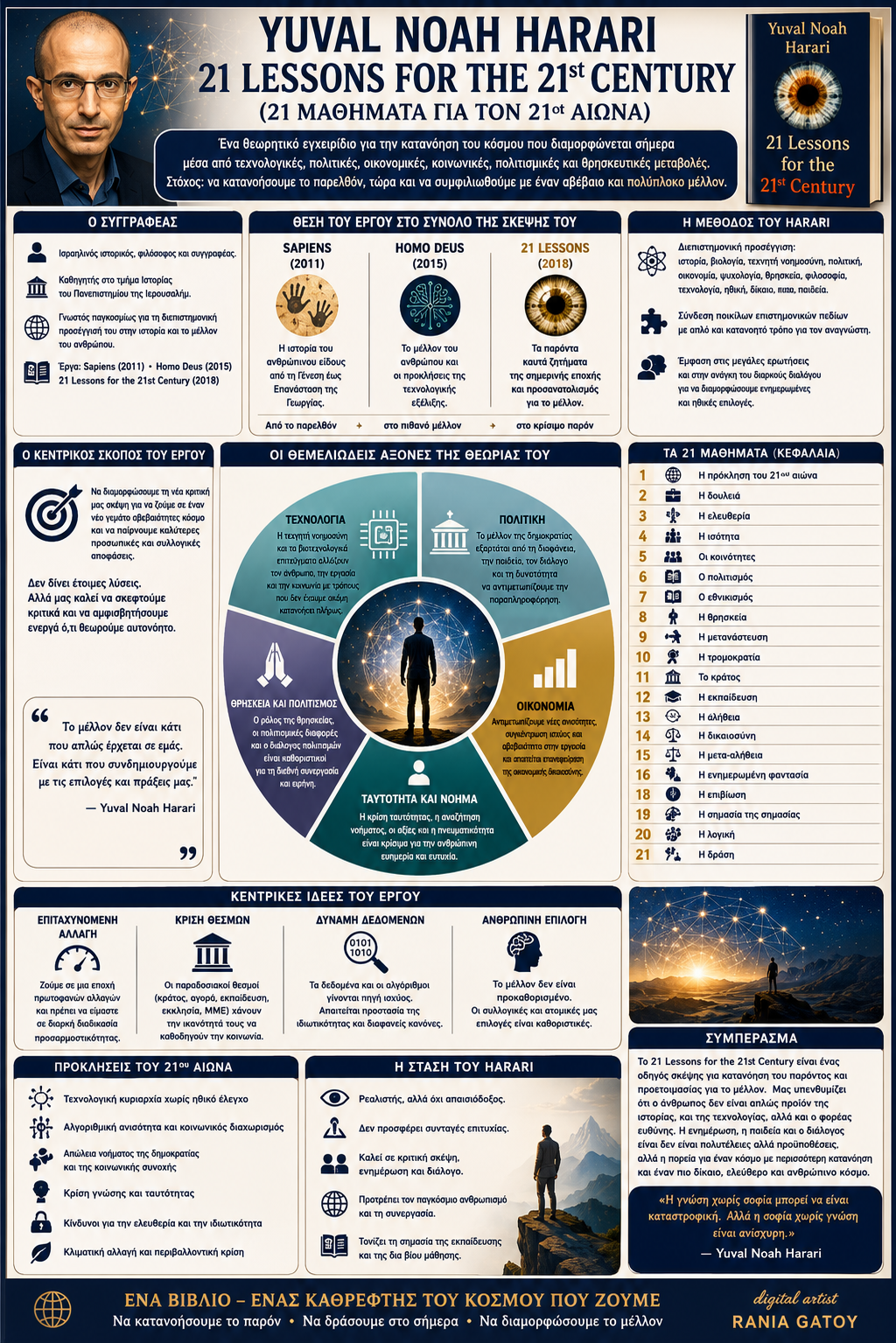
ΣΤΑ ΑΓΓΛΙΚΑ


DIALOGUE BETWEEN RANIA GATOU AND KYRIAKOS KYRIAZOPOULOS ON YUVAL NOAH HARARI’S BOOK 21 LESSONS FOR THE 21st CENTURY

Rania Gatou is the General Secretary of the International Humanitarian Organization Coeurs Pour Tous, a Researcher in Cardiac Surgery, Cultural Columnist – Researcher of Cultural Discourse, Poet – Visual Artist (https://raniagatou.gr/).

Yuval Noah Harari is Professor of World History at the Hebrew University of Jerusalem, a world-renowned historian and author of works such as Sapiens, Homo Deus, and 21 Lessons for the 21st Century, which have been translated into many languages.

Kyriakos Kyriazopoulos is Director of the Master’s Programme entitled Theory of Law and Interdisciplinary Legal Studies at the Faculty of Law of the Aristotle University of Thessaloniki and Coordinator of the Seminar Artificial Intelligence, Ethics and Democracy of that Master’s Programme (https://theory.law.auth.gr/).

Rania Gatou:
Professor, I would like us to begin with the fundamental question. Why did this book generate such extensive international discussion?
Kyriakos Kyriazopoulos:
Because Harari does not attempt to write yet another history of the past, nor a prediction of the distant future. He attempts to interpret the present. He argues that humanity is living through a period in which traditional political, social, and ideological certainties are weakening, while technological developments are accelerating at an unprecedented pace. According to the book’s introduction, the central question is how human beings can understand a world that they themselves have created but are increasingly finding difficult to control.
________________________________________
Rania Gatou:
The first part of the book concerns the technological challenge. Why does Harari consider technology to be the most important issue of our time?
Kyriakos Kyriazopoulos:
Because, in his view, for the first time in history the technologies of information science and biotechnology are not merely transforming humanity’s tools but humanity itself. Artificial intelligence, big data, and biotechnology may influence work, freedom, equality, and even the very concept of human personality. This constitutes the fundamental starting point of the book.
________________________________________
Rania Gatou:
One of the best-known chapters is the one devoted to work. What is Harari’s position?
Kyriakos Kyriazopoulos:
Harari argues that artificial intelligence threatens not only manual occupations but also many cognitive activities that we have thus far regarded as exclusively human. He does not claim that unemployment is inevitable, but rather that the labour market will undergo profound transformation and that millions of people will need to retrain many times throughout their lives. Consequently, the question is not only which professions will disappear, but above all what new form of education is required for a world of continuous change.
________________________________________
Rania Gatou:
Does this mean that human beings will be replaced by machines?
Kyriakos Kyriazopoulos:
Not exactly. Harari believes that many functions can be automated more efficiently by algorithms. However, his principal concern is not the replacement of human labour but the possibility that major social inequalities may emerge if the benefits of technological development become concentrated in the hands of a small number of individuals or organizations.
________________________________________
Rania Gatou:
In the following chapter he discusses freedom. Why does he connect freedom with data?
Kyriakos Kyriazopoulos:
Because he believes that whoever controls data may gradually influence human decisions. If algorithms know an individual’s preferences, habits, and even psychological tendencies better than the individual does, they may acquire considerable influence over that person’s choices. This issue is directly connected with democracy, privacy, and the protection of fundamental rights.
________________________________________
Rania Gatou:
So Harari considers data to be the new form of power?
Kyriakos Kyriazopoulos:
Precisely. He argues that in the future economic and political power will increasingly depend upon the possession and processing of data. For this reason, the fourth chapter of the first part connects equality with the ownership of data, warning that the concentration of such power may lead to new forms of social inequality.
________________________________________
Rania Gatou:
The second part concerns politics. Does he argue that the nation-state is no longer sufficient?
Kyriakos Kyriazopoulos:
Yes. Harari maintains that many of the most significant challenges of the twenty-first century—such as climate change, pandemics, cyberattacks, and artificial intelligence—transcend national borders. Consequently, he argues that forms of international cooperation are required that are capable of addressing problems on a global scale.
________________________________________
Rania Gatou:
What is your opinion as a legal scholar?
Kyriakos Kyriazopoulos:
Here an important distinction must be made. Harari correctly points out that many contemporary problems possess a global dimension. However, from a legal perspective, international cooperation does not necessarily imply the weakening of the State. The State remains the primary bearer of democratic legitimacy and the protection of rights. Consequently, the objective is not the abolition of the nation-state but more effective cooperation among States through international law and international organizations.
________________________________________
Rania Gatou:
The book frequently refers to democracy. Is Harari optimistic or pessimistic?
Kyriakos Kyriazopoulos:
I would say that he is cautious. He does not reject liberal democracy; on the contrary, he acknowledges that it has been the most successful political model of the modern era. Nevertheless, he expresses concern that new technologies are creating unprecedented challenges that traditional democratic institutions may find difficult to address without substantial adaptation. This position is already articulated in the introduction to the work.
________________________________________
Rania Gatou:
If you had to summarize the central message of the book in a single sentence, what would it be?
Kyriakos Kyriazopoulos:
I would say that Harari invites us to reflect seriously on how we can preserve human freedom, human dignity, and democracy in a world where technology is advancing more rapidly than our institutions, our public policies, and our ethical capacity to manage it.
Rania Gatou:
Professor, in our previous discussion we referred to the first chapter, where Harari describes the disillusionment of the great ideologies of the twentieth century and the uncertainty that characterizes the twenty-first century. In the second chapter he now turns to work. Why does he consider this issue to be so crucial?
Kyriakos Kyriazopoulos:
Because, according to Harari, work is not merely a means of securing income. For most people it is also a primary source of social identity, personal dignity, and integration into a community. If technological developments radically transform the labour market, then not only the economy is affected, but also the way in which people perceive themselves and their place in society. This is the fundamental starting point of his analysis.
Rania Gatou:
So artificial intelligence is presented as the principal cause of this transformation?
Kyriakos Kyriazopoulos:
Exactly. Harari argues that, for the first time in history, automation is not confined to physical labour. The progress of artificial intelligence now enables machines to perform cognitive tasks as well, which until recently were regarded as the exclusive domain of human beings. Consequently, not only repetitive manual occupations are threatened, but also professions requiring data analysis, diagnosis, forecasting, or decision-making.
Rania Gatou:
However, does history not show that every technological revolution ultimately created more jobs than it eliminated?
Kyriakos Kyriazopoulos:
Harari acknowledges this historical precedent, but he points out that the present situation may be qualitatively different. During previous industrial revolutions, people were able to move from one occupational sector to another. Today, however, the pace of technological development may become so rapid that large segments of the population may be unable to adapt in time to the new demands.
Rania Gatou:
So the problem is not only the loss of jobs but also the inability to adapt?
Kyriakos Kyriazopoulos:
Precisely. Harari places particular emphasis on the continuous need for retraining. He argues that the knowledge acquired during one’s youth will probably not suffice for one’s entire professional life. On the contrary, lifelong learning becomes a necessary condition for social survival.
Rania Gatou:
Does this mean that the role of the educational system is also changing?
Kyriakos Kyriazopoulos:
Yes. The author suggests that educational systems can no longer be confined to transmitting fixed bodies of knowledge. They must cultivate skills of adaptability, critical thinking, cooperation, and lifelong learning. In a world where information changes rapidly, greater importance is attached to the individual’s ability to learn anew than to the memorization of specific information.
Rania Gatou:
Harari also uses the term “useless class.” Is this a prediction or a warning?
Kyriakos Kyriazopoulos:
I would say that he uses it primarily as a warning. He expresses concern that, if the economy is unable to absorb the people displaced by automation, a large social group may emerge that is no longer regarded as economically necessary. He does not claim that this is an inevitable future, but rather that it is a risk requiring political and social responses.
Rania Gatou:
In your opinion, what is the greatest contribution of this chapter?
Kyriakos Kyriazopoulos:
Its greatest contribution is that it shifts the discussion from technology to the human being. It does not merely ask which tasks machines will perform. It asks what it will mean for human dignity, social cohesion, and democracy if work ceases to constitute the central axis of human life. Thus, the issue of artificial intelligence is transformed from a technical problem into a profound social, political, and ethical question.
Rania Gatou:
As a legal scholar, how do you assess this approach?
Kyriakos Kyriazopoulos:
I believe that Harari’s analysis successfully highlights the social challenges posed by technological development. However, the book does not undertake a systematic legal examination of the mechanisms for the protection of rights, the liability of artificial intelligence systems, or the regulatory framework governing the labour market. These are matters that belong primarily to legal scholarship and require supplementary analysis beyond the scope of the work.
Rania Gatou:
Professor, after his analysis of work, Harari moves on to the chapter on freedom. Why does he believe that this concept is now under new pressure?
Kyriakos Kyriazopoulos:
Because he argues that technological developments are radically transforming the way in which human decisions are made. The progress of artificial intelligence, biotechnology, and data collection creates, in his view, the possibility of analysing human preferences with unprecedented precision. Consequently, the question arises whether the decisions we regard as entirely personal continue to be genuinely free or whether they are increasingly influenced by algorithmic systems and by those who control the data.
Rania Gatou:
So Harari questions the very concept of free will?
Kyriakos Kyriazopoulos:
Rather than rejecting it, he seeks to re-examine it. He presents the view that a large part of human behaviour is influenced by biological and psychological mechanisms which may gradually become subject to technological analysis. If algorithms can predict an individual’s future choices more accurately than the individual himself or herself, then a new philosophical and political problem arises: who ultimately makes the decisions, and who directs those decisions?
Rania Gatou:
Does this mean that the greatest danger is not the machines themselves but the concentration of information?
Kyriakos Kyriazopoulos:
This is one of the central arguments of the chapter. Harari points out that the value of data is continuously increasing. Whoever possesses the ability to collect, process, and combine enormous quantities of information acquires considerable economic and political power. Consequently, the discussion concerning freedom relates not only to individual rights but also to the structure of power within contemporary societies.
Rania Gatou:
Is there, however, an optimistic aspect to this chapter?
Kyriakos Kyriazopoulos:
Yes. Harari does not regard technology as being, in itself, either beneficial or destructive. Developments depend upon the manner in which societies regulate technology, upon the political decisions that are adopted, and upon the preservation of democratic institutions. His central message is that technological progress does not eliminate the need for human responsibility; on the contrary, it makes that responsibility even more important.
________________________________________
Transition to the Chapter “Equality”
Rania Gatou:
Harari then examines equality. How does he connect technology with this issue?
Kyriakos Kyriazopoulos:
He argues that new technologies may create forms of inequality different from those previously experienced by humanity. These are not limited to economic inequalities, but also include inequalities in access to knowledge, data, technological infrastructure, and, potentially, even to the biotechnological possibilities of enhancing human beings themselves.
Rania Gatou:
So he believes that inequality may become even deeper?
Kyriakos Kyriazopoulos:
That is precisely what concerns him. If the most advanced technologies become available only to a limited number of States, corporations, or economic elites, the gap between social groups may widen considerably. Technological progress, therefore, does not by itself guarantee greater social justice.
Rania Gatou:
Therefore, the problem is not technology itself but the distribution of technology?
Kyriakos Kyriazopoulos:
That is one of the principal conclusions of the chapter. The very same technological capabilities may either expand opportunities or reinforce exclusion. For this reason, Harari consistently connects technological development with politics, economics, and institutions.
Rania Gatou:
As a legal scholar, how do you evaluate this line of reasoning?
Kyriakos Kyriazopoulos:
I believe that the book raises the major questions in an insightful manner without, however, entering into a detailed normative analysis. From a legal perspective, the protection of freedom and equality depends not only upon technological development but also upon the existence of effective constitutional guarantees, strong protection of fundamental rights, rules governing the processing of personal data, mechanisms ensuring the accountability of algorithmic systems, and effective judicial review. The book identifies the challenges; legal scholarship is called upon to formulate the answers.
________________________________________
Chapter 5 – “Community”
Rania Gatou:
Professor, after analysing freedom and equality, Harari turns to the concept of community. Why does he regard it as such an important issue for the twenty-first century?
Kyriakos Kyriazopoulos:
Because he argues that technological progress and globalization, while expanding opportunities for communication among people, have simultaneously weakened many of the traditional bonds that once constituted communities. People communicate more easily than ever before, but this does not necessarily mean that they feel more closely connected with one another. Harari explores the contradiction between technological interconnectedness and social isolation.
Rania Gatou:
Is he therefore critical of social media?
Kyriakos Kyriazopoulos:
His approach is more nuanced. He does not reject digital communication as such. He points out, however, that online interaction cannot always replace the relationships of trust, solidarity, and personal participation that characterize a genuine community. In his view, there is a danger that digital platforms may create the impression of social participation without producing corresponding bonds in real life.
Rania Gatou:
How is this connected with politics?
Kyriakos Kyriazopoulos:
Harari believes that democratic institutions presuppose a minimum level of social trust. When citizens no longer feel that they belong to communities sharing common points of reference, they find it more difficult to cooperate and to seek common solutions. Thus, the weakening of community is not merely a social phenomenon but also a political challenge.
Rania Gatou:
In your opinion, what is the principal message of this chapter?
Kyriakos Kyriazopoulos:
That technological progress alone is insufficient to preserve the cohesion of a society. Communities are built through relationships of trust, common institutions, and the participation of citizens. If these elements are weakened, then even the most advanced technologies cannot replace the social fabric.
Chapter 6 – “Civilization”
Rania Gatou:
Immediately afterwards, Harari refers to civilization. What does he mean by this term?
Kyriakos Kyriazopoulos:
The term is used in a broad sense. It refers not only to art or literature, but also to systems of values, collective narratives, traditions, and shared conceptions that enable people to organize their social life. Harari examines how civilizations interact in an increasingly interconnected world.
Rania Gatou:
Does he argue that there is a single global civilization?
Kyriakos Kyriazopoulos:
Not in an absolute sense. He observes that globalization creates common economic, scientific, and technological structures without eliminating cultural particularities. On the contrary, local identities are often strengthened precisely because they come into contact with a broader international environment. His interest focuses on the coexistence of these two tendencies.
Rania Gatou:
So he rejects the idea that civilizations are completely isolated?
Kyriakos Kyriazopoulos:
Yes. He believes that throughout their historical development civilizations have always influenced one another. According to his analysis, the exchange of ideas, technologies, and institutions constitutes a permanent characteristic of human history. Contemporary globalization accelerates this process without, however, eliminating diversity.
Rania Gatou:
How does this relate to today’s political conflicts?
Kyriakos Kyriazopoulos:
Harari believes that many conflicts are presented as clashes of civilizations, whereas in reality they are far more complex, involving economic, geopolitical, social, and historical factors. For this reason, he proposes that simplistic interpretations should be avoided and that the multiple causes of every conflict should be examined.
Rania Gatou:
As a legal scholar, what do you consider to be the significance of this chapter?
Kyriakos Kyriazopoulos:
Its significance lies in the fact that it reminds us that legal institutions do not operate in a cultural vacuum. Law functions within specific social and cultural environments. At the same time, however, from a legal perspective the recognition of cultural diversity must be reconciled with respect for fundamental rights, equality before the law, and the rule of law. The book establishes the broader framework of this discussion without developing a specific legal theory.
________________________________________
Chapter 7 – “Nationalism”
Rania Gatou:
Professor, Harari devotes an entire chapter to nationalism. Why does he believe that this issue acquires particular significance in the twenty-first century?
Kyriakos Kyriazopoulos:
Because he observes that contemporary humanity is confronted with problems that transcend the borders of every individual State. Climate change, the development of artificial intelligence, cybersecurity, global economic crises, and pandemics are, according to his analysis, issues that cannot be resolved exclusively through national policies. For this reason, he examines whether traditional nationalism is sufficient as a framework for addressing these new challenges.
Rania Gatou:
Does he therefore argue that nations are no longer important?
Kyriakos Kyriazopoulos:
No. It is important to read his argument carefully. Harari does not deny the historical or cultural significance of nations, nor does he question the fact that people develop strong ties with their homeland. What he points out is that love for one’s nation is not, by itself, sufficient to address problems that are inherently global in nature. This distinction runs throughout the entire chapter.
Rania Gatou:
So he does not equate patriotism with nationalism?
Kyriakos Kyriazopoulos:
Exactly. He distinguishes commitment to the particular history, culture, and society of a people from the belief that every international issue can be resolved exclusively through national sovereignty. His interest is not focused on the abolition of States but on the need for complementary international cooperation.
________________________________________
Global Problems
Rania Gatou:
What examples does he use to support this position?
Kyriakos Kyriazopoulos:
He refers to problems whose consequences are not confined within the borders of a single State. Environmental degradation, for example, does not stop at national frontiers. The same applies to digital technologies, the circulation of information, and the development of artificial intelligence. If every State acts entirely independently, it becomes difficult to address effectively phenomena that possess a global dimension.
Rania Gatou:
Does he therefore propose the creation of a world government?
Kyriakos Kyriazopoulos:
No. The book does not advance such a specific institutional proposal. His principal position is that stronger international cooperation is required, without developing a comprehensive model of global political organization. His interest is focused more on highlighting the problem than on presenting a complete constitutional blueprint for the international community.
________________________________________
The Relationship with Democracy
Rania Gatou:
How is nationalism connected with democracy?
Kyriakos Kyriazopoulos:
Harari points out that democratic institutions historically developed primarily within nation-states. However, when the most important decisions are increasingly influenced by global technological and economic forces, tension arises between national democratic legitimacy and the actual scope of the problems that must be addressed. This issue constitutes one of the principal concerns of the chapter.
________________________________________
Legal Assessment
Rania Gatou:
As a Professor of Law, how do you assess this position?
Kyriakos Kyriazopoulos:
I believe that Harari raises an exceptionally important political question, but his answer necessarily remains general. From the perspective of legal scholarship, international cooperation cannot function independently of the fundamental principles of international law, such as State sovereignty, the principle of the sovereign equality of States, democratic legitimacy, and the protection of human rights.
In other words, the fact that a problem is global does not automatically abolish the constitutional guarantees or the international legal rules governing relations among States. The challenge is to achieve a balance between effective international cooperation and the preservation of the democratic accountability of institutions.
Rania Gatou:
Could we therefore say that this chapter is not so much a theory of nationalism as a theory of governance in a globalized world?
Kyriakos Kyriazopoulos:
I believe that this is an accurate interpretation. Nationalism serves as the starting point for examining a broader question: how can collective action be organized when the most significant problems of our age transcend the traditional boundaries of States? This chapter is organically connected with what follows in the subsequent parts of the book concerning religion, migration, and global challenges.
Chapter 8 – “Religion”
Rania Gatou:
Professor, after discussing nationalism, Harari turns to religion. Why does he regard religion as one of the central issues of the twenty-first century?
Kyriakos Kyriazopoulos:
Because, according to Harari, religion continues to influence political developments, collective identities, and international relations, even though the contemporary world is becoming increasingly scientific and technologically advanced. He argues that religion cannot be understood merely as a set of theological beliefs. It also functions as a powerful social institution, shaping values, historical memory, and collective identity.
Rania Gatou:
Does he distinguish between religion and spirituality?
Kyriakos Kyriazopoulos:
Yes. Harari attempts to distinguish organized religious systems from the individual’s personal search for meaning. His principal concern in this chapter, however, is the role that organized religions play within modern political societies and the extent to which they continue to influence public life.
Rania Gatou:
One of the ideas often associated with Harari is that religions function as systems of social cooperation. Does this also appear in this book?
Kyriakos Kyriazopoulos:
Indeed. He argues that throughout history religions have contributed significantly to enabling large groups of people to cooperate by creating common narratives, shared moral rules, and collective identities. In his view, their historical importance cannot be understood solely through theological doctrines but also through the social functions they have performed.
Rania Gatou:
Does he suggest that religion has become obsolete?
Kyriakos Kyriazopoulos:
No. On the contrary, he repeatedly observes that religion continues to exercise considerable influence in many societies. What he questions is not the existence of religion itself but its ability, on its own, to provide solutions to the unprecedented technological and global challenges of the twenty-first century.
________________________________________
Religion and Science
Rania Gatou:
How does Harari approach the relationship between religion and science?
Kyriakos Kyriazopoulos:
He does not present them as absolute enemies. Instead, he argues that they answer different kinds of questions. Scientific inquiry seeks to explain how the world functions, whereas religions have traditionally attempted to provide meaning, moral orientation, and social cohesion. Difficulties arise when either sphere attempts to replace the other.
Rania Gatou:
Does he therefore consider dialogue possible?
Kyriakos Kyriazopoulos:
His position suggests that constructive coexistence is possible, provided that each sphere recognizes its own limits. Scientific progress cannot by itself resolve every ethical issue, while religious traditions cannot replace empirical scientific investigation. This distinction underlies much of his discussion.
________________________________________
Religion and Politics
Rania Gatou:
Harari also examines the relationship between religion and politics. What concerns him most?
Kyriakos Kyriazopoulos:
He is primarily concerned with the use of religious identity within political conflicts. He observes that many contemporary disputes are presented as religious confrontations, although their causes are frequently geopolitical, economic, historical, or social. Consequently, he warns against reducing complex political problems to exclusively religious explanations.
Rania Gatou:
So religion is not necessarily the cause of conflict?
Kyriakos Kyriazopoulos:
Exactly. Harari repeatedly emphasizes that religious language is often employed to express broader political or national conflicts. Therefore, careful analysis is required before attributing violence exclusively to religion itself.
________________________________________
Legal Assessment
Rania Gatou:
As a Professor of Ecclesiastical Law, how do you assess Harari’s approach?
Kyriakos Kyriazopoulos:
From the perspective of legal scholarship, this chapter is particularly interesting because it recognises the continuing importance of religion within contemporary societies. Nevertheless, Harari approaches religion primarily from a historical and sociological perspective rather than from a legal one.
The legal dimension involves additional issues, such as freedom of religion or belief, equality of religious communities before the law, the autonomy of religious organisations, the neutrality of the State, the protection of places of worship, conscientious objection, and the jurisprudence of constitutional and international courts. These issues fall outside the scope of Harari’s analysis.
For that reason, while the chapter provides a valuable framework for discussion, it should be supplemented by constitutional law, international human rights law, and the law governing relations between States and religious or non-religious communities.
Rania Gatou:
Would it therefore be fair to say that Harari examines religion mainly as a social phenomenon rather than as a legal institution?
Kyriakos Kyriazopoulos:
Yes. That is, in my opinion, the most accurate description of his methodology. His analysis seeks to explain the role of religion within the broader evolution of human societies. It is not intended to provide a systematic legal theory of religious freedom or of the constitutional regulation of relations between the State and religious communities.
________________________________________
Transition to the Next Chapter
Rania Gatou:
Immediately after religion, Harari turns to migration. Is there a connection between these two chapters?
Kyriakos Kyriazopoulos:
There is. Both chapters examine questions of identity and coexistence. Religion concerns cultural and spiritual identity, whereas migration concerns the movement of people between different societies and the challenges arising from that movement. Together, they prepare the reader for Harari’s broader discussion of globalization, pluralism, and the future of democratic societies.
Chapter 9 – “Immigration”
Rania Gatou:
Professor, after his discussion of religion, Harari turns to immigration. Why does he regard migration as one of the defining issues of the twenty-first century?
Kyriakos Kyriazopoulos:
Because migration has become one of the most visible consequences of globalization. The unprecedented mobility of populations, the development of transportation and communication technologies, armed conflicts, economic inequalities, and environmental pressures have all contributed to the movement of millions of people across national borders. Harari considers migration not merely a demographic phenomenon but also a political, cultural, and ethical challenge for contemporary democracies.
Rania Gatou:
Does he support unrestricted immigration?
Kyriakos Kyriazopoulos:
No. Harari’s position is considerably more nuanced than it is sometimes presented. He attempts to analyse the expectations and obligations that arise both for migrants and for receiving societies. He argues that migration is based upon an implicit social understanding: migrants seek admission into another society, while the host society determines the conditions under which integration may take place. Consequently, the discussion concerns not only rights but also mutual responsibilities.
________________________________________
Integration
Rania Gatou:
One of the central concepts of the chapter is integration. How does Harari understand this concept?
Kyriakos Kyriazopoulos:
He distinguishes between simple physical presence within a country and genuine participation in its social life. According to his analysis, integration involves acceptance of the fundamental legal and political institutions of the receiving society while, at the same time, allowing individuals to preserve significant aspects of their own cultural identity. Thus, the challenge lies in finding an equilibrium between social cohesion and cultural diversity.
Rania Gatou:
Does he therefore reject multiculturalism?
Kyriakos Kyriazopoulos:
He does not reject cultural pluralism as such. Rather, he asks under what conditions different cultural communities can coexist peacefully within the same political order. The emphasis of his analysis is placed on practical coexistence rather than on ideological labels.
________________________________________
Identity
Rania Gatou:
How does the issue of identity appear in this chapter?
Kyriakos Kyriazopoulos:
Harari argues that migration inevitably raises questions concerning collective identity. Citizens often wonder what characteristics define their national community and which values should remain common to everyone. At the same time, migrants seek recognition and inclusion without necessarily abandoning every aspect of their previous identity. This interaction creates tensions that democratic institutions are called upon to manage.
Rania Gatou:
Does he believe that these tensions can be resolved?
Kyriakos Kyriazopoulos:
He does not present a universal solution. Instead, he argues that every society must seek its own balance between openness and social cohesion, taking into account its historical experience, constitutional principles, and democratic institutions.
________________________________________
Migration and Globalization
Rania Gatou:
How does migration relate to globalization?
Kyriakos Kyriazopoulos:
Harari considers migration one of the clearest manifestations of globalization. Economic interdependence, technological development, and the global circulation of information make societies increasingly interconnected. Consequently, migration cannot be examined in isolation from broader international developments.
________________________________________
Legal Assessment
Rania Gatou:
Professor, from the perspective of legal scholarship, how would you evaluate Harari’s discussion?
Kyriakos Kyriazopoulos:
The chapter successfully identifies the principal political and social dilemmas surrounding migration. Nevertheless, its purpose is analytical rather than legal.
From the legal perspective, migration is governed by an extensive body of constitutional, international, and European legal rules. These include the protection of refugees under international law, human rights obligations, asylum procedures, immigration law, anti-discrimination rules, citizenship legislation, and the jurisprudence of international and constitutional courts.
These legal dimensions are not developed systematically in the book because Harari’s principal objective is to examine the broader political implications of migration rather than its detailed legal regulation. Consequently, the chapter serves as a valuable introduction to the debate but should be complemented by specialised legal analysis.
Rania Gatou:
So the discussion is primarily political and sociological?
Kyriakos Kyriazopoulos:
Precisely. Harari seeks to explain why migration has become one of the central issues of contemporary politics and why it generates intense public debate in many democratic societies. The legal mechanisms for addressing these questions belong to a different level of analysis.
________________________________________
Chapter 10 – “Terrorism”
Rania Gatou:
Immediately afterwards, Harari examines terrorism. Why does he include this topic among the major lessons of the twenty-first century?
Kyriakos Kyriazopoulos:
Because terrorism has profoundly influenced political life during recent decades. Harari argues, however, that its psychological and symbolic impact is often considerably greater than its actual military capacity. Terrorist organisations generally possess limited conventional military power, yet they attempt to influence governments and societies by creating fear that extends far beyond the immediate victims of an attack.
Rania Gatou:
So fear becomes the principal weapon?
Kyriakos Kyriazopoulos:
Exactly. According to Harari, terrorism seeks above all to influence the reactions of governments and populations. The effectiveness of terrorist violence depends largely upon the political, social, and psychological responses that follow an attack. For this reason, he argues that democracies should avoid reactions that inadvertently amplify the objectives of terrorism itself.
Rania Gatou:
Does he minimise the seriousness of terrorism?
Kyriakos Kyriazopoulos:
No. He fully recognises its human cost and its capacity to destabilise societies. What he questions is the tendency to attribute to terrorism a level of strategic power disproportionate to its actual capabilities. His analysis therefore focuses on the broader political effects of fear rather than on military considerations alone.
Chapter 11 – “War”
Rania Gatou:
Professor, after discussing terrorism, Harari turns to war. This seems almost paradoxical. Why does he separate these two phenomena?
Kyriakos Kyriazopoulos:
Because he considers them fundamentally different. Terrorism is generally carried out by comparatively small organisations seeking psychological and political impact disproportionate to their military strength. War, by contrast, traditionally involves organised armed conflict between States or other major political entities. Harari argues that the historical evolution of war during recent decades differs significantly from that of previous centuries.
Rania Gatou:
One of the most debated claims in this chapter is that large-scale wars have become less frequent. How does he justify this position?
Kyriakos Kyriazopoulos:
He argues that several developments have altered the incentives for war. The existence of nuclear weapons has dramatically increased the potential cost of direct confrontation between major powers. At the same time, economic globalization has created extensive interdependence among States, making prolonged military conflict economically damaging even for the victors. Furthermore, scientific and technological cooperation increasingly depends upon international stability. According to Harari, these factors have contributed to reducing the likelihood of traditional interstate wars, although they have by no means eliminated the possibility of armed conflict.
Rania Gatou:
Does he therefore conclude that humanity has entered a peaceful era?
Kyriakos Kyriazopoulos:
No. Harari is careful not to make such a claim. He explicitly recognises that wars continue to occur and that violence remains a central feature of international politics. His argument is comparative rather than absolute. He suggests that the structural conditions influencing the outbreak of wars have changed, not that war itself has disappeared.
________________________________________
New Forms of Conflict
Rania Gatou:
Does Harari believe that future conflicts will differ from those of the past?
Kyriakos Kyriazopoulos:
Very much so. He points to the growing importance of cyber operations, information warfare, artificial intelligence, autonomous technologies, and attacks against digital infrastructure. Future conflicts may increasingly target communication networks, financial systems, databases, and critical infrastructure rather than conventional battlefields alone. In this sense, technology is transforming not only civilian life but also the very nature of international conflict.
Rania Gatou:
So technology again occupies a central position?
Kyriakos Kyriazopoulos:
Indeed. One of the recurring themes throughout the book is that technological development affects every major sphere of human activity. The chapter on war illustrates that national security itself is being reshaped by digital technologies and artificial intelligence.
________________________________________
The Risk of Escalation
Rania Gatou:
Does Harari express concern that technological progress may itself become a source of conflict?
Kyriakos Kyriazopoulos:
Yes. He observes that competition over technological superiority may intensify international rivalries. Artificial intelligence, biotechnology, cyber capabilities, and advanced computing may all become strategic resources. Consequently, technological competition acquires geopolitical significance extending far beyond the commercial sphere.
________________________________________
Legal Assessment
Rania Gatou:
Professor, how do you assess this chapter from the standpoint of legal scholarship?
Kyriakos Kyriazopoulos:
The chapter raises extremely important questions concerning the future of international security. However, Harari approaches these issues primarily from historical and geopolitical perspectives.
From the legal standpoint, the analysis would need to be supplemented by the law governing the use of force under the Charter of the United Nations, international humanitarian law, the law of armed conflict, arms control treaties, cyber norms, and the emerging legal regulation of autonomous weapons systems and artificial intelligence in military contexts.
These legal dimensions are largely beyond the scope of the book because its objective is to stimulate reflection on the transformation of war rather than to present a comprehensive legal framework governing armed conflict.
Rania Gatou:
Would it therefore be fair to say that Harari is primarily interested in the changing conditions under which wars arise?
Kyriakos Kyriazopoulos:
Yes. His principal concern is to explain how technological, economic, and political transformations are altering the strategic environment within which conflicts occur. The legal regulation of those conflicts requires an additional level of analysis that belongs to international legal scholarship.
________________________________________
Transition to the Third Part of the Book
Rania Gatou:
With the chapter on war, Harari completes his discussion of the major political challenges facing humanity. The following chapters appear to become more philosophical. Is that correct?
Kyriakos Kyriazopoulos:
Precisely. After examining technology, politics, religion, migration, terrorism, and war, Harari shifts his attention to questions concerning human knowledge, truth, meaning, and the future of civilization. The emphasis gradually moves from institutions and global politics to the intellectual and ethical foundations upon which contemporary societies rest. This transition marks the beginning of the third major thematic section of the book.
Chapter 12 – “Humility”
Rania Gatou:
Professor, after discussing technology, politics, religion, migration, terrorism, and war, Harari begins a much more philosophical section of the book. The first chapter is entitled Humility. Why does he choose this concept?
Kyriakos Kyriazopoulos:
Because Harari believes that one of humanity’s recurring historical mistakes has been the conviction that a particular nation, religion, civilization, or ideological system possesses complete knowledge of reality. He argues that history repeatedly demonstrates the limitations of such certainty. For this reason, he proposes intellectual humility as an indispensable virtue for the twenty-first century.
Rania Gatou:
So humility is not presented merely as a personal moral virtue?
Kyriakos Kyriazopoulos:
Exactly. Harari extends the concept far beyond individual ethics. He applies it to political ideologies, national identities, religions, scientific communities, and civilizations. According to his analysis, societies become more capable of learning and adapting when they recognise that their knowledge is necessarily limited.
________________________________________
Historical Perspective
Rania Gatou:
How does Harari support this position historically?
Kyriakos Kyriazopoulos:
He points to numerous moments in history during which dominant powers believed that they fully understood reality, only to discover later that they had seriously underestimated unforeseen developments. Scientific discoveries, technological revolutions, political transformations, and cultural changes repeatedly challenged ideas that had once appeared unquestionable. This historical pattern leads him to advocate caution whenever certainty becomes absolute.
Rania Gatou:
Does he therefore reject certainty altogether?
Kyriakos Kyriazopoulos:
No. He does not argue that knowledge is impossible. Rather, he maintains that knowledge remains provisional and subject to revision as new evidence emerges. In this sense, humility does not weaken scientific inquiry; instead, it strengthens it by encouraging continuous critical examination.
________________________________________
Humility and Politics
Rania Gatou:
How does this idea affect political life?
Kyriakos Kyriazopoulos:
Harari argues that democratic societies benefit when political leaders acknowledge uncertainty and remain open to evidence and dialogue. Conversely, when political systems become convinced of their absolute infallibility, they may become resistant to criticism and incapable of correcting mistakes. Humility therefore acquires constitutional as well as ethical significance.
________________________________________
Legal Assessment
Rania Gatou:
Professor, what is your legal assessment of this chapter?
Kyriakos Kyriazopoulos:
The legal relevance of humility lies in the structure of constitutional democracy itself. Constitutional systems are founded upon the assumption that no institution, no authority, and no individual should exercise unlimited power. Separation of powers, judicial review, constitutional guarantees, and fundamental rights all reflect institutional humility: they recognise that every exercise of public authority requires checks and balances.
Harari approaches the matter philosophically, whereas constitutional law embodies similar principles through legal institutions. Consequently, although the terminology differs, there is an interesting convergence between his argument and fundamental constitutional doctrines.
________________________________________
Chapter 13 – “God”
Rania Gatou:
The following chapter is entitled God. Why does Harari introduce such a topic immediately after humility?
Kyriakos Kyriazopoulos:
Because he wishes to examine the historical role of religious belief within human civilization. Rather than entering into theological questions concerning the existence of God, he focuses primarily upon the social, historical, and political functions that religious traditions have performed. His analysis therefore remains essentially historical rather than confessional.
Rania Gatou:
Does he evaluate religions according to their truth?
Kyriakos Kyriazopoulos:
No. Harari deliberately refrains from discussing theological truth claims. Instead, he investigates how religious narratives have contributed to social cooperation, legal development, moral education, collective identity, and political organization throughout history. His concern is explanatory rather than doctrinal.
Rania Gatou:
Does he believe that morality necessarily depends upon religion?
Kyriakos Kyriazopoulos:
He suggests that moral systems may develop through various historical and cultural processes. Religious traditions have undoubtedly exercised profound moral influence, but he also recognises that ethical reflection may emerge within secular philosophical traditions. His analysis therefore distinguishes between religion as a historical institution and morality as a broader human concern.
________________________________________
Religion and Human Responsibility
Rania Gatou:
What message does Harari ultimately wish to convey through this chapter?
Kyriakos Kyriazopoulos:
He argues that, regardless of one’s religious convictions, contemporary humanity cannot avoid assuming responsibility for addressing its own global challenges. Artificial intelligence, climate change, biotechnology, nuclear weapons, and digital technologies require concrete political and ethical decisions. Consequently, responsibility cannot simply be transferred elsewhere; it rests upon human societies themselves.
________________________________________
Legal Assessment
Rania Gatou:
As a Professor of Ecclesiastical Law, how do you evaluate this chapter?
Kyriakos Kyriazopoulos:
The chapter is intellectually stimulating because it analyses religion as a major historical force shaping civilizations. Nevertheless, it does not seek to present a theological or legal doctrine concerning religion.
From the standpoint of legal scholarship, additional issues become essential, including freedom of religion or belief, the constitutional status of religious communities, institutional autonomy, the protection of religious minorities, equality before the law, and the jurisprudence of constitutional courts and the European Court of Human Rights. These legal dimensions necessarily extend beyond the historical framework adopted by Harari.
Accordingly, the chapter should be understood as a historical-philosophical reflection rather than as a systematic study of religion in law.
Chapter 14 – “Secularism”
Rania Gatou:
Professor, immediately after the chapter entitled God, Harari turns to secularism. Why does he place these two chapters consecutively?
Kyriakos Kyriazopoulos:
Because he wishes to compare two different frameworks through which human societies have sought to understand the world. After examining the historical significance of religion, he analyses the intellectual tradition of secularism and its contribution to modern democratic societies. His purpose is not to present these approaches as necessarily incompatible but rather to explore the values and methods characteristic of secular thought.
Rania Gatou:
How does Harari define secularism?
Kyriakos Kyriazopoulos:
He describes secularism primarily as an intellectual attitude that emphasises critical inquiry, personal responsibility, empirical investigation, and openness to evidence. In his presentation, secularism encourages individuals to examine reality through observation, rational discussion, and continuous learning rather than through unquestioning acceptance of authority.
________________________________________
Critical Thinking
Rania Gatou:
Critical thinking appears to occupy a central place in this chapter. Why?
Kyriakos Kyriazopoulos:
Because Harari considers critical thinking indispensable in an age characterised by unprecedented quantities of information. Modern societies are confronted with enormous volumes of data, competing narratives, misinformation, and rapidly evolving technologies. According to his analysis, citizens require the ability to evaluate evidence independently rather than simply accepting assertions because they originate from political, religious, technological, or media authorities.
Rania Gatou:
Does he therefore identify secularism with science?
Kyriakos Kyriazopoulos:
No. Although he attaches great importance to scientific inquiry, he does not reduce secularism to science alone. He presents it more broadly as a cultural tradition that values intellectual openness, personal responsibility, and the willingness to revise one’s views when confronted with convincing evidence.
________________________________________
Responsibility
Rania Gatou:
You have already mentioned responsibility. Why is this concept so important?
Kyriakos Kyriazopoulos:
Because Harari argues that modern societies increasingly face problems that require human decisions rather than predetermined answers. Artificial intelligence, biotechnology, environmental protection, digital governance, and international security all demand ethical and political choices. Consequently, citizens and institutions alike must assume responsibility for the consequences of those choices instead of expecting ready-made solutions.
________________________________________
Education
Rania Gatou:
Does Harari connect secularism with education?
Kyriakos Kyriazopoulos:
Very much so. Education occupies a central position throughout the book, and particularly within this chapter. Harari argues that education should cultivate intellectual flexibility, critical reasoning, curiosity, and the capacity to continue learning throughout life. These qualities become especially important in a world where technological change constantly transforms professional and social realities.
________________________________________
Legal Assessment
Rania Gatou:
Professor, how do you evaluate this chapter from the standpoint of legal scholarship?
Kyriakos Kyriazopoulos:
The chapter raises important philosophical questions concerning democratic citizenship and public reasoning. Nevertheless, it does not seek to analyse the constitutional principle of State neutrality or the legal regulation of relations between the State and religious or non-religious communities.
From the perspective of constitutional and international law, secularism may assume very different institutional forms in different legal systems. Comparative constitutional law demonstrates that democratic States regulate these relationships through a wide variety of constitutional arrangements. Consequently, Harari’s discussion should be understood as a philosophical reflection on secular culture rather than as a comparative legal study of constitutional models.
Rania Gatou:
So his principal concern is civic culture rather than constitutional doctrine?
Kyriakos Kyriazopoulos:
Precisely. He is primarily interested in the intellectual qualities that enable democratic societies to respond constructively to uncertainty, technological transformation, and rapid social change. The constitutional institutionalisation of those principles belongs to legal scholarship rather than to the scope of this book.
________________________________________
Chapter 15 – “Ignorance”
Rania Gatou:
The next chapter is entitled Ignorance. This appears to be a rather provocative title. Why does Harari choose it?
Kyriakos Kyriazopoulos:
Because he believes that one of the greatest dangers facing humanity is not merely the absence of information but the illusion that we already possess sufficient knowledge. According to Harari, technological progress has produced unprecedented quantities of information, yet individuals often overestimate their own understanding of complex political, scientific, and economic realities.
Rania Gatou:
Does he therefore argue that people know less than before?
Kyriakos Kyriazopoulos:
Not exactly. His point is subtler. Humanity collectively possesses more scientific knowledge than ever before. However, each individual understands only a very small fraction of that accumulated knowledge. Modern societies function through extensive networks of specialised expertise. Consequently, no single person can fully comprehend every field upon which contemporary civilization depends.
Rania Gatou:
Why is this particularly important today?
Kyriakos Kyriazopoulos:
Because digital technologies create the impression that immediate access to information is equivalent to genuine understanding. Harari distinguishes between possessing information and possessing knowledge. He argues that responsible democratic participation requires not only information but also the capacity to evaluate sources critically, recognise the limits of one’s own expertise, and appreciate the role of specialised scientific knowledge.
________________________________________
The Dangers of Overconfidence
Rania Gatou:
Does Harari therefore warn against intellectual overconfidence?
Kyriakos Kyriazopoulos:
Very much so. He argues that excessive confidence in one’s own understanding may become a serious obstacle to learning. Individuals who believe they already know everything are less likely to examine evidence critically, reconsider their assumptions, or engage constructively with opposing viewpoints. For Harari, recognising one’s own ignorance is therefore not a weakness but the beginning of genuine learning.
Chapter 15 – “Ignorance” (continued)
Rania Gatou:
Professor, if ignorance is inevitable because no individual can know everything, how can democratic societies function successfully?
Kyriakos Kyriazopoulos:
Harari argues that modern societies function through networks of trust, institutions, and specialised expertise. Citizens necessarily rely upon scientists, judges, physicians, engineers, economists, and numerous other experts whose knowledge cannot realistically be mastered by every individual. The challenge therefore lies not in eliminating ignorance altogether but in creating institutions capable of evaluating expertise responsibly while preserving democratic accountability.
Rania Gatou:
Does he therefore advocate blind trust in experts?
Kyriakos Kyriazopoulos:
No. Quite the opposite. Harari insists that expertise should remain open to criticism, verification, and continuous review. Scientific knowledge progresses precisely because it accepts correction when new evidence emerges. Consequently, confidence in expertise should never become unquestioning submission to authority. Critical evaluation remains indispensable.
________________________________________
Information Overload
Rania Gatou:
One of the themes that seems particularly relevant today is information overload. How does Harari analyse this phenomenon?
Kyriakos Kyriazopoulos:
He observes that contemporary societies no longer suffer primarily from a shortage of information but from an overabundance of it. Digital platforms constantly produce enormous quantities of data, opinions, images, and narratives. The principal difficulty therefore becomes selecting reliable information and distinguishing trustworthy evidence from misinformation, manipulation, and deliberate deception.
Rania Gatou:
So education once again becomes essential?
Kyriakos Kyriazopoulos:
Indeed. Throughout the book Harari repeatedly returns to education as one of the principal responses to technological transformation. In the context of ignorance, education is not limited to memorising information but involves cultivating judgement, critical thinking, intellectual curiosity, and the ability to assess competing claims rationally.
________________________________________
Legal Assessment
Rania Gatou:
How would you evaluate this chapter from the standpoint of legal scholarship?
Kyriakos Kyriazopoulos:
The chapter has important implications for constitutional democracy. Democratic institutions presuppose informed public participation. Consequently, issues such as access to information, transparency of public administration, freedom of expression, media pluralism, academic freedom, and scientific independence become legally significant.
Harari discusses these matters primarily at the philosophical and political levels. A legal analysis would additionally examine constitutional guarantees, international human rights law, judicial protection of freedom of expression, and regulatory frameworks governing digital information environments. Nevertheless, his central observation—that ignorance combined with overconfidence constitutes a serious democratic risk—is highly relevant to contemporary constitutional discourse.
________________________________________
Chapter 16 – “Justice”
Rania Gatou:
Professor, after ignorance Harari turns to justice. Why does he consider justice one of the essential lessons of the twenty-first century?
Kyriakos Kyriazopoulos:
Because technological progress, globalization, and economic transformation continuously generate new questions concerning fairness, equality, responsibility, and the distribution of benefits and burdens. Harari argues that although humanity has developed extraordinarily powerful technologies, it has not yet resolved the fundamental problem of ensuring justice within rapidly changing societies.
Rania Gatou:
How does he approach the concept of justice?
Kyriakos Kyriazopoulos:
He emphasises its complexity. Justice cannot be understood solely from the perspective of one nation, one social group, or one generation. Decisions concerning trade, climate change, artificial intelligence, biotechnology, taxation, migration, and environmental protection increasingly affect people across national borders and even future generations. Consequently, our traditional understanding of justice faces unprecedented challenges.
________________________________________
Global Justice
Rania Gatou:
Does Harari therefore advocate a concept of global justice?
Kyriakos Kyriazopoulos:
He argues that many contemporary problems possess global consequences and therefore require broader ethical reflection than purely national approaches can provide. However, he does not construct a systematic philosophical theory of global justice. Instead, he invites readers to recognise that technological and economic interdependence increasingly extends the scope of moral and political responsibility beyond national borders.
Rania Gatou:
Does artificial intelligence also appear in this discussion?
Kyriakos Kyriazopoulos:
Yes. Harari repeatedly returns to artificial intelligence because it illustrates how technological innovation raises new questions concerning equality, employment, decision-making, discrimination, accountability, and the distribution of opportunities. Justice in the twenty-first century must therefore take technological developments into account in ways that previous generations could scarcely have imagined.
________________________________________
Legal Assessment
Rania Gatou:
Professor, this chapter seems particularly relevant to legal scholarship. How do you assess it?
Kyriakos Kyriazopoulos:
Indeed, justice lies at the very heart of legal thought. Harari identifies many of the ethical dilemmas generated by globalization and technological change. However, his treatment remains philosophical rather than doctrinal.
From the legal perspective, justice is expressed through constitutional principles, legislation, judicial decisions, procedural guarantees, equality before the law, due process, human rights protection, administrative legality, and international legal obligations. Questions concerning algorithmic decision-making, artificial intelligence, data protection, and digital governance have already become subjects of extensive legal regulation.
Accordingly, Harari successfully identifies emerging challenges but leaves the institutional and normative responses to constitutional theory, legal philosophy, international law, and specialised branches of legal scholarship.
Rania Gatou:
Would it therefore be fair to say that Harari formulates the questions while legal science develops the institutional answers?
Kyriakos Kyriazopoulos:
That is an excellent way of expressing it. The strength of this chapter lies in demonstrating that technological transformation compels us to reconsider traditional conceptions of justice. The detailed legal implementation of those principles necessarily belongs to the discipline of law itself.
Chapter 17 – “Post-Truth”
Rania Gatou:
Professor, after justice Harari examines what he calls Post-Truth. Why does he regard this as one of the defining challenges of the twenty-first century?
Kyriakos Kyriazopoulos:
Because he believes that contemporary societies are increasingly confronted with a crisis concerning the reliability of information. According to Harari, digital communication technologies enable information to circulate at extraordinary speed, but they also facilitate the rapid dissemination of misinformation, propaganda, conspiracy theories, and deliberately fabricated narratives. Consequently, the central question is no longer merely how information is produced, but how truth itself can be recognised within an environment saturated with competing claims.
Rania Gatou:
Does Harari argue that objective truth no longer exists?
Kyriakos Kyriazopoulos:
No. That is a common misunderstanding. He does not deny the existence of objective facts. Rather, he analyses the growing difficulty experienced by individuals and societies in distinguishing factual reality from manipulation, selective presentation, emotional persuasion, and systematic disinformation. The problem therefore concerns access to truth rather than the existence of truth itself.
________________________________________
Narratives
Rania Gatou:
Harari frequently refers to narratives. What role do they play in this chapter?
Kyriakos Kyriazopoulos:
He argues that human societies have always been organised around shared narratives. Political systems, religions, nations, markets, and legal institutions all depend to some extent upon collectively accepted stories concerning authority, legitimacy, identity, and social cooperation. The difficulty arises when narratives become entirely detached from verifiable reality or when they deliberately replace factual evidence with ideological manipulation.
Rania Gatou:
So narratives are not necessarily false?
Kyriakos Kyriazopoulos:
Exactly. Harari does not suggest that every narrative is deceptive. Rather, he examines the relationship between narratives and factual evidence. Stable democratic societies require narratives capable of uniting citizens, yet they also require institutions committed to investigating facts objectively. The tension between these two elements forms one of the central themes of the chapter.
________________________________________
The Digital Environment
Rania Gatou:
How does digital technology influence this problem?
Kyriakos Kyriazopoulos:
Digital technologies dramatically increase both the speed and the volume of information circulating within society. Social media platforms, algorithmic recommendation systems, and personalised digital environments often expose individuals primarily to information that confirms their existing beliefs. Harari argues that this phenomenon may contribute to social polarisation and make rational public debate increasingly difficult.
Rania Gatou:
Does artificial intelligence also play a role here?
Kyriakos Kyriazopoulos:
Yes. Artificial intelligence enhances the ability to generate convincing texts, images, videos, and other forms of digital content. Consequently, distinguishing authentic material from fabricated material becomes progressively more difficult. Although Harari wrote before many of today’s generative AI systems emerged, his broader concerns regarding technological manipulation of information remain highly relevant.
________________________________________
Legal Assessment
Rania Gatou:
Professor, what is the legal significance of this chapter?
Kyriakos Kyriazopoulos:
Its legal implications are substantial. Democratic constitutional systems depend upon informed public debate, freedom of expression, media pluralism, electoral integrity, and public confidence in institutions. At the same time, constitutional law also protects freedom of opinion and prohibits censorship except under narrowly defined legal conditions.
The challenge therefore lies in reconciling freedom of expression with effective responses to systematic disinformation, foreign information operations, algorithmic manipulation, and technologically generated false content. These issues have become central subjects of constitutional law, European Union law, digital services regulation, and international human rights law.
Harari identifies the underlying problem with considerable clarity, while the legal responses continue to evolve through legislation, judicial decisions, and international cooperation.
Rania Gatou:
Would it therefore be correct to say that truth itself has become a constitutional issue?
Kyriakos Kyriazopoulos:
In many respects, yes. Constitutional democracies depend upon citizens’ ability to participate meaningfully in public life. When information ecosystems become systematically distorted, democratic decision-making itself may be affected. Consequently, protecting the conditions under which truth can be investigated and debated openly has become an increasingly important constitutional objective.
________________________________________
Chapter 18 – “Science Fiction”
Rania Gatou:
The next chapter bears the intriguing title Science Fiction. Why does Harari include science fiction in a book dealing with contemporary political and technological challenges?
Kyriakos Kyriazopoulos:
Because he argues that imaginative visions of the future significantly influence present-day thinking. Science fiction frequently explores technological possibilities before they become scientific realities. Consequently, it shapes public expectations, fears, hopes, and ethical debates concerning artificial intelligence, biotechnology, robotics, genetic engineering, and space exploration.
Rania Gatou:
Does Harari consider science fiction a reliable guide to the future?
Kyriakos Kyriazopoulos:
No. He emphasises that science fiction should not be confused with prediction. Rather, it functions as a laboratory of ideas, allowing societies to reflect upon possible futures before technological developments actually occur. Its value lies less in forecasting specific events than in stimulating ethical, political, and philosophical reflection.
Rania Gatou:
Why is this particularly important today?
Kyriakos Kyriazopoulos:
Because technological development is progressing at unprecedented speed. Questions that once belonged exclusively to literature increasingly become matters of scientific research and public policy. Artificial intelligence, human enhancement, synthetic biology, autonomous machines, and advanced robotics illustrate how imagination and technological reality are gradually converging. Harari therefore encourages readers to think critically about the future before irreversible technological decisions are made.
Chapter 18 – “Science Fiction” (continued)
Rania Gatou:
Professor, does Harari suggest that science fiction has already influenced scientific and political developments?
Kyriakos Kyriazopoulos:
Yes. He observes that many technological ambitions first appeared in imaginative literature long before they became subjects of scientific research. Fiction has frequently inspired scientists, engineers, and entrepreneurs by expanding the boundaries of what appeared conceivable. At the same time, fictional dystopias have encouraged societies to reflect critically upon the possible dangers of uncontrolled technological development.
Rania Gatou:
So science fiction functions as both inspiration and warning?
Kyriakos Kyriazopoulos:
Precisely. Harari argues that fictional narratives may encourage innovation while simultaneously reminding us that technological progress should always be accompanied by ethical reflection and democratic deliberation. The future should never be shaped exclusively by technological capability without consideration of its consequences for humanity.
________________________________________
Legal Assessment
Rania Gatou:
Professor, does this chapter also possess legal significance?
Kyriakos Kyriazopoulos:
Certainly. Science fiction often anticipates legal questions before legislators encounter them in reality. Issues concerning artificial intelligence, autonomous systems, biotechnology, genetic modification, privacy, surveillance, human enhancement, and digital personhood increasingly require legal regulation.
Harari himself does not attempt to formulate legal solutions. Instead, he encourages readers to imagine possible futures, thereby allowing philosophers, legislators, judges, and legal scholars to begin considering appropriate regulatory responses before technological developments become irreversible.
________________________________________
Chapter 19 – “Education”
Rania Gatou:
Professor, Harari concludes the thematic chapters of the book with education. Why does he consider education the final lesson before the epilogue?
Kyriakos Kyriazopoulos:
Because education represents, in many respects, the practical response to almost every challenge discussed throughout the book. Artificial intelligence, biotechnology, globalization, misinformation, democracy, employment, justice, and technological uncertainty all ultimately require citizens capable of continuous learning, critical thinking, adaptability, and ethical judgement. Education therefore becomes the principal instrument through which societies prepare themselves for an unpredictable future.
Rania Gatou:
Does Harari believe that contemporary educational systems remain adequate?
Kyriakos Kyriazopoulos:
He expresses considerable scepticism. Many educational systems were originally designed for industrial societies characterised by relatively stable professions and predictable career paths. According to Harari, today’s rapidly changing technological environment requires educational models capable of preparing individuals for occupations that may not yet exist and for technologies that have not yet been invented.
________________________________________
Lifelong Learning
Rania Gatou:
Throughout the interview you have repeatedly mentioned lifelong learning. Does this chapter explain why?
Kyriakos Kyriazopoulos:
Very clearly. Harari argues that education can no longer be confined to childhood or university studies. Because scientific knowledge and technological innovation evolve continuously, individuals must remain willing to acquire new knowledge and develop new skills throughout their lives. Lifelong learning therefore becomes a permanent feature of modern citizenship rather than an optional activity.
Rania Gatou:
What kinds of abilities does Harari believe future education should cultivate?
Kyriakos Kyriazopoulos:
He repeatedly emphasises critical thinking, emotional resilience, creativity, communication, cooperation, intellectual flexibility, self-awareness, and the ability to distinguish reliable information from manipulation. These capacities become increasingly valuable precisely because routine cognitive tasks may gradually be performed by artificial intelligence systems.
________________________________________
Human Adaptability
Rania Gatou:
Does Harari remain optimistic about humanity’s ability to adapt?
Kyriakos Kyriazopoulos:
Cautiously so. He recognises that technological transformation will inevitably create uncertainty and disruption. Nevertheless, he believes that human beings possess remarkable capacities for learning and adaptation, provided educational systems encourage intellectual curiosity rather than mere memorisation. His optimism therefore depends largely upon educational reform.
________________________________________
Legal Assessment
Rania Gatou:
Professor, how do you evaluate this final thematic chapter?
Kyriakos Kyriazopoulos:
Education possesses profound constitutional significance. The right to education is recognised in numerous constitutional systems and international human rights instruments. At the same time, democratic societies depend upon education to cultivate informed citizenship, respect for fundamental rights, participation in public life, and social cohesion.
Harari analyses education primarily from technological and philosophical perspectives. A legal analysis would additionally examine constitutional guarantees, equal access to education, academic freedom, institutional autonomy, educational governance, digital education, and the protection of children’s rights.
Nevertheless, his principal conclusion—that education constitutes the most effective long-term response to technological transformation—is entirely consistent with many contemporary legal and public policy discussions concerning the future of democratic societies.
Rania Gatou:
Would it therefore be fair to say that education functions as the connecting thread linking all the previous lessons?
Kyriakos Kyriazopoulos:
Absolutely. Artificial intelligence, work, democracy, migration, religion, justice, truth, and technological innovation all ultimately depend upon citizens capable of understanding complex realities and making responsible decisions. Education therefore serves as the foundation upon which Harari builds his broader vision of humanity’s future.
________________________________________
Transition to the Epilogue
Rania Gatou:
Professor, with the completion of the chapter on education, have we now reached the conclusion of Harari’s work?
Kyriakos Kyriazopoulos:
Almost. The thematic analysis of the nineteen lessons has now been completed. What follows is the Epilogue, in which Harari brings together the principal ideas developed throughout the book and reflects upon the future of humanity as a whole. The Epilogue serves not merely as a summary but as a synthesis of the broader philosophical message underlying the entire work.
Epilogue
Rania Gatou:
Professor, we have now completed our discussion of the nineteen thematic lessons presented by Harari. What is the principal purpose of the Epilogue?
Kyriakos Kyriazopoulos:
The Epilogue functions as a synthesis of the book’s central ideas rather than as the introduction of new themes. Harari gathers together the major issues previously examined—artificial intelligence, biotechnology, democracy, religion, globalization, migration, terrorism, war, justice, truth, and education—and reflects upon what they collectively reveal about humanity’s present condition and future prospects. The Epilogue therefore provides a philosophical conclusion to the entire work.
Rania Gatou:
Does Harari offer definitive answers?
Kyriakos Kyriazopoulos:
No. One of the most distinctive characteristics of the entire book is that Harari generally prefers to formulate questions rather than provide definitive solutions. His objective is to encourage readers to think critically about the unprecedented transformations currently affecting humanity. The Epilogue reinforces this intellectual approach by emphasising uncertainty rather than certainty.
________________________________________
Humanity at a Turning Point
Rania Gatou:
How does Harari describe the present historical moment?
Kyriakos Kyriazopoulos:
He portrays humanity as standing at an exceptional historical crossroads. Technological innovation has granted human beings extraordinary capacities to influence biological evolution, digital communication, economic organisation, and even aspects of human cognition. Yet these unprecedented capabilities are accompanied by equally unprecedented ethical, political, and legal responsibilities.
According to Harari, the decisive question is not whether technology will continue to develop—it certainly will—but whether humanity will develop sufficient wisdom to govern that technological power responsibly.
________________________________________
Shared Challenges
Rania Gatou:
Throughout the book Harari repeatedly returns to global cooperation. Why is this theme so important?
Kyriakos Kyriazopoulos:
Because many of the challenges confronting contemporary humanity transcend national borders. Climate change, pandemics, cyber security, artificial intelligence, financial stability, nuclear weapons, migration, and digital governance all possess international dimensions. Harari therefore argues that increasingly interconnected problems require correspondingly cooperative responses.
He does not deny the continuing importance of States or national identities. Rather, he maintains that effective solutions increasingly depend upon international collaboration.
________________________________________
The Individual
Rania Gatou:
Amid all these global developments, does Harari still assign an important role to individual human beings?
Kyriakos Kyriazopoulos:
Very much so. Although the book discusses enormous technological and political transformations, Harari repeatedly reminds readers that individual responsibility remains essential. Critical thinking, intellectual honesty, continuous learning, ethical judgement, and active democratic participation remain indispensable regardless of technological progress.
In this respect, the Epilogue returns to many of the personal qualities introduced throughout the earlier chapters, demonstrating that technological progress cannot substitute for human responsibility.
________________________________________
Legal Assessment of the Epilogue
Rania Gatou:
Professor, how would you assess the Epilogue from the standpoint of legal scholarship?
Kyriakos Kyriazopoulos:
The Epilogue reinforces the interdisciplinary nature of Harari’s work. It highlights numerous issues that have already become central subjects of constitutional law, international law, human rights law, digital regulation, bioethics, and legal philosophy. Nevertheless, Harari intentionally refrains from proposing detailed institutional or legislative solutions.
From a legal perspective, these challenges require constitutional safeguards, democratic accountability, international cooperation, judicial protection of fundamental rights, and effective legal regulation of emerging technologies. Consequently, legal scholarship assumes a particularly important role in translating broad philosophical concerns into concrete institutional frameworks.
Harari’s contribution therefore lies primarily in identifying the magnitude of the challenges rather than designing comprehensive legal responses.
________________________________________
Overall Assessment of the Book
Rania Gatou:
Professor, having now examined the entire book, how would you evaluate 21 Lessons for the 21st Century overall?
Kyriakos Kyriazopoulos:
It is an exceptionally stimulating interdisciplinary work that successfully combines history, political science, economics, philosophy, technology studies, and ethics. Its greatest strength lies in presenting complex contemporary issues in a manner that is intellectually accessible while simultaneously encouraging readers to think critically about the future.
Rather than attempting to provide exhaustive specialist analyses of each topic, Harari constructs a broad intellectual framework through which readers may understand the profound transformations occurring within contemporary civilization. The book therefore functions primarily as an invitation to sustained reflection rather than as a comprehensive academic treatise on any single discipline.
Rania Gatou:
Would you therefore recommend the book?
Kyriakos Kyriazopoulos:
Certainly. I would recommend it to anyone interested in understanding the interaction between technology, politics, economics, ethics, and global society during the twenty-first century. At the same time, I would also recommend reading it alongside specialised literature in constitutional law, international law, political science, philosophy, economics, artificial intelligence, and the social sciences, because many of the questions raised by Harari require deeper disciplinary analysis than the book itself intends to provide.
________________________________________
Concluding Remarks
Rania Gatou:
Professor, if you were asked to summarise the central message of Harari’s book in a single sentence, what would you say?
Kyriakos Kyriazopoulos:
I would say this:
The future of humanity will depend less upon the technologies we invent than upon the wisdom, responsibility, democratic maturity, and ethical judgement with which we choose to use them.
Rania Gatou:
Professor Kyriakos Kyriazopoulos, thank you very much for this extensive discussion of Yuval Noah Harari’s 21 Lessons for the 21st Century.
Kyriakos Kyriazopoulos:
Thank you very much. It was a great pleasure.
Critical Evaluation of Harari’s Methodology
Rania Gatou:
Professor, throughout our discussion you have repeatedly distinguished between Harari’s historical and philosophical analysis and the legal perspective. How would you characterise his overall methodology?
Kyriakos Kyriazopoulos:
Harari adopts an explicitly interdisciplinary methodology. He combines historical examples, political analysis, technological developments, economic trends, philosophical reflection, and ethical considerations in order to construct a broad interpretation of the contemporary world. His purpose is not to produce specialised research within a single academic discipline but rather to identify connections among developments that are often studied separately.
Consequently, readers should approach the book as an interdisciplinary synthesis rather than as a specialised legal, historical, philosophical, or technological monograph.
Rania Gatou:
Does this interdisciplinary character constitute one of the book’s principal strengths?
Kyriakos Kyriazopoulos:
I believe it does. Contemporary problems rarely belong exclusively to one academic discipline. Artificial intelligence, for example, simultaneously raises technological, legal, ethical, economic, political, sociological, and philosophical questions. Harari succeeds in demonstrating these interconnections and thereby encourages dialogue among different fields of knowledge.
________________________________________
The Book’s Contribution to Public Debate
Rania Gatou:
Would you say that Harari addresses primarily academics or the general public?
Kyriakos Kyriazopoulos:
He successfully reaches both audiences. Specialists recognise many of the issues already under discussion within their respective disciplines, while non-specialist readers receive an accessible introduction to highly complex contemporary challenges. This combination largely explains the remarkable international influence of the book.
Rather than overwhelming readers with technical detail, Harari seeks to stimulate informed public discussion concerning questions that affect every democratic society.
________________________________________
Artificial Intelligence as the Central Theme
Rania Gatou:
Professor, if you had to identify one subject that connects almost every chapter of the book, what would it be?
Kyriakos Kyriazopoulos:
Without hesitation, I would identify artificial intelligence together with the broader technological transformation of contemporary society. Even when Harari discusses religion, democracy, justice, education, migration, terrorism, or war, technological development continually reappears as the background against which these issues acquire new significance.
Artificial intelligence is therefore not simply another chapter of the book; it functions as one of its central organising principles.
Rania Gatou:
Does Harari regard artificial intelligence as inherently beneficial or inherently dangerous?
Kyriakos Kyriazopoulos:
Neither. Throughout the book he consistently avoids technological determinism. Artificial intelligence is presented as an extraordinarily powerful tool whose consequences depend largely upon the institutional, ethical, political, and legal frameworks within which it is developed and employed. Technology itself is neither morally good nor morally bad; human decisions determine its ultimate impact.
________________________________________
Democracy in the Twenty-First Century
Rania Gatou:
Another recurring theme throughout the book is democracy. What is Harari’s principal concern in this regard?
Kyriakos Kyriazopoulos:
He is concerned that rapidly advancing technologies may outpace the capacity of democratic institutions to regulate them effectively. Artificial intelligence, big data, biotechnology, algorithmic decision-making, and digital surveillance all possess the potential to transform political power.
Harari therefore emphasises that democratic institutions must remain capable of protecting human dignity, political participation, individual liberty, and public accountability even as technological conditions evolve.
________________________________________
Final Legal Reflection
Rania Gatou:
Professor, after examining the entire work, what do you consider to be its greatest contribution from the perspective of legal scholarship?
Kyriakos Kyriazopoulos:
Its greatest contribution lies in demonstrating that the legal challenges of the twenty-first century cannot be understood in isolation from broader technological, political, economic, and ethical developments.
Constitutional law, international law, human rights law, digital regulation, bioethics, data protection, and legal philosophy increasingly intersect with scientific and technological innovation. Harari vividly illustrates the necessity of genuinely interdisciplinary legal thinking, even though he deliberately leaves the formulation of specific legal doctrines to jurists themselves.
In that sense, the book does not replace legal scholarship; rather, it challenges legal scholars to engage more deeply with the profound transformations currently reshaping contemporary civilization.
Rania Gatou:
Would it therefore be fair to conclude that the book opens the discussion rather than closes it?
Kyriakos Kyriazopoulos:
Precisely. Harari’s objective is not to deliver final answers but to encourage sustained intellectual inquiry. His work invites readers—and especially scholars—to continue investigating the legal, ethical, political, philosophical, and technological questions that will increasingly define the twenty-first century.
Harari’s Place in Contemporary Intellectual Thought
Rania Gatou:
Professor, where would you place Yuval Noah Harari within contemporary intellectual discourse?
Kyriakos Kyriazopoulos:
Harari occupies a distinctive position among contemporary public intellectuals because he deliberately crosses traditional disciplinary boundaries. He is trained as a historian, yet his writings consistently engage with philosophy, economics, political science, sociology, psychology, technology, biology, ethics, and international affairs. Rather than remaining within the methodological limits of a single discipline, he seeks to construct an integrated interpretation of the major forces transforming modern civilization.
Rania Gatou:
Is this interdisciplinary approach responsible for the international success of his work?
Kyriakos Kyriazopoulos:
To a considerable extent, yes. Readers from many different academic backgrounds can recognise aspects of their own disciplines within his analyses. Historians identify historical interpretation, lawyers recognise constitutional and regulatory challenges, economists observe structural economic change, while specialists in artificial intelligence encounter discussions concerning technological transformation. This broad accessibility has enabled Harari’s books to reach audiences extending far beyond academic circles.
________________________________________
The Book’s Relationship with Legal Scholarship
Rania Gatou:
Throughout our discussion you have frequently explained how legal scholarship complements Harari’s analysis. Could you summarise that relationship?
Kyriakos Kyriazopoulos:
Certainly. Harari primarily identifies emerging challenges. Law, by contrast, seeks to establish institutional mechanisms through which societies respond to those challenges.
For example, where Harari discusses artificial intelligence, lawyers examine liability, accountability, transparency, data protection, intellectual property, consumer protection, and constitutional safeguards. Where he discusses democracy, constitutional lawyers analyse electoral systems, separation of powers, judicial review, and the protection of fundamental rights. Where he discusses biotechnology, legal scholars examine bioethics, medical law, human dignity, and regulatory oversight.
Accordingly, Harari opens the discussion, whereas legal scholarship develops the normative and institutional frameworks through which democratic societies may address these issues.
________________________________________
Interdisciplinarity
Rania Gatou:
Professor, one impression left by the book is that no discipline can solve these problems independently. Would you agree?
Kyriakos Kyriazopoulos:
Entirely. One of Harari’s most significant contributions is his demonstration that twenty-first-century challenges are inherently interdisciplinary. Artificial intelligence alone illustrates this reality. It simultaneously raises questions concerning computer science, constitutional law, administrative law, criminal law, international law, ethics, philosophy, sociology, economics, psychology, political science, and education.
No single discipline possesses all the necessary analytical tools. Effective responses therefore require genuine interdisciplinary cooperation among specialists from numerous academic fields.
Rania Gatou:
Would you therefore say that interdisciplinarity is itself one of the book’s principal messages?
Kyriakos Kyriazopoulos:
Yes. Even though Harari does not explicitly formulate interdisciplinarity as one of the nineteen lessons, it permeates the entire work. Every major issue discussed in the book demonstrates the necessity of combining insights from different scientific disciplines if we are to understand and govern rapidly evolving technological societies.
________________________________________
Human Responsibility
Rania Gatou:
Throughout the interview another recurring idea has been human responsibility. Why does Harari return to it so frequently?
Kyriakos Kyriazopoulos:
Because technological development does not determine human destiny independently of human choice. Artificial intelligence, biotechnology, robotics, digital communication, and scientific innovation create possibilities rather than predetermined outcomes.
Whether these technologies strengthen democracy or undermine it, protect human dignity or threaten it, expand freedom or restrict it ultimately depends upon political institutions, legal regulation, ethical principles, and the decisions made by individual human beings. Responsibility therefore remains fundamentally human despite increasingly autonomous technological systems.
________________________________________
Critical Reflection
Rania Gatou:
Professor, if readers complete Harari’s book, what should they do next?
Kyriakos Kyriazopoulos:
They should continue reading critically. Harari himself encourages intellectual curiosity rather than passive acceptance of his conclusions. Readers should compare his analyses with specialised scholarship in law, political science, economics, philosophy, history, sociology, theology, artificial intelligence, and international relations.
Only through continued study can one fully appreciate both the strengths of Harari’s synthesis and the areas requiring more detailed disciplinary analysis. In that respect, 21 Lessons for the 21st Century serves as an excellent point of departure rather than the final destination of scholarly inquiry.
Harari and the Rule of Law
Rania Gatou:
Professor, although Harari is not a lawyer, many of the issues he discusses seem directly connected with the rule of law. Would you agree?
Kyriakos Kyriazopoulos:
Entirely. While Harari approaches contemporary developments primarily through history, philosophy, and political analysis, the practical implementation of many of his concerns ultimately depends upon legal institutions.
Whenever he discusses artificial intelligence, surveillance technologies, democratic governance, biotechnology, migration, terrorism, freedom of expression, or privacy, the rule of law inevitably becomes relevant. These issues require legal certainty, constitutional guarantees, independent courts, democratic accountability, and effective judicial protection of fundamental rights.
Rania Gatou:
Would it therefore be correct to say that technological innovation ultimately requires legal innovation?
Kyriakos Kyriazopoulos:
Yes. New technologies frequently create situations not fully anticipated by existing legal systems. Legislatures, courts, regulatory authorities, and international organisations must therefore continuously evaluate whether current legal frameworks remain adequate.
Harari does not develop detailed legal doctrine, yet his analyses repeatedly illustrate why legal systems must evolve together with technological progress while preserving fundamental constitutional principles.
________________________________________
Human Rights
Rania Gatou:
Human rights also seem to appear implicitly throughout the book. How do you view their role?
Kyriakos Kyriazopoulos:
Human rights constitute one of the underlying normative frameworks through which many of Harari’s concerns may be understood. Questions concerning privacy, equality, freedom of expression, religious liberty, democratic participation, education, non-discrimination, human dignity, and access to information all fall within the broader field of international human rights protection.
Although Harari rarely analyses individual legal instruments, many of the dilemmas he identifies directly engage principles protected by constitutional law, the European Convention on Human Rights, and numerous international human rights treaties.
________________________________________
Artificial Intelligence and Human Dignity
Rania Gatou:
Professor, one issue repeatedly discussed today concerns the relationship between artificial intelligence and human dignity. Does Harari address this question?
Kyriakos Kyriazopoulos:
He approaches it indirectly. Rather than analysing legal definitions of human dignity, he asks how increasingly sophisticated technologies may influence human autonomy, employment, political participation, decision-making, identity, and self-understanding.
From the legal perspective, however, these developments are closely connected with the principle of human dignity, which occupies a central position within many constitutional systems and international human rights instruments. Consequently, Harari’s broader philosophical reflections naturally invite legal analysis centred upon the protection of human dignity in technologically advanced societies.
________________________________________
Democracy and Constitutional Guarantees
Rania Gatou:
Can democratic constitutions adequately respond to these rapid technological developments?
Kyriakos Kyriazopoulos:
Constitutional systems possess considerable adaptive capacity, but they also face significant challenges. Fundamental constitutional principles such as legality, proportionality, equality, judicial independence, freedom of expression, privacy, and democratic accountability remain stable. Their practical application, however, continually evolves as new technologies emerge.
Artificial intelligence therefore does not abolish constitutional law; rather, it requires constitutional principles to be interpreted within new technological contexts.
________________________________________
International Cooperation
Rania Gatou:
Harari repeatedly emphasises international cooperation. Does law provide mechanisms capable of supporting such cooperation?
Kyriakos Kyriazopoulos:
International law already provides numerous institutional frameworks through treaties, international organisations, regional integration systems, and multilateral agreements. Nevertheless, technological developments often advance more rapidly than international legal regulation.
Consequently, one of the principal legal challenges of the coming decades will involve strengthening international cooperation concerning artificial intelligence, cybersecurity, biotechnology, environmental protection, digital governance, and transnational data flows while simultaneously respecting democratic legitimacy and State sovereignty.
________________________________________
Legal Education
Rania Gatou:
Professor, what implications does Harari’s work have for legal education itself?
Kyriakos Kyriazopoulos:
Very significant ones. Contemporary legal education can no longer remain confined exclusively to traditional legal doctrine. Future lawyers increasingly require familiarity with artificial intelligence, digital technologies, data governance, bioethics, economics, political science, sociology, philosophy, and international relations.
This does not diminish the importance of doctrinal legal analysis. Rather, it expands the intellectual context within which legal reasoning operates. Harari’s work strongly reinforces the importance of interdisciplinary legal education capable of preparing future jurists for rapidly changing technological societies.
Rania Gatou:
Would you therefore describe Harari’s work as especially valuable for law students?
Kyriakos Kyriazopoulos:
Certainly. Not because it teaches legal doctrine—it does not—but because it encourages future lawyers to recognise the broader social, technological, political, and ethical contexts within which legal institutions function. That broader perspective is becoming increasingly important for legal scholarship in the twenty-first century.
Artificial Intelligence and Legal Responsibility
Rania Gatou:
Professor, throughout our discussion artificial intelligence has repeatedly emerged as the central technological challenge of the twenty-first century. What, in your opinion, is the principal legal question that AI raises?
Kyriakos Kyriazopoulos:
Perhaps the most fundamental legal question concerns responsibility. As artificial intelligence systems become increasingly autonomous in performing complex tasks, legal systems must determine who bears responsibility when those systems cause harm, make erroneous decisions, discriminate unlawfully, or produce unforeseen consequences.
This issue extends far beyond technical design. It concerns constitutional accountability, civil liability, criminal responsibility, administrative oversight, consumer protection, and international regulation. Harari repeatedly illustrates the emergence of these challenges, even though he intentionally refrains from proposing detailed legal solutions.
Rania Gatou:
Can existing legal systems address such questions?
Kyriakos Kyriazopoulos:
Many existing legal principles remain applicable, yet technological innovation continually creates new factual circumstances requiring legal interpretation and, where necessary, legislative adaptation. The enduring principles of legality, proportionality, transparency, equality before the law, judicial review, and human dignity continue to provide the constitutional foundation upon which future regulation may develop.
________________________________________
Transparency and Explainability
Rania Gatou:
Another issue frequently discussed today concerns the transparency of artificial intelligence. Does Harari anticipate this concern?
Kyriakos Kyriazopoulos:
Indirectly, yes. Harari repeatedly warns against excessive dependence upon algorithmic systems whose internal reasoning may not be fully understood by those affected by their decisions.
From the legal perspective, this concern relates closely to transparency, explainability, procedural fairness, and effective judicial protection. Citizens must be able to understand, challenge, and where appropriate contest decisions that significantly affect their rights and legitimate interests. These principles are increasingly important as algorithmic decision-making expands into both public administration and private enterprise.
________________________________________
Digital Democracy
Rania Gatou:
Professor, do you believe democracy itself will change significantly because of artificial intelligence?
Kyriakos Kyriazopoulos:
Democracy has always adapted to technological change. Printing, radio, television, and the internet each transformed political communication. Artificial intelligence may produce an equally profound transformation.
The essential constitutional challenge will be preserving democratic participation, electoral integrity, public accountability, freedom of political expression, and informed public debate within increasingly digital environments. Harari consistently reminds readers that technological innovation should strengthen rather than weaken democratic institutions.
________________________________________
Universities in the Age of Artificial Intelligence
Rania Gatou:
What role should universities play in this technological transformation?
Kyriakos Kyriazopoulos:
Universities occupy a uniquely important position because they educate the scientists, engineers, lawyers, judges, policymakers, educators, and public officials who will ultimately govern these technologies.
Consequently, universities should encourage interdisciplinary education, scientific integrity, ethical reflection, critical thinking, international cooperation, and responsible innovation. Harari’s work strongly reinforces this educational mission by demonstrating that technological expertise alone is insufficient without broader philosophical, legal, and ethical understanding.
________________________________________
The Responsibility of Future Lawyers
Rania Gatou:
Professor, if you were speaking directly to future lawyers, what lesson would you draw from Harari’s book?
Kyriakos Kyriazopoulos:
I would encourage them never to view law as isolated from society. Future legal practice will increasingly require familiarity with technological innovation, artificial intelligence, cybersecurity, digital governance, biotechnology, international cooperation, and interdisciplinary research.
Lawyers must remain faithful to enduring constitutional principles while simultaneously developing the intellectual flexibility necessary to address entirely new legal questions. Harari’s work illustrates precisely why such intellectual openness will become increasingly valuable throughout the twenty-first century.
________________________________________
An Interdisciplinary Future
Rania Gatou:
After completing this extensive discussion, what final impression does Harari leave upon the reader?
Kyriakos Kyriazopoulos:
Perhaps above all else, he demonstrates that humanity has entered an era in which no important public issue can be understood adequately through the perspective of only one academic discipline.
Artificial intelligence cannot be separated from ethics. Democracy cannot be separated from technology. Human rights cannot be separated from digital governance. Education cannot be separated from scientific innovation. International law cannot be separated from global technological interdependence.
This interconnectedness constitutes one of the defining characteristics of the contemporary world and one of the central insights running throughout Harari’s entire work.
Harari and the Future of Humanity
Rania Gatou:
Professor, after analysing every chapter of 21 Lessons for the 21st Century, what would you identify as Harari’s overarching concern for the future of humanity?
Kyriakos Kyriazopoulos:
Harari’s overarching concern is that humanity has acquired unprecedented technological capabilities without having achieved a corresponding level of political wisdom, ethical maturity, and institutional preparedness. Scientific progress is accelerating, while democratic institutions, educational systems, and legal frameworks often struggle to adapt at the same pace.
His central warning is therefore not directed against technology itself but against humanity’s possible inability to govern that technology responsibly.
________________________________________
Technology and Human Freedom
Rania Gatou:
Does Harari believe that technological progress necessarily threatens human freedom?
Kyriakos Kyriazopoulos:
No. Harari consistently avoids deterministic conclusions. Technology may expand human freedom by improving health, education, communication, scientific knowledge, and economic opportunity. Equally, however, it may facilitate surveillance, manipulation, discrimination, and excessive concentrations of political or economic power.
The decisive factor is not technology itself but the legal, democratic, ethical, and institutional environment within which technology develops. Human freedom therefore remains a political and legal achievement rather than an automatic consequence of scientific progress.
________________________________________
The Need for Ethical Leadership
Rania Gatou:
Throughout the book Harari frequently discusses responsibility. Does he also imply the need for ethical leadership?
Kyriakos Kyriazopoulos:
Indeed he does. Although he rarely formulates this explicitly, the entire work presupposes that political leaders, scientists, judges, educators, legislators, journalists, entrepreneurs, and citizens alike bear responsibility for shaping technological development.
Ethical leadership, transparency, democratic accountability, scientific integrity, and respect for human dignity are repeatedly presented as indispensable conditions for responsible governance in technologically advanced societies.
________________________________________
The Role of International Institutions
Rania Gatou:
Can international institutions contribute meaningfully to addressing these global challenges?
Kyriakos Kyriazopoulos:
Harari clearly believes that many contemporary problems require international cooperation. Climate change, pandemics, cyber threats, artificial intelligence, nuclear security, and international migration cannot be managed exclusively through isolated national policies.
International institutions therefore possess an increasingly important coordinating role. From the legal perspective, however, international cooperation must also respect democratic legitimacy, State sovereignty, the rule of law, and internationally recognised human rights.
________________________________________
The Future of Legal Scholarship
Rania Gatou:
Professor, what future do you foresee for legal scholarship in light of the developments discussed by Harari?
Kyriakos Kyriazopoulos:
Legal scholarship will become progressively more interdisciplinary. Lawyers will increasingly collaborate with computer scientists, engineers, economists, philosophers, sociologists, psychologists, medical specialists, ethicists, and experts in artificial intelligence.
Traditional legal reasoning will remain indispensable, but it will increasingly operate within a broader interdisciplinary framework. Harari’s work vividly illustrates why future legal education and legal research must embrace this broader intellectual horizon.
________________________________________
A Message to Young Researchers
Rania Gatou:
If a young researcher were inspired by Harari’s book, what advice would you offer?
Kyriakos Kyriazopoulos:
I would encourage them to cultivate intellectual curiosity across disciplinary boundaries while maintaining methodological rigour within their own field.
Interdisciplinarity should never replace disciplinary expertise; rather, it should enrich it. Genuine interdisciplinary scholarship requires deep knowledge of one’s primary discipline together with openness to constructive dialogue with other scientific fields. Harari himself exemplifies this aspiration by consistently engaging with ideas extending beyond the traditional boundaries of historical research.
________________________________________
A Final Reflection
Rania Gatou:
Professor, after this long discussion, what single impression remains strongest in your mind?
Kyriakos Kyriazopoulos:
Perhaps this: every technological revolution ultimately becomes a human question.
Artificial intelligence becomes a question about justice.
Biotechnology becomes a question about human dignity.
Digital communication becomes a question about democracy.
Economic innovation becomes a question about equality.
Scientific progress becomes a question about responsibility.
For precisely this reason, Harari’s book is not fundamentally about machines; it is about humanity itself. Technology merely provides the context within which humanity must decide what kind of civilisation it wishes to build during the twenty-first century.
Overall Conclusions
Rania Gatou:
Professor, throughout this extensive interview we have discussed every major theme of 21 Lessons for the 21st Century. Before we conclude, could you summarise the book’s principal intellectual achievements?
Kyriakos Kyriazopoulos:
Certainly. I believe Harari’s work makes at least five significant contributions to contemporary intellectual discussion.
First, it successfully presents highly complex global developments in a coherent and accessible manner without reducing them to simplistic explanations.
Secondly, it demonstrates the profound interdependence between technological innovation and political, economic, ethical, and social transformation.
Thirdly, it encourages readers to think critically rather than passively accepting either technological optimism or technological pessimism.
Fourthly, it illustrates the necessity of interdisciplinary research for understanding the challenges of the twenty-first century.
Finally, it reminds us that the future remains open and will ultimately depend upon human decisions rather than technological inevitability.
________________________________________
The Importance of Critical Thinking
Rania Gatou:
If one concept recurs throughout the entire book, would it be critical thinking?
Kyriakos Kyriazopoulos:
I believe so. Harari consistently invites readers to question assumptions, examine evidence, recognise complexity, and resist simplistic narratives. Whether discussing politics, religion, economics, artificial intelligence, nationalism, migration, education, or democracy, he encourages intellectual independence rather than ideological certainty.
This emphasis upon critical reflection constitutes one of the book’s greatest educational strengths.
________________________________________
The Continuing Importance of Law
Rania Gatou:
Professor, after completing our legal reflections throughout the interview, how would you summarise the role of law in the world Harari describes?
Kyriakos Kyriazopoulos:
Law remains one of civilisation’s most important instruments for reconciling technological innovation with justice, liberty, equality, democratic legitimacy, and human dignity.
Artificial intelligence, biotechnology, digital surveillance, algorithmic governance, and global communication do not diminish the importance of law. On the contrary, they increase the need for sound constitutional institutions, effective legislation, independent courts, accountable public administration, and international cooperation.
Technological civilisation therefore requires not less law but better law—law capable of protecting fundamental values while remaining sufficiently adaptable to unprecedented technological developments.
________________________________________
Universities and Future Generations
Rania Gatou:
Professor, throughout the interview you have repeatedly referred to universities. Why are they so central to Harari’s broader message?
Kyriakos Kyriazopoulos:
Because universities occupy the unique position of preparing future generations for challenges that have not yet fully emerged.
Universities cultivate scientific knowledge, critical reasoning, interdisciplinary cooperation, democratic values, ethical reflection, and intellectual independence. These qualities will become increasingly important as artificial intelligence, biotechnology, quantum computing, and digital governance continue transforming contemporary societies.
Harari’s work therefore implicitly reinforces the enduring mission of higher education: preparing responsible citizens capable not merely of adapting to technological change but also of governing it wisely.
________________________________________
A Personal Reflection
Rania Gatou:
Professor, after carefully studying Harari’s book, has it influenced your own perspective?
Kyriakos Kyriazopoulos:
It has certainly reinforced my conviction that legal scholarship cannot remain intellectually isolated from broader developments in science, technology, philosophy, economics, sociology, and political life.
As a legal scholar, I regard interdisciplinary dialogue not as an optional academic exercise but as an increasingly necessary condition for understanding contemporary legal problems. Harari’s work serves as a valuable reminder that legal institutions ultimately exist within wider historical and technological processes that lawyers themselves must continually study.
________________________________________
Closing Thoughts Before the Final Part
Rania Gatou:
Professor, one final question before we conclude our interview in the next and final part. If readers remember only one idea from 21 Lessons for the 21st Century, what should it be?
Kyriakos Kyriazopoulos:
I would hope they remember that humanity’s future will never be determined exclusively by technology.
Technology expands possibilities.
Politics shapes institutions.
Law establishes guarantees.
Education develops judgement.
Ethics provides orientation.
Democracy ensures accountability.
Ultimately, however, it is human responsibility that determines whether scientific and technological progress serves freedom, justice, peace, and human dignity.
That, in my view, is the enduring lesson running throughout Harari’s remarkable work.
Final Conclusions
Rania Gatou:
Professor, we have now reached the conclusion of this extensive discussion of Yuval Noah Harari’s 21 Lessons for the 21st Century. If you were to offer one final overall assessment, how would you summarise the significance of this book?
Kyriakos Kyriazopoulos:
I would describe it as one of the most influential interdisciplinary works written during the first decades of the twenty-first century. Its importance lies not in presenting definitive solutions but in identifying the central questions that humanity will increasingly confront as technological progress reshapes political institutions, economic structures, social relations, and individual existence.
Harari succeeds in encouraging readers to think simultaneously as historians, citizens, scientists, philosophers, educators, policymakers, and members of a global society. This breadth of perspective constitutes one of the book’s greatest achievements.
________________________________________
The Enduring Relevance of the Book
Rania Gatou:
Do you believe the book will remain relevant in the years ahead?
Kyriakos Kyriazopoulos:
Yes, although particular technological developments will undoubtedly evolve, the fundamental questions raised by Harari are likely to remain central for many years.
How should democracies govern artificial intelligence?
How should legal systems regulate emerging technologies?
How can human dignity be protected within increasingly digital societies?
How should education prepare future generations?
How can international cooperation address global challenges?
These questions are not temporary. They will continue shaping public debate throughout the coming decades.
________________________________________
An Interdisciplinary Legacy
Rania Gatou:
Professor, throughout our interview you have repeatedly emphasised interdisciplinarity. Would you regard that as Harari’s principal intellectual legacy?
Kyriakos Kyriazopoulos:
I certainly would regard it as one of his most significant contributions. Harari demonstrates that contemporary civilisation cannot be understood through isolated academic disciplines.
History explains origins.
Law establishes institutions.
Political science analyses power.
Economics studies production and distribution.
Philosophy examines values.
Sociology investigates social structures.
Computer science develops technological innovation.
Ethics evaluates responsibility.
Only through sustained dialogue among these disciplines can contemporary humanity hope to understand the unprecedented transformations currently taking place.
________________________________________
A Final Legal Observation
Rania Gatou:
As a Professor of Law, what final legal observation would you wish to leave with our readers?
Kyriakos Kyriazopoulos:
I would emphasise that every major technological revolution eventually becomes a constitutional question.
Artificial intelligence raises questions concerning fundamental rights.
Digital governance raises questions concerning democratic accountability.
Biotechnology raises questions concerning human dignity.
Big data raises questions concerning privacy.
Automation raises questions concerning labour law and social justice.
Cybersecurity raises questions concerning national and international security.
Consequently, the future development of law will increasingly depend upon close cooperation with the sciences, technology, ethics, and the social sciences. The twenty-first-century lawyer must therefore become not less specialised but more intellectually open to interdisciplinary dialogue.
________________________________________
A Final Message to Readers
Rania Gatou:
Professor, before we conclude, would you like to leave one final message for our readers?
Kyriakos Kyriazopoulos:
With pleasure.
Read widely.
Question critically.
Protect democratic institutions.
Respect scientific knowledge.
Defend human dignity.
Value education.
Remain intellectually curious.
Recognise that technological innovation is ultimately a human enterprise requiring wisdom, responsibility, justice, and ethical judgement.
Only by combining scientific progress with democratic values, constitutional guarantees, and respect for the human person can technological civilisation genuinely contribute to the common good.
That, I believe, is the enduring lesson that readers may take from Yuval Noah Harari’s 21 Lessons for the 21st Century.
________________________________________
Closing Remarks
Rania Gatou:
Professor Kyriakos Kyriazopoulos, thank you sincerely for this exceptionally comprehensive and enlightening discussion of Yuval Noah Harari’s 21 Lessons for the 21st Century. It has been a privilege to explore this remarkable work through historical, philosophical, legal, ethical, political, and technological perspectives.
Kyriakos Kyriazopoulos:
Thank you very much, Ms Rania Gatou.
It has been a genuine pleasure to participate in this discussion. I hope that our dialogue encourages readers not only to study Harari’s work carefully but also to continue reflecting critically upon the profound transformations affecting humanity today.
Knowledge acquires its greatest value when it inspires responsible action, thoughtful dialogue, and a deeper commitment to freedom, justice, democracy, and human dignity.
Thank you very much.


Μάρτιος 2025

Σχετικά άρθρα

Ρώμη: Πολιτική μάχη για το μέλλον μιας κοινωνικής στέγης

Έντονη αντιπαράθεση στην Ιταλία για την επιβίωση της Spin Time, μιας οργάνωσης κοινωνικής αλληλεγγύης. Τα Αδέλφια της Ιταλίας, υπό την πρωθυπουργό Τζόρτζια Μελόνι, αντιδρούν.Ανταπόκριση...

Η υπόθεση της Λειψίας στην Ομοσπονδιακή Εισαγγελία

Η Ομοσπονδιακή Εισαγγελία ανέλαβε την έρευνα για το παγιδευμένο drone στο αεροδρόμιο Λειψίας. Στο επίκεντρο η ασφάλεια κρίσιμων υποδομών. Εθνικό Συμβούλιο Ασφαλείας υπό τον...

H Γερμανία ψάχνει και… εναλλακτικές για τη θητεία

Η πιθανή επαναφορά της στρατιωτικής θητείας θα κάνει υποχρεωτική και την πολιτική εναλλακτική θητεία, αλλάζοντας αναγκαστικά τον χαρακτήρα της.Στη Γερμανία κανείς δεν μπορεί να...

Αποκαλύψεις και διαψεύσεις για το παγιδευμένο drone

Το παγιδευμένο drone στη Λειψία φέρνει στο προσκήνιο φόβους για περαιτέρω υβριδικές επιθέσεις, ενώ οι έρευνες επεκτείνονται και στο δεύτερο ύποπτο περιστατικό με πτήση...

ΑΦΗΣΤΕ ΜΙΑ ΑΠΑΝΤΗΣΗ

εισάγετε το σχόλιό σας!
παρακαλώ εισάγετε το όνομά σας εδώ